Neoclassicism · 1758
John St. Clair (John Singleton Copley, 1758)
John Singleton Copley (1738–1815) made John St. Clair. It dates from 1758. It belongs to the Neoclassicism movement. It is made in oil on board. It is kept at Metropolitan Museum of Art in new york, United States of America. It measures 4 × 4 cm.
- 1758
- Oil On Board
- 4 × 4 cm
- Metropolitan Museum of Art, new york

 Preview

 Hand Made Oil Painting
 Send
 Share
 Fact sheet


 Download
 Similars
 X-Ray
 Diaporama
 Q&A

 Stats
John St. Clair, in brief
- Title
- John St. Clair
- Artist
- John Singleton Copley (1738–1815)
- Artist born in
- Boston, United States
- Date
- 1758
- Medium
- Oil On Board
- Dimensions
- 4 × 4 cm
- Where to see it
- Metropolitan Museum of Art, new york, United States of America
- Movement
- Neoclassicism
- Period
- Early Modern
- Subject
- portraiture, colonial era, wealthy man, formal attire, 18th century, miniature art
What does John St. Clair depict?
Identification of the Portrait of John St. Clair
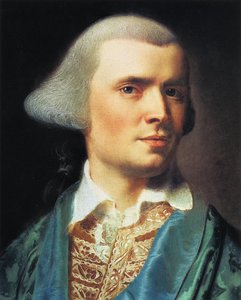
The artwork titled John St. Clair is a miniature portrait executed by the artist John Singleton Copley. This small-scale work dates to 1758. It depicts a man presented in formal attire, captured in a format that emphasizes the individual's likeness through a compact composition.
The subject is a man wearing a red coat over a white shirt and a blue waistcoat. His hair is styled in a powdered wig, a feature characteristic of the mid-18th century. The portrait is rendered in oil on an ivory board. It is presented within an oval frame that includes a gold loop for hanging.
Composition and Visual Elements
The composition follows a classic pyramidal structure, with the figure centrally positioned to occupy most of the available space. The subject is depicted from the torso up, framed within an oval format. He wears a red coat layered over a white shirt and a blue waistcoat. A powdered wig, styled in the fashion of the period, sits upon his head. The background remains dark and indistinct, which focuses the viewer's attention entirely on the central figure.
Directional lighting is applied to the subject, specifically highlighting the face and the upper torso. This light creates a clear distinction between the illuminated features and the shadowed areas of the clothing and background. The color palette is dominated by shades of red and brown, providing a somber tone to the miniature portrait. The arrangement of shapes is primarily organic, seen in the rounded contours of the face, the texture of the hair, and the folds of the draped garments.
Technique and Materials Used
This miniature portrait is executed in oil on an ivory board. The artist utilized a method of layering translucent glazes to build the image. This technical approach allows for a high degree of realism in the rendering of skin tones and the varied textures of the subject's clothing. The brushwork is applied with precision to define the fine details of the facial features and the folds of the garments.
The work is presented within an oval frame. A gold loop is attached to the frame to facilitate hanging. The application of paint on the ivory surface creates a sense of volume through the interplay of light and shadow, specifically in the depiction of the red coat and the white shirt.
Which museum holds John St. Clair?
Metropolitan Museum of Art
new york, United States of America
Origins and History of the Metropolitan Museum of Art The Metropolitan Museum of Art began with a vision shared by a group of businessmen, financiers, and leading artists and thinkers. Following its incorporation in 1870, the institution sought a permanent home to house its growing acquisitions. Before settling into its current location, the museum briefly resided in the Douglas Mansion estate on West 14th Street.


High-resolution images of John St. Clair

John Singleton Copley, John St. Clair (1758), Metropolitan Museum of Art. Public domain.
Questions on John St. Clair, answered
Where can I see the original "John St. Clair" by John Singleton Copley?
"John St. Clair" by John Singleton Copley is on display at the Metropolitan Museum of Art, new york, United States of America. The museum listing refers to the original work, not to reproductions.
In what year was "John St. Clair" by John Singleton Copley created?
The creation of "John St. Clair" by John Singleton Copley is dated 1758.
What is "John St. Clair" made with?
"John St. Clair" is executed in oil on board.
What size is "John St. Clair" by John Singleton Copley in real life?
The original "John St. Clair" by John Singleton Copley measures 4 x 4 cm.
What is "John St. Clair" about?
"John St. Clair" by John Singleton Copley depicts: portraiture, colonial era, wealthy man, formal attire, 18th century, miniature art, historical figure, red coat.
Is "John St. Clair" by John Singleton Copley in the public domain?
The copyright answer for "John St. Clair" by John Singleton Copley: the work is in the public domain - its copyright has expired. This determines whether reproductions of the image may be freely made.
Who is the artist behind "John St. Clair"?
The artist behind "John St. Clair" is John Singleton Copley. The work is catalogued under John Singleton Copley's name.
What art movement does "John St. Clair" by John Singleton Copley belong to?
The movement associated with "John St. Clair" by John Singleton Copley is Neoclassicism. This classification situates the work among related artists and artworks.
Which period of John Singleton Copley's career does "John St. Clair" belong to?
Within John Singleton Copley's career, "John St. Clair" falls in the Mature Period. The phase helps compare it with the artist's other works.
About the artist, John Singleton Copley
1738–1815, United States
John Singleton Copley
Early Life, Family and Training John Singleton Copley emerged from the commercial grit of colonial Boston, born in 1738. His upbringing was rooted in the maritime trade of Long Wharf, where his mother, Mary Singleton Copley, managed a shop. His father, Richard Copley, worked as a tobacco merchant. This environment provided more than just a social backdrop; it offered a direct view of the material textures and social hierarchies that would later define his visual language.
About John Singleton Copley Notable works by John Singleton Copley
Also by John Singleton Copley
 Watson and the Shark1778
 Brook Watson and the Shark1778
 Paul Revere1768
 The Colapse of the Earl of Chatham in the House of Lords (also known as The Death of the Earl of Chatham)1779

Essays around John St. Clair
 Masterpieces of John Singleton Copley: The Top 25 Essential ArtworksExplore the top 25 masterpieces of John Singleton Copley. Discover the finest Colonial American art on OriginalUniqueArt.com.
 American artworks of the 1800sIconic American works by Gilbert Stuart and John Trumbull define an era. Explore the full collection online at OriginalUniqueArt.com.
 American neoclassical paintersAmerican Neoclassical painters like Gilbert Stuart, John Singleton Copley, and Benjamin West. Shop museum-quality art reproductions on Orig…