Neoclassicism · 1769
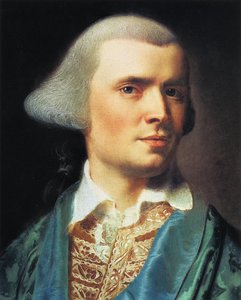
Ebenezer Storer (John Singleton Copley, 1769)
John Singleton Copley (1738–1815) made Ebenezer Storer. It dates from 1769. It belongs to the Neoclassicism movement. It is made in oil on canvas. It measures 61 × 46 cm.
- 1769
- Oil On Canvas
- 61 × 46 cm

 Preview

 Hand Made Oil Painting
 Send
 Share
 Fact sheet


 Download
 Similars
 X-Ray
 Diaporama
 Q&A

 Stats
Ebenezer Storer, in brief
- Title
- Ebenezer Storer
- Artist
- John Singleton Copley (1738–1815)
- Artist born in
- Boston, United States
- Date
- 1769
- Medium
- Oil On Canvas
- Dimensions
- 61 × 46 cm
- Movement
- Neoclassicism
- Period
- Early Modern
- Subject
- man, turban, green robe, white collar, portrait, fabric
What does Ebenezer Storer depict?
Portrait of Ebenezer Storer by John Singleton Copley
This portrait painting depicts Ebenezer Storer, rendered by the artist John Singleton Copley. The work is likely from about 1769. The subject is positioned in a three-quarter view, facing forward with a slight turn toward the viewer's left. His gaze is directed toward the audience, establishing a sense of formality and dignity through his steady expression.
The subject is presented against a dark, undifferentiated background that lacks discernible texture. This choice of setting focuses the viewer's attention entirely on the figure of Storer. He is dressed in an elaborate robe and a turban, attire that suggests a position of wealth or a connection to trade. A stark white collar provides a sharp point of contrast against the darker tones of his clothing and the surrounding space.
The composition follows a traditional structure typical of 18th-century portraiture. The subject's head is topped by a prominent circular turban, while the folds of his garments create organic, curvilinear shapes. The lighting is diffused and even, appearing to originate from the upper left of the frame. This light illuminates the face and the textures of the clothing without creating harsh shadows, maintaining a calm and orderly presentation of the sitter.
Composition and Visual Elements of the Portrait
The subject is positioned slightly off-center within the frame, creating a three-quarter view. Storer faces forward, though his body and gaze maintain a slight turn toward the viewer's left. This orientation directs the eye toward the dark, undifferentiated background, which lacks any discernible detail or depth. The absence of environmental context focuses all visual attention on the figure and his attire.
The color palette is dominated by various shades of green. Deep forest green appears in the turban and the robe, while lighter, more muted greens are used within the patterns of the fabric. A stark white collar provides a sharp point of contrast against these darker tones and the surrounding shadows. The turban forms a prominent circular shape atop the head, providing a geometric counterpoint to the organic, curvilinear forms of the face and the draped clothing.
Light enters the composition from the upper left, illuminating the face and the textures of the garments without creating harsh shadows. This even lighting reveals the subtle variations in the flesh tones, which are rendered in shades of pink and beige. The fabric of the robe suggests a soft, luxurious texture through the use of highlights that indicate a slight sheen on the surface of the material.
Technique and Material Composition
This portrait is executed in oil paint on canvas. The technical approach is representative of 18th-century American portraiture, utilizing a method of careful observation to achieve a high degree of realism. The artist employs skillful rendering of form and texture, particularly in the depiction of the subject's attire and facial features. The fabric of the turban and robe shows subtle highlights that indicate a soft, luxurious sheen, while the skin tones are achieved through delicate variations in color to convey smoothness.
The lighting in the composition is diffused and even, avoiding harsh shadows across the subject. A gentle light source appears to originate from the upper left of the frame, illuminating the face and the folds of the clothing. This lighting strategy works in tandem with the artist's precise brushwork to define the edges of the white collar, the turban, and the draped garments. The background remains dark and undifferentiated, which focuses the viewer's attention on the physical presence and material details of the sitter.
High-resolution images of Ebenezer Storer
John Singleton Copley, Ebenezer Storer (1769). Public domain.
Colours matched to the original by a digital expert, the file finely retouched, faithful to the artist's brushwork.
Own the high-resolution fileQuestions on Ebenezer Storer, answered
When was "Ebenezer Storer" made?
"Ebenezer Storer" by John Singleton Copley was created in 1769.
What medium is "Ebenezer Storer" by John Singleton Copley executed in?
"Ebenezer Storer" is executed in oil on canvas.
How big is the original "Ebenezer Storer"?
The recorded dimensions of "Ebenezer Storer" by John Singleton Copley are 46 x 61 cm. Reproductions can be ordered in other sizes while keeping the same proportions.
What subjects appear in "Ebenezer Storer" by John Singleton Copley?
"Ebenezer Storer" by John Singleton Copley depicts: man, turban, green robe, white collar, portrait, fabric, skin tones.
Is "Ebenezer Storer" by John Singleton Copley in the public domain?
The copyright answer for "Ebenezer Storer" by John Singleton Copley: the work is in the public domain - its copyright has expired. This determines whether reproductions of the image may be freely made.
Which artist is "Ebenezer Storer" attributed to?
The artist behind "Ebenezer Storer" is John Singleton Copley. The work is catalogued under John Singleton Copley's name.
Which artistic current is "Ebenezer Storer" by John Singleton Copley part of?
"Ebenezer Storer" by John Singleton Copley belongs to the Neoclassicism movement. This movement provides the stylistic context of the work.
Where does "Ebenezer Storer" fall in John Singleton Copley's career?
Within John Singleton Copley's career, "Ebenezer Storer" falls in the Mature Period. The phase helps compare it with the artist's other works.
What was John Singleton Copley's age when "Ebenezer Storer" was created?
John Singleton Copley made "Ebenezer Storer" at the age of 31. The artist was born in 1738 and the work is dated 1769.
About the artist, John Singleton Copley
1738–1815, United States
John Singleton Copley
Early Life, Family and Training John Singleton Copley emerged from the commercial grit of colonial Boston, born in 1738. His upbringing was rooted in the maritime trade of Long Wharf, where his mother, Mary Singleton Copley, managed a shop. His father, Richard Copley, worked as a tobacco merchant. This environment provided more than just a social backdrop; it offered a direct view of the material textures and social hierarchies that would later define his visual language.
About John Singleton Copley Notable works by John Singleton Copley
Also by John Singleton Copley
 Watson and the Shark1778
 Brook Watson and the Shark1778
 Paul Revere1768
 The Colapse of the Earl of Chatham in the House of Lords (also known as The Death of the Earl of Chatham)1779
Essays around Ebenezer Storer
 Masterpieces of John Singleton Copley: The Top 25 Essential ArtworksExplore the top 25 masterpieces of John Singleton Copley. Discover the finest Colonial American art on OriginalUniqueArt.com.
 18th century American paintersMasterpieces by Copley and Stuart define 18th century American art. Explore the full collection online at OriginalUniqueArt.com.
 American artworks of the 1810s1810s American art by Gilbert Stuart, John Trumbull, and Rembrandt Peale. Find museum-quality reproductions on OriginalUniqueArt.com.