Preview
 Send
Send Share
Share
 Details
 Guide
Guide

 Download
 Similars
 X-Ray
X-Ray Diaporama
 Stats
StatsView on the Hudson


 Read More
Giclée / Art Print
Museum-quality giclée or canvas print with fast production and flexible finish options. ( Buy Hand Made Painting Switch to Digital Image)




P118B $10

P118H $10

P118W $10

P438Z $10

P508JH $12

P508YH $12

P805H $10

P805Z $10

P919BZ $10

P919G $10

P919XJ $10

P959ZH $10

P968JZ $12

W106C $8

W218G $10

W218JH $8

W218Y $10

W307PJ $10

W316G $10

W316PJ $8

W316Y $10

W398PJ $8

W4111J $10

W500HY $15

W500JH $15

W692G $12

W849H $8

W940BG $15

W953PJ $8




Pick from our preset sizes that match the artwork's original proportions.

You may enter your own dimensions to fit a specific frame or space. If your selected size does not match the original image's proportions, we will either crop the artwork or extend the image with a mirrored or solid-fill edge. A digital mockup will be sent for your approval before production begins.
Please note that the on-screen preview does not reflect the actual cropping or extension. Only the mockup will accurately show the final composition.
While custom sizes are available, we recommend selecting a dimension from the predefined list to preserve the original proportions.
Worldwide Delivery () in 2 weeks instead of standard 4/5 weeks. (26 September)

Free Worldwide Express Shipping

High-Quality Linen Canvas

Full Shipping Insurance

Customs Tax Refund Guarantee

True Color Matching Guarantee

100-Day Return Policy (Defects Only)

100% Money-Back Guarantee

Bulk Discount Offer
 Glass option is only available in size under 110 CM

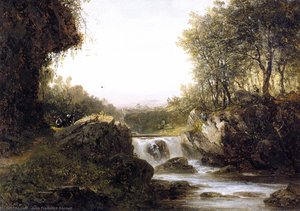
View on the Hudson
Giclée / Art Print
Reproduction Size
-


Total Price
$ 81
A Moment Captured: John Frederick Kensett’s “View on the Hudson”
The painting "View on the Hudson," completed in 1865 by John Frederick Kensett, stands as a quintessential example of Luminist art—a movement that championed observation and tonal subtlety to convey the profound beauty of natural landscapes. More than just a depiction of scenery, it’s an invitation into a contemplative space where the viewer can experience the stillness and grandeur of the Hudson River Valley at twilight.Subject Matter and Composition
Kensett meticulously rendered the Hudson River Estuary as it appeared during sunset. Dominating the canvas is a majestic mountain range—the Catskill Mountains—silhouetted against a fiery sky ablaze with hues of orange, crimson, and violet. Below, the river flows serenely, reflecting the celestial glow, dotted with small boats gliding across its surface. Two figures stand on the shore, seemingly absorbed in observing the unfolding spectacle – their presence adds a human element to this otherwise solitary vista. The artist’s compositional choices prioritize clarity and balance, guiding the eye through the scene with careful placement of elements.Technique and Style: Luminist Precision
Kensett adhered rigorously to Luminist principles, rejecting dramatic chiaroscuro—the bold contrasts of light and dark favored by Romantic painters—in favor of a diffused tonal palette. He achieved this effect through painstaking layering of thin glazes – translucent washes of pigment applied over multiple coats – allowing the underlying color to subtly influence the final hue. This technique resulted in an astonishingly luminous quality, capturing not just what was seen but also how it felt: a palpable sense of warmth and tranquility. The artist’s meticulous attention to detail is evident in the rendering of textures—the rugged peaks of the mountains, the ripples on the water's surface, and even the subtle folds of clothing worn by the figures—demonstrating Kensett’s commitment to capturing the essence of nature with uncompromising accuracy.Historical Context: The Hudson River School
“View on the Hudson” emerged during a period of significant artistic innovation in America – the Hudson River School. This influential group of painters, including Frederic Church and Asher Durand, rejected European academic conventions and instead sought inspiration directly from the American wilderness. They championed scientific observation alongside aesthetic appreciation, reflecting the burgeoning transcendentalist movement that emphasized intuition and spiritual experience. Kensett’s work embodies this ethos, capturing not merely a picturesque landscape but also an idealized vision of America's unspoiled natural heritage—a legacy that continues to resonate with audiences today.Symbolism and Emotional Impact
Beyond its visual beauty, “View on the Hudson” carries symbolic weight. The sunset represents both closure and renewal – marking the end of one day and anticipating the dawn of another. The mountains symbolize strength and permanence, anchoring the scene in timeless grandeur. More profoundly, however, the painting evokes a feeling of profound peace and contemplation. It invites viewers to step outside the hustle and bustle of daily life and reconnect with the restorative power of nature—a sentiment that aligns perfectly with Luminist ideals and speaks to our enduring fascination with landscapes that inspire awe and serenity.Conclusion: An Enduring Legacy
John Frederick Kensett’s “View on the Hudson” remains a masterpiece of Luminist art, securing its place as one of America's most treasured landscape paintings. Its masterful technique, combined with its evocative depiction of twilight beauty and its underlying philosophical message, ensures that it continues to captivate audiences generations after its creation—a testament to Kensett’s ability to transform observation into enduring artistic expression.Artist Biography
a life devoted to capturing serene landscapes
john frederick kensett, an american artist and engraver, was born on march 22, 1816, in cheshire, connecticut. as a member of the second generation of the hudson river school of artists, kensett's signature works are characterized by their serene and luminous qualities, celebrating the transcendental aspects of nature.early life and training
kensett attended school at cheshire academy and studied engraving with his father, thomas kensett. he later worked as an engraver in new haven until 1838, then moved to new york city to work on banknote engravings. in 1840, kensett traveled to europe to study painting, refining his talents alongside benjamin champney.established studio and luminist style
after establishing his studio in new york, kensett extensively traveled throughout the northeast and colorado rockies, capturing the essence of these landscapes. his style evolved from traditional hudson river school to a more refined luminist approach, characterized by unselfconscious brushstrokes conveying qualities of atmospheric light.- mount washington from the valley of conway (1851), an iconic painting, was purchased by the american art union and distributed to 13,000 subscribers.
- eaton's neck, long island (1872), a prime example of kensett's luminist style, is now in the collection of the metropolitan museum of art in new york.
legacy and contributions
kensett was a founder of the metropolitan museum of art and a full member of the national academy of design. his work, widely acclaimed during his lifetime, continues to influence landscape painting. key works:- sunset sky (ca. 1870), the metropolitan museum of art, new york
- three mile harbor (ca. 1860), museum of fine arts, tallahassee

John Frederick Kensett
1816 - 1872 , United States of America
Quick Facts
- Artistic Movement Or Style: Hudson River School & Luminism
- Artists Or Movements Influenced By This Artist: ['Luminism']
- Artists Who Influenced This Artist:
- Thomas Cole
- Benjamin Champney
- Date Of Birth: March 22, 1816
- Date Of Death: December 14, 1872
- Full Name: John Frederick Kensett
- Nationality: American
- Notable Artworks:
- Mount Washington from the Valley of Conway
- Eaton's Neck, Long Island
- Place Of Birth: Cheshire, United States
Related Articles
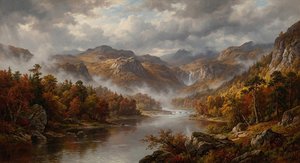
Hudson River School: 10 Masterpieces That Capture America's Wild Beauty | OriginalUniqueArt
Journey through America's breathtaking landscapes with our guide to the Top 10 Hudson River School masterpieces. Explore Thomas Cole, Frederic Church & more! Find museum-quality art reproductions and elevate your home decor at OriginalUniqueArt.com.

The Sublime Landscape: Exploring the Hudson River School Movement
Explore the captivating world of the Hudson River School! Discover the history, artists, and defining characteristics of this iconic American art movement. Learn about Romanticism's influence & find inspiration for your collection.

Wild & Untamed: The High-Impact Energy of American Romanticism and the Hudson River School
Experience the raw power of American Romanticism. Explore the high-impact energy of the Hudson River School through premium, hand-painted oil reproductions that capture the sublime beauty and untamed spirit of the American wilderness for discerning collectors.
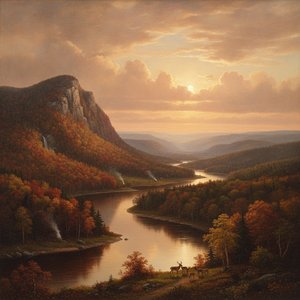
The Hudson River School: A Definitive Guide to America's Romantic Landscape Tradition
Explore the profound legacy of the Hudson River School. Discover how masters like Thomas Cole captured the American sublime through Romanticism and Luminism. A definitive guide for art historians and collectors seeking to understand America's wild beauty.
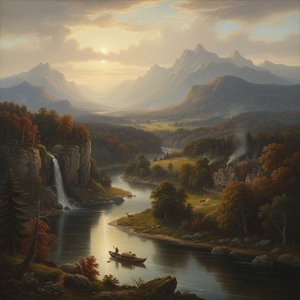
Capturing the American Spirit: A Journey Through Iconic Landscapes and the Legacy of the Hudson River School
Explore the profound beauty of American art history. From the Hudson River School to iconic landscapes, discover a curated journey through the masterpieces that defined a nation's spirit and the enduring legacy of American Romanticism.