Preview
 Send
Send Share
Share
 Details
 Guide
Guide

 Download
 Similars
 X-Ray
X-Ray Diaporama
 Stats
StatsThe Prodigal Son
 Oil On Canvas
- WallArt
- Baroque
 1625
1625- Early Modern
 86.0 x 70.0 cm
 Academy of Fine Arts Vienna
 Read More
Giclée / Art Print
Museum-quality giclée or canvas print with fast production and flexible finish options. ( Buy Hand Made Painting Switch to Digital Image)




P118B $10

P118H $10

P118W $10

P438Z $10

P508JH $12

P508YH $12

P805H $10

P805Z $10

P919BZ $10

P919G $10

P919XJ $10

P959ZH $10

P968JZ $12

W106C $8

W218G $10

W218JH $8

W218Y $10

W307PJ $10

W316G $10

W316PJ $8

W316Y $10

W398PJ $8

W4111J $10

W500HY $15

W500JH $15

W692G $12

W849H $8

W940BG $15

W953PJ $8




Pick from our preset sizes that match the artwork's original proportions.

Type the width and the height you need, to fit your frame or your wall. A print can only be cut, never made bigger than the picture, so a size with a different shape loses a part of the image. We send you a digital mockup to approve before we print anything. The picture shown on this page does not show the real cut — only the mockup does.
Worldwide Delivery () in 2 weeks instead of standard 4/5 weeks. (26 October)

Free Worldwide Express Shipping

High-Quality Linen Canvas

Full Shipping Insurance

Customs Tax Refund Guarantee

True Color Matching Guarantee

100-Day Return Policy (Defects Only)

100% Money-Back Guarantee

Bulk Discount Offer
 Glass option is only available in size under 110 CM

The Prodigal Son
Giclée / Art Print
Reproduction Size
-


Total Price
$ 81
A Moment of Profound Human Drama
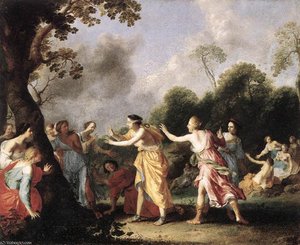
Johann Liss’s depiction of The Prodigal Son immediately draws the viewer into a charged atmosphere of human emotion. This is not merely a biblical narrative rendered on canvas; it is a vibrant tableau vivant, capturing the complex interplay between reconciliation and conflict. The eye is first drawn to the central figures—the contrast between the man clad in somber black and his counterpart draped in rich red suggests opposing forces, perhaps representing sin versus grace, or estrangement versus welcome. Their proximity, yet palpable tension, forms the emotional core of the piece, inviting contemplation on the nature of forgiveness.
Mastery of Baroque Narrative
Painted around 1625, this work sits firmly within the rich tapestry of early Dutch Baroque art, though Liss himself brings a distinct energy to the subject. While some might associate the period with quiet domesticity, Liss here elevates the scene to grand drama. Observe the surrounding figures; they are not mere background decoration but participants in an unfolding social event. The inclusion of details—the casually placed wine glass near the bottom right, the watchful dog on the left, and the simple wooden bench—grounds the divine narrative in a tangible, lived-in reality. Liss employs light not just to illuminate, but to direct our gaze, highlighting gestures and expressions that speak volumes without uttering a single word.
Symbolism Woven into Every Detail
The symbolism inherent in The Prodigal Son is timeless. The journey of the son returning home speaks universally to themes of repentance, redemption, and unconditional love. Color plays a crucial symbolic role: the deep reds often signify vitality or passion, while blacks can suggest mourning or humility. Furthermore, the composition itself—the grouping of figures around an implied center of action—mirrors the way human relationships are structured by moments of crisis and subsequent reunion. It is a visual meditation on grace.
Bringing Baroque Drama Home
For those seeking to infuse a space with depth, history, and narrative weight, this reproduction offers unparalleled artistic resonance. The scale of 86 x 70 cm allows the drama to breathe, ensuring that every gesture and facial expression can be appreciated up close. Owning a piece like this is acquiring more than just decoration; it is curating a focal point for contemplation—a place where conversations pause, where one might reflect on personal journeys toward reconciliation. It serves beautifully in an entryway or a formal drawing-room, commanding attention with its masterful blend of narrative power and technical finesse.
Questions & Answers
Is "The Prodigal Son" held in the country of its creator?
No - the artwork is kept abroad. "The Prodigal Son" is held in Austria, while Johann Liss was born in Germany.
How is "The Prodigal Son" recommended to be printed - what size, what orientation?
A print of "The Prodigal Son" by Johann Liss is recommended at a medium size in portrait orientation.
What style does "The Prodigal Son" belong to?
"The Prodigal Son" is a work of Baroque. The movement indicates the artistic tradition the work is part of.
Artist Biography
A Master of the Baroque Spirit
Johann Liss, also known as Jan Lys, stands as a luminous figure within the 17th-century German Baroque movement, a painter whose journey through Europe mirrored the vibrant, shifting currents of his era. Born in Schleswig-Holstein, Germany, specifically in Oldenburg, Liss’s early life was shaped by the rigorous artistic traditions of his home state. His path as an artist was one of constant motion and profound transformation, as he moved from the northern reaches of Germany to the great artistic hubs of the continent. Through his studies with Hendrick Goltzius in Haarlem and Amsterdam, he absorbed the technical mastery of the Dutch tradition before embarking on a travels that would eventually lead him through Paris and into the heart of Italy.
The evolution of Liss’s style is a captivating study in artistic adaptation. His early period, marked by his time in Rome around 1620–1622, reveals a deep engagement with the dramatic tension of Caravaggio. During these formative years, his canvases were defined by the stark, powerful contrasts of light and shadow, a technique that imbued his religious and mythological subjects with an immediate, visceral presence. However, as he migrated toward Venice, his palette underwent a magnificent metamorphosis. The somber depths of his Roman period gave way to a spirited treatment of the painted surface, characterized by brilliant colors and a loose, energetic brushwork that seemed to breathe with life.
Themes of Divinity and Desire
Liss possessed a rare ability to navigate the dual realms of the sacred and the profane, treating biblical narratives and classical myths with equal emotional intensity. In his religious works, such as The Sacrifice of Isaac, he utilized the Baroque aesthetic to explore profound themes of faith, obedience, and divine intervention. He often set these heavy theological moments against expansive, meticulously rendered landscapes, creating a tension between the monumental weight of the scripture and the natural world. His depictions of the divine were never merely static; they pulsed with a sense of movement and psychological depth that captured the religious fervor of the 17th century.
Conversely, his mythological works allowed for a more sensuous exploration of the human form and classical legend. In pieces like Venus and Adonis, Liss embraced a burgeoning aesthetic of beauty and desire, using oil on copper to achieve subtle tonal variations that heightened the emotional stakes of Ovidian tragedy. Whether capturing the tragic demise of Cleopatra or the divine judgment in Apollo and Marsyas, his work consistently sought to transcend simple storytelling. He looked toward the raw power of emotion, utilizing thick impasto and dynamic compositions to ensure that every mythological encounter felt both ancient and urgently alive.
Legacy and Artistic Influence
The significance of Johann Liss extends far beyond his individual canvases, as his stylistic innovations helped pave the way for future generations of painters. His later Venetian style, with its emphasis on light, color, and a certain fluid spontaneity, acted as a precursor to the Rococo movement. The energetic brushstrokes found in his work can be seen as an early influence on the great Guardi brothers, and his ability to integrate foreign influences into the Venetian tradition left a lasting mark on the Republic's artistic landscape.
His impact is most clearly felt in the lineage of 18th-century masters. The works of Sebastiano Ricci, Giovanni Battista Tiepolo, and Giovanni Piazzetta all carry echoes of the brilliance and movement that Liss pioneered. Though his life was cut short by the plague in Verona, leaving behind a legacy of both pious biblical subjects and sensuous mythological tales, he remains a vital link in the chain of Baroque excellence. He was a painter who mastered the art of transformation, turning the shadows of Rome into the radiant light of Venice.

Johann Liss
1597 - 1630 , Germany
Quick Facts
- Artistic Movement Or Style: Baroque
- Artists Or Movements Influenced By This Artist:
- Sebastiano Ricci
- Giovanni Battista Tiepolo
- Giovanni Piazzetta
- Artists Who Influenced This Artist:
- Hendrick Goltzius
- Caravaggio
- Full Name: Johann Liss
- Nationality: German
- Notable Artworks:
- The Sacrifice of Isaac
- Venus and Adonis
- The Death of Cleopatra
- Apollo and Marsyas
- Place Of Birth: Schleswig-Holstein, Germany
- Date Of Birth: 1597
- Date Of Death: 1630
Related Articles

The Visceral Stage: Exploring Dramatic Narratives & Emotional Intensity in Baroque Art
Explore the dramatic world of Baroque art! Discover iconic masters like Caravaggio & Rembrandt, their techniques, and the movement's lasting impact. Expert insights for collectors & enthusiasts at OriginalUniqueArt.

Dutch Baroque Masters: 10 Paintings That Shaped an Era | OriginalUniqueArt
Journey through the Golden Age with our guide to the Top 10 Dutch Baroque masterpieces! Explore iconic paintings by Rembrandt, Vermeer & Frans Hals. Find museum-quality art reproductions and elevate your home decor at OriginalUniqueArt.com.

The Dramatic Flourish: Exploring the Baroque Movement's Enduring Legacy in Art History
Explore the dramatic world of Baroque art! Discover iconic artists like Caravaggio & Rubens, defining techniques, and its lasting impact on art history. Expert insights for collectors & enthusiasts at OriginalUniqueArt.

Decoding Baroque Grandeur: A Guide to the Drama and Emotion of 17th-Century Art
Explore the breathtaking drama of 17th-century Baroque art. Our expert guide decodes the use of chiaroscuro, emotional intensity, and historical grandeur to help you appreciate and curate timeless masterpieces for your collection.

Golden Age Reflections: Dutch Baroque Painting & Cultural Innovation
Explore the Dutch Golden Age of painting! Discover key artists like Vermeer & ter Borch, their innovative techniques, and the rich cultural context behind these Baroque masterpieces. Learn about collecting & appreciating this iconic art period.