
 Preview
 Send
Send Share
Share
 Details
 Guide
Guide

 Download
 Similars
 X-Ray
X-Ray Diaporama
 Q&A
Q&A Stats
StatsLeadbeater

- 20.0 x 29.0 cm


 Read More
Giclée / Art Print
Museum-quality giclée or canvas print with fast production and flexible finish options. ( Buy Hand Made Painting Switch to Digital Image)




































Pick from our preset sizes that match the artwork's original proportions.

Type the width and the height you need, to fit your frame or your wall. A print can only be cut, never made bigger than the picture, so a size with a different shape loses a part of the image. We send you a digital mockup to approve before we print anything. The picture shown on this page does not show the real cut — only the mockup does.
Worldwide Delivery () in 2 weeks instead of standard 4/5 weeks. (11 November)

Free Worldwide Express Shipping

High-Quality Linen Canvas

Full Shipping Insurance

Customs Tax Refund Guarantee

True Color Matching Guarantee

100-Day Return Policy (Defects Only)

100% Money-Back Guarantee

Bulk Discount Offer
 Glass option is only available in size under 110 CM

Leadbeater
Giclée / Art Print
Reproduction Size
-


Total Price
$ 81
Questions & Answers
In what period was "Leadbeater" by Jean Jacques Wild made?
"Leadbeater" by Jean Jacques Wild dates from the 19th-Century period. The period gives the historical context of the work.
What palette and what feeling does "Leadbeater" combine?
The neutrals palette of "Leadbeater" by Jean Jacques Wild goes together with its mysterious emotional tone. Color is one of the ways a work conveys feeling.
Which palette and lead color define "Leadbeater"?
The color identity of "Leadbeater" by Jean Jacques Wild: a neutrals palette, dominated by rosy brown (#bbaa8f).
Artist Biography
Jean Jacques Wild: A Pioneer of Oceanic Illustration
Jean Jacques Wild, later known as John James Wild, was a Swiss linguist, oceanographer, and a remarkably precise naturalist illustrator whose work stands as a testament to the burgeoning field of scientific illustration in the late 19th century. Born in Zurich in 1824, his life unfolded across continents – from the academic halls of Ireland to the vibrant, challenging landscape of colonial Australia – each stage profoundly shaping his artistic vision and scientific pursuits. Wild’s legacy isn't simply found in a collection of meticulously rendered images; it resides in his dedication to accuracy, his pioneering use of photographic techniques during the groundbreaking Challenger Expedition, and his enduring contribution to our understanding of Australian fauna.The Challenger Expedition: A Crucible for Artistic Innovation
Wild’s career truly ignited with his participation in the Royal Society's Challenger Expedition (1872-1876). This ambitious voyage, a global survey of the world’s oceans, represented a radical shift in scientific methodology. Crucially, it brought together scientists and artists – a rare combination at the time – creating an environment ripe for innovation. Wild served as both official artist and secretary to Sir Wyville Thompson, the expedition's director. He wasn’t merely documenting; he was actively involved in shaping the expedition’s output. The advent of photography aboard HMS Challenger allowed for immediate image capture, a revolutionary development that dramatically altered the process of scientific illustration. Wild skillfully adapted to this new reality, producing detailed drawings alongside photographs, ensuring a comprehensive record of the expedition's discoveries. His seminal work, *Thalassa: An Essay on the Depth, Temperature and Currents of the Ocean*, showcased his ability to synthesize complex data into accessible and visually compelling narratives – earning him an honorary doctorate from the University of Zurich in recognition of his contribution.A Life Dedicated to Observation and Illustration
Following the expedition, Wild relocated to Belfast, Ireland, where he taught languages before embarking on a journey that ultimately led him to Australia. His move was spurred by a desire for opportunity, but also by a growing fascination with the unique biodiversity of the Australian continent. In 1881, he emigrated to Melbourne, establishing himself as a respected figure in the burgeoning scientific community. He supplemented his income through lecturing on modern languages and literature at Trinity College, acting as a matriculation examiner, and taking on occasional artistic commissions. His reputation for accuracy quickly gained him recognition, culminating in a significant commission from Frederick McCoy, curator of the Melbourne Museum, to contribute illustrations to *Prodromus of the Zoology of Victoria*. This project became his most enduring legacy, showcasing his remarkable skill in capturing the intricate details of Australian wildlife.The Prodromus and Beyond: A Legacy of Precision
Wild’s work on *Prodromus of the Zoology of Victoria* established him as a leading naturalist illustrator. He meticulously documented a vast array of species – from the iconic Tasmanian Giant Crab to various reptiles, insects, and fish – with an unparalleled level of detail and scientific rigor. His illustrations weren't simply decorative; they were vital components of McCoy’s comprehensive taxonomic work, providing crucial visual references for scientists and naturalists alike. Furthermore, his talent was recognized by Walter Baldwin Spencer, the Professor of Biology at Melbourne University, who commissioned him to illustrate the Giant Gippsland Earthworm in 1888 – a testament to Wild's artistic prowess and scientific credibility. His dedication extended beyond purely scientific illustration; he also delivered the inaugural lecture on Anthropology at the Australasian Association for the Advancement of Science in Sydney that same year, demonstrating his broad intellectual interests.A Lasting Impact: Isle Names and Scientific Remembrance
Jean Jacques Wild’s influence extends beyond his artistic output. Two geographical features bear his name – Wild Islet in the D'Entrecasteaux Islands and Wild Knoll in Antarctica’s Ellsworth Mountains – a fitting tribute to a man who dedicated his life to exploring and documenting the natural world. His work continues to be studied by scientists and art historians alike, serving as a reminder of the crucial role that illustration plays in advancing scientific knowledge. His legacy is not just one of artistic skill but also of meticulous observation, innovative thinking, and a profound respect for the wonders of the natural world.
Jean Jacques Wild
1824 - 1900 , Switzerland
Quick Facts
- Full Name: Jean Jacques Wild”
- Nationality: Swiss
- Date Of Birth: 1824
- Date Of Death: 1900
- Place Of Birth: Zurich, Switzerland
- John James Wild: Date of birth": "1824
- Notable Artworks: ['Thalassa”, “At Anchor”, “Giant Gippsland Earthworm”\n ],\n "Artists who influenced this artist": [None specified],\n "Artists or movements influenced by this artist": [None specified']
- Artistic Movement Or Style: Natural history illustration
Related Articles

Giclée Prints: Archival Quality & Aesthetic Nuances for the Discerning Collector
Explore the world of giclée prints with OriginalUniqueArt. Learn about archival quality, aesthetic nuances & investment potential. Expert guidance for discerning art collectors seeking museum-quality reproductions and lasting value.
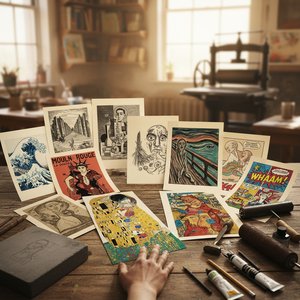
Top 10 Lithographs That Revolutionized Art | OriginalUniqueArt
Explore 10 legendary lithographs by Toulouse-Lautrec, Munch & Picasso that redefined art! Discover the stories behind these iconic prints and find museum-quality reproductions for your home decor at OriginalUniqueArt.com. Explore the full collection online.

Animalia: Exploring the Enduring Presence of Animals in Art & Interior Design
Explore the rich history of animal symbolism in art, from ancient mythology to modern masterpieces. Discover how animals have inspired artists for centuries and learn how to incorporate these powerful motifs into your home décor.
The Refined Aesthetic of Victorian Illustration: A Study in Narrative & Technique
Explore the captivating world of Victorian illustration! Discover Pre-Raphaelite influences, key artists like Rossetti & Stephens, and the era's rich narrative detail. A deep dive for art enthusiasts.

The Evocative Detail of Nature: A History of Naturalistic Illustration
Explore the rich history of botanical illustration! Discover pioneering artists like Maria Sibylla Merian & Marianne North. Learn about scientific precision, artistic expression, and find museum-quality reproductions at OriginalUniqueArt.

