() ·

A painting made for you, by hand

Spring

Hand Made Oil Reproduction

Hand-painted oil on canvas in your size and frame, made to order by our artists. ( Switch to Print Switch to Digital Image)

Collectible Description

A vibrant rainbow arches over a sunlit pastoral field in Jean-François Millet's Spring, a masterpiece of French Realism that captures the serene harmony of nature and invites you to bring this seasonal beauty home.

Artist Biography

Jean-François Millet (1814-1875): French Realist painter of the Barbizon School, celebrated for poignant depictions of peasant life like 'The Gleaners' & 'The Angelus'. Explore his legacy.

from ·

Chapter 1

How large should it be?

Slide to change the size; the picture on the left shows the frame at its real width. The proportions of the original are kept.

Standard
custom
CM
INCH

Pick from our preset sizes that match the artwork's original proportions.

width
height

Type the width and the height you need, to fit your frame or your wall. This is hand-painted, so for a size with a different shape the artist can paint a bit more around the picture, or cut a bit — you choose. We send you a digital mockup to approve before the painting starts. The picture shown on this page does not show the real result — only the mockup does.

Chapter 2

How should it arrive?

Choose the edges of the stretched canvas

Choose your frame

Corner sample of the WhiteWrap canvas edge finish, stretched on solid wood bars
White $1
Corner sample of the BlurSideWrap canvas edge finish, stretched on solid wood bars
Blurside $1
Corner sample of the ExtendedWrap canvas edge finish, stretched on solid wood bars
Extended $1
Corner sample of the P118B picture frame: moulded polystyrene, 5 cm wide and 3 cm thick
P118B $10
Corner sample of the P118H picture frame: moulded polystyrene, 5 cm wide and 3 cm thick
P118H $10
Corner sample of the P118W picture frame: moulded polystyrene, 5 cm wide and 3 cm thick
P118W $10
Corner sample of the P438Z picture frame: moulded polystyrene, 5.5 cm wide and 3.5 cm thick
P438Z $10
Corner sample of the P508JH picture frame: moulded polystyrene, 7 cm wide and 3.5 cm thick
P508JH $12
Corner sample of the P508YH picture frame: moulded polystyrene, 7 cm wide and 3.5 cm thick
P508YH $12
Corner sample of the P805H picture frame: moulded polystyrene, 5 cm wide and 3.5 cm thick
P805H $10
Corner sample of the P805Z picture frame: moulded polystyrene, 5 cm wide and 3.5 cm thick
P805Z $10
Corner sample of the P919BZ picture frame: moulded polystyrene, 7 cm wide and 3.5 cm thick
P919BZ $10
Corner sample of the P919G picture frame: moulded polystyrene, 7 cm wide and 3.5 cm thick
P919G $10
Corner sample of the P919XJ picture frame: moulded polystyrene, 7 cm wide and 3.5 cm thick
P919XJ $10
Corner sample of the P959ZH picture frame: moulded polystyrene, 5 cm wide and 3 cm thick
P959ZH $10
Corner sample of the P968JZ picture frame: moulded polystyrene, 6 cm wide and 4 cm thick
P968JZ $12
Corner sample of the W106C picture frame: solid wood, 5 cm wide and 3 cm thick
W106C $8
Corner sample of the W218G picture frame: solid wood, 5 cm wide and 3 cm thick
W218G $10
Corner sample of the W218JH picture frame: solid wood, 5 cm wide and 3 cm thick
W218JH $8
Corner sample of the W218Y picture frame: solid wood, 5 cm wide and 3 cm thick
W218Y $10
Corner sample of the W307PJ picture frame: solid wood, 6 cm wide and 3 cm thick
W307PJ $10
Corner sample of the W316G picture frame: solid wood, 6 cm wide and 3 cm thick
W316G $10
Corner sample of the W316PJ picture frame: solid wood, 6 cm wide and 3 cm thick
W316PJ $8
Corner sample of the W316Y picture frame: solid wood, 6 cm wide and 3 cm thick
W316Y $10
Corner sample of the W398PJ picture frame: solid wood, 5 cm wide and 3 cm thick
W398PJ $8
Corner sample of the W4111J picture frame: solid wood, 6.5 cm wide and 3.5 cm thick
W4111J $10
Corner sample of the W500HY picture frame: solid wood, 7 cm wide and 5 cm thick
W500HY $15
Corner sample of the W500JH picture frame: solid wood, 7 cm wide and 5 cm thick
W500JH $15
Corner sample of the W692G picture frame: solid wood, 8 cm wide and 4 cm thick
W692G $12
Corner sample of the W849H picture frame: solid wood, 5 cm wide and 3 cm thick
W849H $8
Corner sample of the W940BG picture frame: solid wood, 7.5 cm wide and 4.5 cm thick
W940BG $15
Corner sample of the W953PJ picture frame: solid wood, 6 cm wide and 3.5 cm thick
W953PJ $8
Corner sample of the H24-GOLD picture frame: carved wood with gesso, 10 cm wide and 6 cm thick
H24-GOLD $30
Corner sample of the H24-SILVER picture frame: carved wood with gesso, 10 cm wide and 6 cm thick
H24-SILVER $30
Corner sample of the H36-GOLD picture frame: carved wood with gesso, 15 cm wide and 6.5 cm thick
H36-GOLD $45
Corner sample of the H36-SILVER picture frame: carved wood with gesso, 15 cm wide and 6.5 cm thick
H36-SILVER $45
Frame preview
Framed

Moulding: . Overall size with the frame: .

Chapter 3

Who paints it, and should anything change?

Examples of what can be changed: Replace face with customer photo; Add pet (e.g., replace cat with dog); Include hidden message in background; Change background landscape or elements.
After order, OriginalUniqueArt.com team will email client for instructions and provide a mockup preview

Worldwide Delivery () in 3/4 weeks instead of standard 5 weeks. (4 November). No compromise on quality.

Chapter 4

The finishing touches

A nameplate, as in a museum?

Engraved Bronze Plaque Details

This elegant plaque features the artist's name and the title of the artwork, finely engraved for a timeless presentation.

It is made from bronze with a refined, elegant finish. The text is precisely laser-engraved for a sharp and permanent result. Measuring 9x2 cm, the plaque is compact yet easy to read. It's built to be durable and scratch-resistant, offering a professional, museum-quality look. Mounting is simple thanks to the included adhesive backing.

Transparent Acrylic Plaque Details

The plaque includes essential engraved details such as the artist's name, the title of the artwork, the date it was created, the type of media used-like oil on canvas or watercolor-a brief description of the piece, and a QR code that links to the complete artwork information.

It is crafted from clear acrylic, offering a sleek, modern appearance. The text is UV-engraved in black to ensure strong visual contrast. With a size of 10x15 cm, it ensures optimal readability. It comes equipped with two metal hooks for secure wall mounting. The plaque is designed to be weather-resistant, making it suitable for various environments, and it includes interactive features that work seamlessly with smartphone scanning.

Black Acrylic Plaque Details

This elegant plaque includes engraved information such as the artist's name, the title of the artwork, the date it was created, the type of media used (like oil on canvas or watercolor), a short description of the artwork, and a QR code for quick access to more information.

The plaque itself is made from refined black acrylic with a premium finish. The text is laser-engraved in white for high contrast and readability. Its size is 10x15 cm, designed to be easy to read. It comes with two metal hooks for professional mounting. The design is sleek and fits any interior style. It is also weather-resistant and durable, with built-in digital integration for mobile compatibility.

A protective varnish?

When do you need it?

Chapter 5

Your painting, as you ordered it

Spring

Reproduction Medium

Reproduction Size

-

Elite Senior Artist

More detail, finesse, and extra production time

-

Reproduction Frame

-

-

For artworks or reproductions larger than 105 cm (approximately 41 inches) on any side, the frame will be shipped as a kit, disassembled. This method ensures safe delivery and prevents damage during transport.

Professional assembly required - this is not a DIY product.
The kit must be assembled and the canvas stretched by an experienced professional framer, using wood glue (not supplied), a canvas stretching plier and clamps to hold the bars square while the glue dries. Incorrect assembly or uneven canvas tension can permanently damage the artwork and is not covered by our warranty.

  • All solid wood bars are included, precisely cut to size.

  • Assembled with the screws provided, plus wood glue for the corner joints, which is not supplied and must be sourced by your framer.

  • Professional tools are required and not included: a canvas stretching plier (tensioner) and clamps to hold the bars square while the glue dries.

Important:
The corner joints require wood glue, the bars must be held with clamps until the glue is fully dry, and tightening the canvas on the assembled frame requires a canvas stretching plier. None of these are included in the kit. Please arrange an experienced professional framer before ordering this size.

Nameplate

-

-

Protective Varnish

Glossy Varnish (enhances colors, protects against light/moisture)

-

Customize My Artwork

Examples of what can be changed: Replace face with customer photo; Add pet (e.g., replace cat with dog); Include hidden message in background; Change background landscape or elements.

-

Urgent

Worldwide Delivery () in 3/4 weeks instead of standard 5 weeks. (4 November). No compromise on quality.

-

Express Shipping

Worldwide Delivery () in 5 weeks. (11 November).

Included

Total Price

$ 300

Total Price $ 300

Glass option is only available in size under 110 CM

Included with every order

  • Free Worldwide Express Shipping
  • High-Quality Linen Canvas
  • Full Shipping Insurance
  • Customs Tax Refund Guarantee
  • True Color Matching Guarantee
  • 100-Day Return Policy (Defects Only)
  • 100% Money-Back Guarantee
  • Bulk Discount Offer

A Symphony of Renewal: Reimagining Millet’s Spring

In the quietude of a sun-drenched landscape, Jean-François Millet’s "Spring" unfolds as a profound meditation on the cyclical nature of life and the enduring bond between humanity and the earth. Created during a pivotal period in the artist's career, this masterpiece serves as a cornerstone of the Barbizon School, moving beyond mere pastoral scenery to capture the very soul of the Realist movement. As one gazes upon the canvas, there is an immediate sense of entering a sacred space where the boundaries between the laborer and the land begin to dissolve. The painting does not merely show us a field; it invites us to breathe in the damp, fertile air of a world awakening from its winter slumber.

The composition is a masterclass in subtle emotional orchestration. Millet employs a muted, earthy palette—rich browns, deep greens, and soft ochres—that avoids the trap of saccharine sentimentality. Instead, he presents a landscape that feels lived-in and authentic. The placement of the figures, a farmer and his son, is intentionally understated; they are not the overwhelming protagonists but rather integral threads woven into the larger tapestry of nature. This technique creates a sense of spiritual equilibrium, suggesting that human toil is not an imposition upon the world, but a harmonious participation in its natural rhythms.

Symbolism and the Light of Hope

Beyond its physical beauty, "Spring" is layered with a profound symbolic language that speaks to the heart of the human condition. The most striking celestial feature—the rainbow arching across the sky—serves as a powerful emblem of divine grace and the promise of renewal following life's inevitable storms. This motif, deeply rooted in Christian iconography, provides a luminous counterpoint to the darker, more grounded elements of the earth below. Above, the birds circling through the atmosphere add a sense of kinetic vitality, their flight mirroring the burgeoning energy of the season and the unbridled freedom found in the natural order.

Millet’s brushwork further enhances this narrative of transition. While the trees—sturdy oaks and beeches—stand as silent witnesses to the passing years, the fresh, raw greens of the new growth and the delicate blossoms scattered along the roadside signal a rebirth. There is a palpable tension between the remnants of winter, seen in the bare, chopped branches and heavy clouds, and the burgeoning life of spring. For the collector or the admirer, this duality offers a timeless resonance, making the piece an evocative centerpiece that reflects both the struggles of existence and the persistent triumph of hope.

An Essential Addition to the Refined Interior

For the discerning interior designer or art enthusiast, a high-quality reproduction of "Spring" offers more than just aesthetic appeal; it provides an emotional anchor for a room. The painting’s balanced composition and soothing color temperature make it an incredibly versatile choice for various decor styles, from the rustic warmth of a country manor to the sophisticated minimalism of a modern gallery space. It possesses the rare ability to command attention through its depth and texture without ever feeling intrusive.

Integrating this work into a living space allows for a daily encounter with tranquility. Whether placed in a sunlit study to inspire contemplation or in a grand dining hall to evoke a sense of historical grandeur, Millet’s vision brings a piece of the French countryside into the home. To possess such a reproduction is to hold a fragment of art history—a window into a world where labor is dignified, nature is revered, and every new season carries the promise of a fresh beginning.

Questions & Answers

Is there a slideshow for "Spring" by Jean-François Millet?

"Spring" by Jean-François Millet can be viewed as a slideshow on the artwork's Diaporama page.

What underlying hue runs through "Spring" by Jean-François Millet?

An ochre to sepia hue runs through "Spring" by Jean-François Millet.

Is "Spring" held in the country of its creator?

Yes - the artwork is kept in the artist's home country. "Spring" is held in France, while Jean-François Millet was born in France.

More about this painting

Preview AR preview Switch to Print Switch to Digital Image Send
Details Guide Add to favorites Download Similars X-Ray Diaporama Q&A Stats

In numbers

  • 1868the year it was painted
  • 29frames to choose from
  • standard sizes, in its own proportions
  • 5weeks to paint and deliver it
Jean-François Millet

Jean-François Millet

1814 - 1875, France

Quick facts about Jean-François Millet

  • Artistic Movement Or Style: Realism; Barbizon school
  • Artists Or Movements Influenced By This Artist:
    • Impressionism
    • Social Realism
    • Vincent van Gogh
    • Claude Monet
  • Artists Who Influenced This Artist:
    • Michelangelo
    • Poussin
    • Honoré Daumier
    • Paul Delaroche
  • Full Name: Jean-François Millet
  • Nationality: French
  • Notable Artworks:
    • The Gleaners
    • The Angelus
    • The Sower
    • Man with a Hoe
    • Harvesters Resting
  • Place Of Birth: Gruchy, France
  • Date Of Birth: 1814
  • Date Of Death: 1875

Artist Biography

A Life Rooted in the Soil: The World of Jean-François Millet

Jean-François Millet, a name synonymous with the dignity of rural life and the burgeoning Realist movement in 19th-century France, was born not into artistic privilege but into the very world he would immortalize on canvas. October 4, 1814, found him arriving in Gruchy, a small Norman village steeped in agricultural tradition. This upbringing wasn’t merely a backdrop to his life; it *was* his life, shaping his vision and imbuing his art with an authenticity that resonated deeply with a society undergoing rapid change. His parents, Jean-Louis-Nicolas and Aimée-Henriette-Adélaïde Henry Millet, were farmers themselves, instilling in young Jean-François a profound connection to the land and its laborers. Early education came not only from formal schooling—facilitated by local priests who recognized his intellectual promise—but also from the rhythms of farm work: sowing, reaping, threshing, tasks that would later become central motifs in his paintings. This intimate knowledge wasn’t simply observational; it was experiential, a visceral understanding of hardship and resilience.

From Academic Aspirations to Rural Revelation

Millet's artistic journey began with formal training, first under portrait painter Bon Du Mouchel in Cherbourg, then with Théophile Langlois de Chèvreville, a student of Baron Gros. In 1837, he ventured to Paris and enrolled at the prestigious École des Beaux-Arts, studying under Paul Delaroche. However, the academic expectations of the Salon system proved stifling. Initial successes were followed by rejections, and Millet found himself grappling with artistic disillusionment. A turning point came in the 1840s, marked by personal tragedy – the loss of his wife, Pauline-Virginie Ono – and a growing dissatisfaction with the prevailing romanticized depictions of peasant life. He began to reject idealized pastoral scenes, seeking instead to portray rural existence with unflinching honesty. This shift was further solidified by his association with artists like Constant Troyon, Narcisse Diaz, Charles Jacque, and Théodore Rousseau, who formed the core of the Barbizon school. These painters shared a commitment to *plein air* painting – working directly from nature – and a rejection of academic artifice. Millet’s move to Barbizon in 1849 marked a decisive break with Parisian conventions and an embrace of his artistic destiny, deeply rooted in the landscapes and lives surrounding him.

The Poetry of Labor: Themes and Techniques

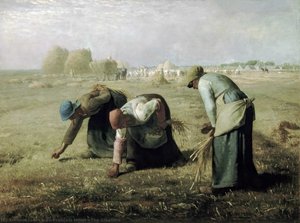
Millet's oeuvre is characterized by its profound empathy for the working class, particularly peasant farmers. He didn’t merely depict their labor; he elevated it to a level of dignity and spiritual significance previously unseen in art. His paintings are not sentimental idealizations but rather honest portrayals of hardship, resilience, and quiet devotion. The Gleaners (1857), perhaps one of his most iconic works, exemplifies this approach. The three women depicted gathering leftover grain after the harvest aren’t romanticized figures; they are laborers, bent double by toil, yet possessing a quiet dignity that commands respect. The Angelus (1850-1861), another masterpiece, captures a moment of profound spirituality – a peasant couple pausing for prayer at sunset – transforming an everyday act into something sacred. The Sower (1850) is arguably his most recognizable image, representing the cyclical nature of agricultural labor and humanity’s connection to the land. Technically, Millet drew inspiration from the Dutch Masters, particularly their masterful use of light and shadow, and from classical sculpture, evident in the monumental quality of his figures. He employed a limited palette, focusing on earthy tones that reflected the colors of the countryside, and built up layers of paint to create a sense of texture and depth.

A Lasting Legacy: Millet’s Influence and Historical Significance

Jean-François Millet died in Barbizon on January 20, 1875, leaving behind a body of work that profoundly impacted the course of modern art. He played a pivotal role in establishing Realism as a dominant force in painting, challenging the conventions of academic art and paving the way for future movements like Impressionism and Social Realism. His focus on everyday life and social issues resonated with artists who sought to depict the world around them with honesty and authenticity. His influence extended beyond painting; his images became symbols of rural virtue and working-class solidarity, inspiring writers, poets, and political thinkers. Artists such as Correa Benito Rebolledo continued to explore themes of rural life and social justice, directly influenced by Millet’s example. Today, Millet's paintings continue to captivate audiences with their timeless beauty, emotional depth, and enduring message of human dignity. His work serves as a powerful reminder that even in the face of hardship, there is grace, resilience, and profound spiritual meaning to be found in the simplest of lives.

Major Works

  • The Gleaners (1857): A poignant depiction of women gathering leftover grain.
  • The Angelus (1850-1861): A symbol of rural piety and a moment of quiet devotion.
  • The Sower (1850): An iconic image representing the cycle of agricultural labor.
  • Man with a Hoe: A powerful representation of physical toil and human endurance.
  • Harvesters Resting: Capturing a moment of respite amidst arduous work.
  • Woman Baking Bread: A depiction of domestic labor imbued with dignity.

Quick Facts

  • Medium: Oil on canvas
  • Year: 1868
  • Subject or theme: Rural landscape; Pastoral scene
  • Influences: Gustave Courbet
  • Dimensions: 86 x 111 cm

Art Quiz

There is only one correct answer for each question.

Question 1:
Jean-François Millet’s ‘Spring’ is considered a pivotal work in the Realist movement. What distinguishes Realism from preceding artistic styles like Romanticism?
Question 2:
The photograph describes a scene featuring prominent elements like a rainbow and birds. What artistic technique is most likely employed by Millet to convey these visual sensations?
Question 3:
‘Spring’ depicts rural laborers engaged in agricultural tasks. What was Millet's primary intention in portraying these figures?
Question 4:
The painting’s composition incorporates elements of Barbizon School aesthetics. What is characteristic of this artistic movement?
Question 5:
Considering Millet’s biographical context—his upbringing in Gruchy and his connection to farming—how does this inform our understanding of ‘Spring’?