Send
Send Share
Share
 Details
 Guide
Guide

 Download
 Similars
 Diaporama
 Stats
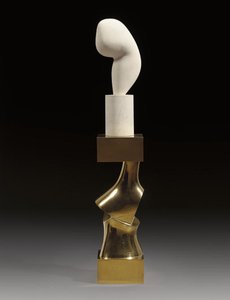
StatsSculpture de Silence, Corneille
 Sculpture
- Sculpture
- Abstraction-Création
 54.0 x 48.0 cm
 Galleria Civica di Arte Moderna e Contemporanea Torino
 Read More
Hand Made Oil Reproduction
Hand-painted oil on canvas in your size and frame, made to order by our artists. ( Switch to Print Switch to Digital Image)




































Pick from our preset sizes that match the artwork's original proportions.

You may enter your own dimensions to fit a specific frame or space. If your selected size does not match the original image's proportions, we will either crop the artwork or extend the painting with additional hand-painted elements. A digital mockup will be sent for your approval before production begins.
Please note that the on-screen preview does not reflect the actual cropping or extension. Only the mockup will accurately show the final composition.
While custom sizes are available, we recommend selecting a dimension from the predefined list to preserve the original proportions.
After order, OriginalUniqueArt.com team will email client for instructions and provide a mockup preview
Worldwide Delivery () in 3/4 weeks instead of standard 5 weeks. (21 September). No compromise on quality.

Free Worldwide Express Shipping

High-Quality Linen Canvas

Full Shipping Insurance

Customs Tax Refund Guarantee

True Color Matching Guarantee

100-Day Return Policy (Defects Only)

100% Money-Back Guarantee

Bulk Discount Offer
 Glass option is only available in size under 110 CM

Sculpture de Silence, Corneille
Reproduction Medium
Reproduction Size
-


Total Price
$ 300
The Enigmatic Stillness of Arp’s “Silence”
Jean Arp's "Sculpture de Silence, Corneille," a remarkable piece from 1942 crafted in rose-colored limestone, transcends the boundaries of traditional sculpture. It isn’t merely an object occupying space; it’s a profound meditation on form, absence, and the very nature of silence itself. The work emerged during a turbulent period – Arp's exile due to the German occupation of Paris – lending it a poignant resonance born from displacement and introspection. This wasn’t simply a retreat into artistic creation, but a deliberate act of resistance, a refusal to be silenced by external forces.
The choice of material is particularly striking. Limestone, typically employed for its strength and durability, here becomes an instrument of fragility. The pale pink hue, almost ethereal in quality, contributes to the sculpture’s dreamlike atmosphere. It's a deliberate departure from Arp’s usual preference for bronze or marble, suggesting a shift towards exploring softer, more organic forms – a move that foreshadows his later explorations of biomorphism and chance-based composition. The subtle variations in tone within the stone itself create an illusion of depth and movement, as if the sculpture is perpetually shifting and evolving.
A Biomorphic Echo of the Natural World
At first glance, “Silence” resembles a stylized female form – a large, abstracted vagina. However, to reduce it to such a literal interpretation would be to miss its deeper significance. Arp’s work consistently sought to strip away representational detail, focusing instead on the underlying geometry and essential forms of nature. This sculpture is not about depicting a specific body; rather, it embodies a primal, almost amniotic space – a suggestion of creation, gestation, and the quiet potential held within stillness. The two small holes, often interpreted as nipples, further enhance this sense of nascent life, hinting at an unseen source of energy.
The work’s genesis lies in Arp's exploration of the concept of “Silence” initiated in 1942. This period saw him grappling with the limitations imposed by war and exile, seeking to express profound emotions through a reductionist approach. The sculpture is a direct result of this process, embodying the very essence of that silence – not as an absence of sound, but as a state of receptive potential, a space for contemplation and transformation.
Connections to Arp’s Artistic Philosophy
“Sculpture de Silence, Corneille” is deeply rooted in Arp's broader artistic philosophy. Influenced by the theories of Henri Bergson, he believed that art should capture the “duration” – the continuous flow of time and experience – rather than static representations. His work often involved a process of chance and intuition, allowing forms to emerge organically from the interplay of geometry and material. This is evident in the sculpture’s seemingly effortless grace, as if it were grown rather than constructed.
Interestingly, a similar piece, “Sculpture de Silence,” created in 1942, exists in the J. Lazard collection in Paris. The similarities in form and material suggest that Arp was exploring this concept repeatedly during his exile, refining his approach through experimentation and reflection. Furthermore, a version of the sculpture is preserved in the collection of Hans Arp’s uncle, Carl Arp, adding another layer to its historical significance.
A Legacy of Quietude
“Sculpture de Silence, Corneille” remains a powerful testament to Arp's artistic vision. It invites viewers to pause, to contemplate the beauty of simplicity, and to recognize the profound potential held within moments of quietude. More than just a sculpture, it’s an invitation to experience the world with heightened awareness – a reminder that true art lies not in representation, but in the evocative power of form and the resonance of silence.
Artist Biography
A Life Forged Between Worlds: The Early Years of Jean Arp
Born Hans Peter Wilhelm Arp in 1886 in the contested city of Strasbourg, a place oscillating between French and German identity, the artist who would become known as Jean Arp embodied a fascinating duality from his very beginnings. This geographical and cultural liminality profoundly shaped his artistic vision, instilling within him a sense of displacement and a questioning of fixed boundaries that would permeate his entire oeuvre. His parents – a French mother and a German father – unknowingly laid the foundation for an artist who consistently challenged categorization. Early studies at the École des Arts et Métiers in Strasbourg and later at the Weimarer Kunstschule in Germany provided Arp with a foundational artistic education, but it was the encouragement of his uncle, Carl Arp, a landscape painter, that truly ignited his passion. A move to Paris in 1908, attending the Académie Julian, further broadened his horizons, exposing him to the vibrant currents of the avant-garde. Yet, Strasbourg remained a potent memory – a city steeped in history and symbolic weight, forever influencing his artistic sensibility. This early period wasn’t merely about acquiring technique; it was about absorbing the complexities of identity and belonging, themes that would resonate throughout his life and work.Embracing Chaos: Dada and the Birth of Biomorphic Forms
The outbreak of World War I proved a pivotal moment for Arp. Disillusioned by the senseless violence and the perceived failures of reason, he gravitated towards the burgeoning Dada movement around 1915. This wasn’t simply an aesthetic choice; it was a radical rejection of established norms, a defiant embrace of chaos as a response to a chaotic world. Arp found himself among a group of artists and intellectuals in neutral Switzerland – Hugo Ball, Tristan Tzara, Marcel Janco – who sought to dismantle traditional artistic conventions. He participated actively in exhibitions with the Moderne Bund, an early modern art alliance, and co-founded the Cologne Dada group in 1920 alongside Max Ernst and Alfred Grünwald. It was during this period that Arp began experimenting with chance operations, a technique reflecting Dada’s rejection of artistic control. His “chance collages,” created by dropping paper fragments onto a surface and adhering them where they fell, were revolutionary – an abdication of conscious design in favor of unpredictable outcomes. Simultaneously, he started to explore biomorphic forms—abstract shapes resembling organic life—which would become a defining characteristic of his work. These weren’t merely abstract designs; they hinted at hidden energies, the fundamental building blocks of existence, and a subconscious connection to nature. This exploration was significantly influenced by his profound artistic partnership with Sophie Taeuber-Arp, whom he married in 1922. Their collaborative projects were innovative and mutually inspiring, pushing the boundaries of both their practices.Surrealist Visions and Sculptural Explorations
As Dada began to dissipate, Arp’s artistic trajectory led him towards Surrealism. His work was featured in the first surrealist exhibition at the Galerie Pierre in Paris in 1925, solidifying his connection to this movement that delved into the realm of dreams and the subconscious. However, Arp didn't simply adopt Surrealism wholesale; he infused it with his own unique sensibility. He began a significant transition from relief sculptures to three-dimensional works, exploring organic abstraction in freestanding forms. The “Human Concretion” series emerged during this period – smooth, rounded sculptures that evoked ambiguous references to both the human form and natural objects. Arp’s material exploration was equally important. He experimented with marble, bronze, glass, and wood, each medium offering different textures and effects, allowing him to further refine his vision of organic abstraction. His biomorphic forms profoundly influenced the development of Surrealism, particularly its fascination with automatism and subconscious imagery. Arp wasn't interested in depicting recognizable objects; he sought to capture the essence of life itself – its growth, its fluidity, its inherent mystery.Legacy and Enduring Influence
Jean Arp’s impact on 20th-century art is undeniable. His pioneering role in organic abstraction, his embrace of chance, and his exploration of biomorphic forms cemented his place as a pivotal figure in the avant-garde. Notable works like *Trousse d'un dada*, the *Dada Heads* series, *Human Concretion without Oval Bowl*, *Le Soleil recerclé*, and *The Three Graces* continue to captivate audiences with their elegant simplicity and profound symbolism. He received increasing recognition in the post-World War II era, culminating in the Grand Prize for Sculpture at the Venice Biennale in 1954, and major retrospective exhibitions at the Museum of Modern Art in New York (1958) and the Musée National d’Art Moderne in Paris (1962). His creation of a relief sculpture for the Harvard Graduate Center stands as a testament to his enduring legacy. Arp's emphasis on organic forms resonated with subsequent generations of artists, influencing movements like Abstract Expressionism and beyond. His embrace of chance operations continues to inspire those exploring randomness and unconventional creative methods. The collaborative work he shared with Sophie Taeuber-Arp is now recognized as some of the most significant contributions to the Dada movement, highlighting the power of artistic partnership. Jean Arp’s innovative approach, his willingness to challenge convention, and his unwavering commitment to exploring the fundamental forces of life ensure that his art will continue to inspire and provoke for generations to come.
Jean Arp
1886 - 1966 , Germany
Quick Facts
- Artistic Movement Or Style: Dada, Surrealism
- Artists Or Movements Influenced By This Artist:
- Surrealism
- Abstract art
- Artists Who Influenced This Artist: ['Wassily Kandinsky']
- Date Of Birth: September 16, 1886
- Date Of Death: June 7, 1966
- Full Name: Jean Arp
- Nationality: German-French
- Notable Artworks:
- Trousse d'un dada
- Human Concretion
- Le Soleil recerclé
- Place Of Birth: Strasbourg, France
Related Articles

Bronze Age to Modern Masters: 10 Sculptures That Redefined Art | OriginalUniqueArt
Journey through art history with 10 legendary bronze sculptures – from Michelangelo's David to Rodin’s Thinker. Explore the stories, techniques & timeless beauty of these masterpieces. Find museum-quality reproductions & elevate your home decor on OriginalUniqueArt.com.

Bronze Sculptures That Defined Art History | OriginalUniqueArt
Journey through art history with our Top 10 bronze sculptures! Explore masterpieces by Rodin, Michelangelo & more. Discover stories behind iconic statues and find museum-quality reproductions for your home decor at OriginalUniqueArt.com.

The Enduring Form: Exploring Themes & Techniques in Sculpture Across Historical Periods
Explore the rich history of sculpture from ancient masterpieces to contemporary innovations. Discover key techniques, influential artists & investment potential for discerning art collectors.
The Enduring Legacy of Bronze Sculpture: History, Techniques & Contemporary Interpretations
Explore the rich history & enduring appeal of bronze sculpture. Learn about casting techniques, iconic artists, collecting tips, & contemporary interpretations. Expert insights for discerning art collectors.

The Enduring Form: Sculpture Across History, Technique & Emotional Resonance
Explore the rich history of sculpture with OriginalUniqueArt. Discover key techniques, influential artists & investment potential for discerning collectors. Expert insights into valuing and collecting timeless masterpieces.