 Preview
 Send
Send Share
Share
 Details
 Guide
Guide

 Download
 Similars
 X-Ray
X-Ray Diaporama
 Q&A
Q&A Stats
StatsGod the Father

- 212.0 x 83.0 cm


 Read More
Giclée / Art Print
Museum-quality giclée or canvas print with fast production and flexible finish options. ( Buy Hand Made Painting Switch to Digital Image)




P118B $10

P118H $10

P118W $10

P438Z $10

P508JH $12

P508YH $12

P805H $10

P805Z $10

P919BZ $10

P919G $10

P919XJ $10

P959ZH $10

P968JZ $12

W106C $8

W218G $10

W218JH $8

W218Y $10

W307PJ $10

W316G $10

W316PJ $8

W316Y $10

W398PJ $8

W4111J $10

W500HY $15

W500JH $15

W692G $12

W849H $8

W940BG $15

W953PJ $8




Pick from our preset sizes that match the artwork's original proportions.

Type the width and the height you need, to fit your frame or your wall. A print can only be cut, never made bigger than the picture, so a size with a different shape loses a part of the image. We send you a digital mockup to approve before we print anything. The picture shown on this page does not show the real cut — only the mockup does.
Worldwide Delivery () in 2 weeks instead of standard 4/5 weeks. (4 November)

Free Worldwide Express Shipping

High-Quality Linen Canvas

Full Shipping Insurance

Customs Tax Refund Guarantee

True Color Matching Guarantee

100-Day Return Policy (Defects Only)

100% Money-Back Guarantee

Bulk Discount Offer
 Glass option is only available in size under 110 CM

God the Father
Giclée / Art Print
Reproduction Size
-


Total Price
$ 81
God the Father: A Testament to Renaissance Faith
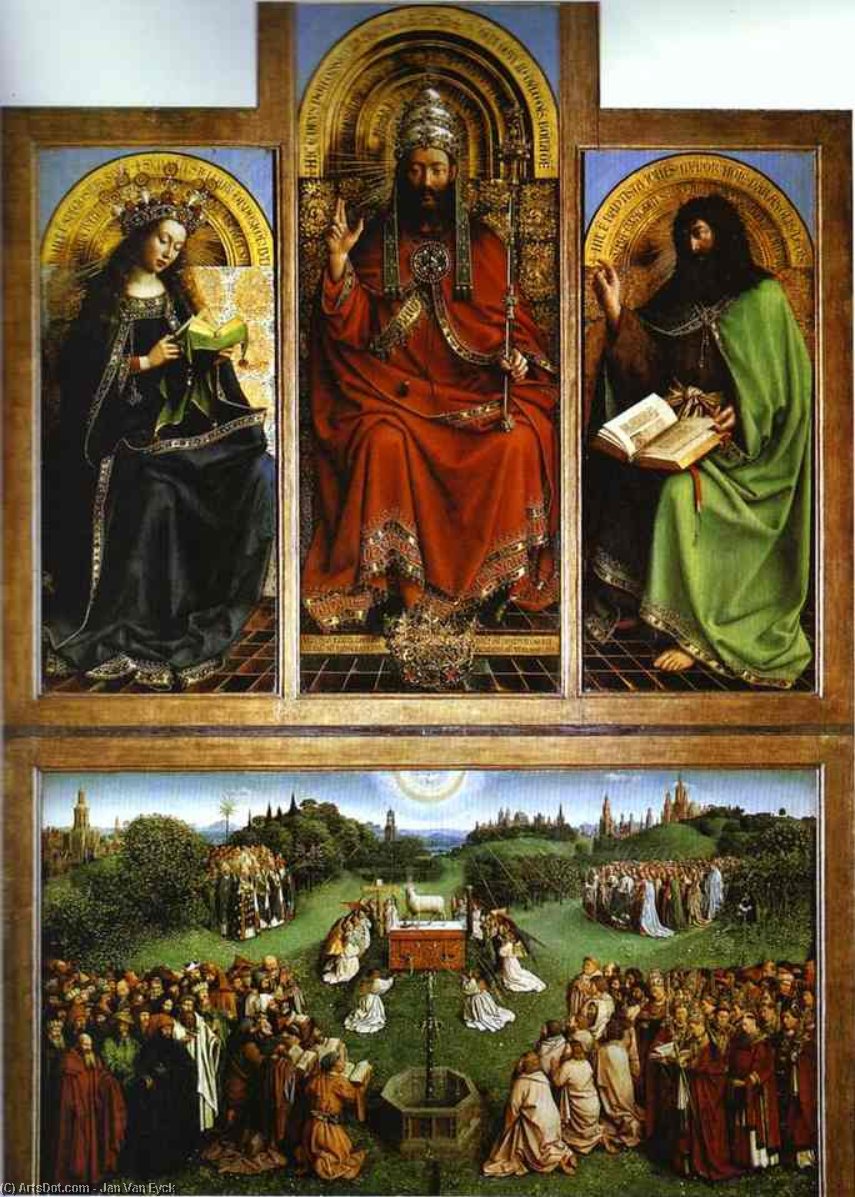
Jan van Eyck’s “God the Father,” completed in 1432, stands as an unparalleled achievement of Early Netherlandish painting and embodies the spiritual fervor that characterized the burgeoning Northern Renaissance. More than just a depiction of religious iconography, this monumental panel—measuring 212 x 83 cm—represents a pivotal moment in artistic history, marking the decisive adoption of oil paint on wood and establishing Van Eyck as a pioneer whose influence reverberates through subsequent generations of artists. Its location within St Bavo’s Cathedral in Ghent serves as a constant reminder of its enduring significance within Flemish religious culture.Composition and Symbolism: The Trinity Embodied
The painting's composition is deliberately structured to convey profound theological concepts. At its core lies a triad—three figures representing Jesus Christ seated upon thrones, each holding a book—a visual representation of the Holy Trinity. This deliberate arrangement transcends mere artistic convention; it speaks directly to Christian doctrine, emphasizing God’s unity and divine majesty. The central figure is crowned with laurel wreaths, symbolizing his regal authority as King of Heaven, while the flanking figures lack crowns, signifying their roles as the Son and Holy Spirit—figures subordinate yet equally vital in God's plan. Surrounding these central saints are attendants – kneeling figures expressing reverence – further reinforcing the solemn atmosphere and inviting contemplation. An angel positioned prominently on the upper right corner adds to the celestial grandeur of the scene, anchoring it within a realm beyond earthly comprehension.Technique: The Revolutionary Brilliance of Oil Paint
What distinguishes “God the Father” from its contemporaries is undeniably Van Eyck’s masterful manipulation of oil paint—a technique that had begun to gain traction in Northern Europe but was still considered experimental at the time. Unlike tempera, which relies on pigment bound with egg yolk and dries quickly, oil paint allows for gradual layering and blending, resulting in astonishing luminosity and depth. This meticulous attention to detail is evident throughout the painting: observe the subtle gradations of color, capturing the textures of drapery and skin with breathtaking accuracy. The artist’s painstaking rendering of light and shadow creates a palpable sense of realism—a characteristic hallmark of Early Netherlandish art that distinguishes it from the more stylized approaches favored in Italy during the Renaissance.Historical Context: Shaping the Northern Renaissance Aesthetic
“God the Father” emerged against the backdrop of a transformative period for European culture – the Early Netherlandish Art Movement. This movement, fueled by humanist ideals and driven by independent artistic exploration, diverged significantly from the dominant Italian Renaissance style. Artists like Van Eyck prioritized meticulous observation and realistic representation, rejecting idealized forms in favor of capturing the nuances of human anatomy and naturalistic landscapes. The painting’s influence extended far beyond Ghent; it served as a model for subsequent artists across Europe, establishing a distinctive visual language that would define the Northern Renaissance aesthetic for decades to come.Emotional Impact: Reverence and Spiritual Reflection
Ultimately, “God the Father” transcends mere artistic skill; it communicates profound spiritual emotion. The painting’s serene stillness invites viewers into a meditative state—a space for contemplation on faith, humility, and divine grace. Its luminous colors and intricate detail evoke a sense of wonder and reverence, transporting the observer to a realm of celestial beauty. As a testament to Van Eyck's genius and the enduring power of religious art, “God the Father” continues to inspire awe and admiration centuries after its creation—a timeless masterpiece that embodies the very essence of Renaissance spirituality.Questions & Answers
What level of contrast does "God the Father" by Jan van Eyck show?
The contrast level of "God the Father" by Jan van Eyck is statement.
Is "God the Father" by Jan van Eyck a bright or a dark artwork?
The perceived brightness of "God the Father" by Jan van Eyck is shadow. It can be matched to the light of the intended space.
How strong are the colors of "God the Father"?
"God the Father" by Jan van Eyck is recorded with a balanced soft saturation and a balanced intensity.
Artist Biography
The Alchemist of Light
To look at a Jan van Eyck painting is to witness the moment Western art stopped pretending and started observing. We often hear the myth that he invented oil paint, but the truth is more grounded and far more impressive: he mastered it. By applying thin, translucent glazes of pigment over one another, he achieved a depth of color and a precision of texture that tempera simply could not sustain. He did not just paint surfaces; he captured how light interacts with them. When you see the gleam of a single candle or the heavy weight of a velvet robe in his work, you are seeing the result of a technical revolution that changed the visual language of Europe.
His career was built on more than just brushwork. Van Eyck operated within the high-stakes environment of the Burgundian court, serving Philip the Good. This position required him to be much more than a craftsman; he functioned as a diplomat, traveling to places like Portugal and Spain on official missions. This access to power provided the financial stability necessary for his technical experiments. He was a man of intellect and discretion, qualities that allowed him to move between the worlds of high politics and fine art with ease.
The Precision of the Northern Eye
The work of Van Eyck is defined by an almost obsessive attention to the minute details of the physical world. In his portraits, he does not merely record a face; he records the texture of skin, the individual strands of hair, and the specific way light hits a turban. This level of realism was driven by a shift in focus toward the individual and the tangible. His ability to render atmospheric perspective—the way distant landscapes soften into a blue haze—showed a sophisticated understanding of how the human eye perceives depth.
His most significant technical achievements can be seen in several key works:
- The Ghent Altarpiece: A massive twelve-panel polyptych that demonstrates his ability to manage complex religious symbolism alongside realistic figures.
- The Arnolfini Portrait: A 1434 work where every object, from the dog representing fidelity to the discarded shoes on holy ground, carries specific weight. The mirror in the background reflects a whole other layer of reality.
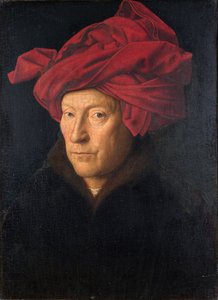
- Portrait of a Man (Self Portrait?): A 1433 oil painting that features his personal motto, "Als ich kan" (As well as I can), etched directly onto the frame.
A Lasting Technical Standard
The influence of Jan van Eyck is not found in a vague sense of inspiration, but in the concrete standards he set for the medium. He moved the needle from the matte, flat surfaces of the medieval era toward a luminous, three-dimensional reality. His signature, "JOHANNES DE EYCK," and his frequent use of his motto served as a direct challenge to his contemporaries. He was not interested in the anonymity common to many medieval painters; he wanted his technical prowess to be recognized and attributed.
Even after his death in Bruges in 1441, the methods he perfected continued to dictate how artists approached light and texture for generations. His work remains a benchmark because it represents the successful marriage of scientific observation and artistic skill. He transformed pigments into something that feels alive, leaving behind a body of work that remains as sharp and clear today as it was in the fifteenth century.
Jan van Eyck
1390 - 1441 , Netherlands
Quick Facts
- Artistic Movement Or Style: Early Netherlandish painting
- Artists Or Movements Influenced By This Artist:
- Early Netherlandish painting
- Generations of painters
- Full Name: Jan van Eyck
- Nationality: Flemish
- Notable Artworks:
- Ghent Altarpiece
- Arnolfini Portrait
- Dresden Triptych
- Man in a Blue Turban
- Place Of Birth: Maastricht, Netherlands
- Date Of Birth: 1390
- Date Of Death: 1441
Related Articles

Early Netherlandish Masters: 10 Paintings That Revolutionized Art & Decor
Journey into the world of Early Netherlandish painting! Explore 10 masterpieces by Jan van Eyck, Rogier van der Weyden & more. Discover stunning detail, symbolism & Renaissance art for your home decor. Find museum-quality reproductions on OriginalUniqueArt.com

Early Netherlandish Masters: 10 Paintings That Revolutionized Art & Decor
Journey into the Early Netherlandish Renaissance! Explore 10 iconic paintings by Jan van Eyck, Rogier van der Weyden & more. Discover stunning detail, symbolism, and oil painting techniques. Find museum-quality art reproductions for your home at OriginalUniqueArt.com.

Hugo van der Goes: Devotion, Innovation & the Psychological Depth of Early Netherlandish Painting
Explore the revolutionary art of Hugo van der Goes – a master of Early Netherlandish painting renowned for his dramatic realism, psychological depth & profound influence on Renaissance artists. Discover his iconic works and lasting legacy.

Illuminating Realism: A Comprehensive Exploration of the Early Netherlandish Renaissance Movement
Explore the captivating world of Early Netherlandish painting! Discover Jan van Eyck & other Flemish masters, their revolutionary techniques, hidden symbolism, and lasting legacy. A comprehensive guide for art enthusiasts.

Jan van Eyck: Innovation, Symbolism & the Dawn of Early Netherlandish Painting
Explore the revolutionary art of Jan van Eyck! Discover his groundbreaking oil painting techniques, hidden symbolism, and lasting impact on the Early Netherlandish Renaissance. A deep dive for art enthusiasts.


