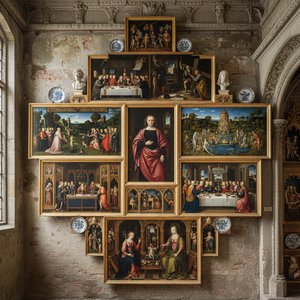
The Turbulent Life Behind a Revolutionary Style
 Wikipedia: Hugo van der Goes
Hugo van der Goes (c. 1430/1440 – 1482) was a Flemish painter who was one of the most significant and original Early Netherlandish painters of the late 15th century. Van der Goes was an important painter of altarpieces as well as portraits. He introd...
Hugo van der Goes, a name that resonates with both profound artistic innovation and a deeply personal struggle, remains one of the most compelling figures of the Early Netherlandish painting tradition. Born around 1440 in Ghent, his life was marked by an unusual trajectory – from successful guild master and sought-after artist to a reclusive lay brother within a monastic community. This dramatic shift profoundly shaped his artistic vision, imbuing his work with an unparalleled emotional intensity and psychological realism that captivated contemporaries and continues to move viewers today. Unlike many artists of the period whose lives are shrouded in relative obscurity, fragments of van der Goes’ story emerge through chronicles and guild records, revealing a man grappling with faith, ambition, and ultimately, a desire for spiritual solace. This internal conflict is arguably the very engine driving the extraordinary power of his paintings.
Early Influences & The Ghent Altarpiece: Foundations of Realism
Early Netherlandish painting is the body of work by artists active in the Burgundian and Habsburg Netherlands during the 15th- and 16th-century Northern Renaissance period, once known as the Flemish Primitives. It flourished especially in the cities...
Van der Goes entered the painters’ guild in Ghent in 1467, a period when the city was a thriving hub of artistic production. While details of his early training remain elusive, it's reasonable to assume he absorbed the prevailing aesthetic principles of artists like Jan van Eyck and Robert Campin – pioneers who were already revolutionizing painting with their meticulous detail and naturalistic representation. However, van der Goes quickly surpassed mere imitation. His early commissions for the city of Ghent demonstrate a burgeoning talent for complex compositions and heraldic decoration. The influence of the monumental Ghent Altarpiece, completed by Van Eyck and his brother Hubert, cannot be overstated; it established a standard for realism and symbolic richness that van der Goes would build upon, but with a distinctly personal inflection. He wasn’t simply replicating existing forms; he was pushing the boundaries of what paint could achieve in conveying both physical presence and spiritual meaning.
Portinari Altarpiece: A Masterpiece That Transformed Italian Renaissance Painting
 Hugo van der Goes
Explore the innovative Flemish Renaissance art of Hugo van der Goes (1440-1482). Known for dramatic realism, emotional portraits & the Portinari Altarpiece, he profoundly influenced Italian Renaissance painting.
The commission that cemented van der Goes' reputation – and profoundly impacted the course of Italian art – arrived in 1473 from Tommaso Portinari, a Florentine merchant based in Bruges. The resulting Portinari Altarpiece, now housed in the Uffizi Gallery, is not merely a painting; it’s an immersive experience. The triptych depicts the Adoration of the Magi with remarkable naturalism and emotional depth. What truly set this work apart was its innovative use of space, composition, and – crucially – the portrayal of human emotion. The figures are not idealized saints but individuals rendered with a startling degree of psychological complexity. This realism, coupled with van der Goes’ masterful handling of light and color, had a seismic effect on Italian artists like Leonardo da Vinci and Michelangelo, who studied the altarpiece intently upon its arrival in Florence. It introduced a new level of naturalism and emotional intensity that would become hallmarks of the High Renaissance.
Psychological Portraiture: Capturing Inner Lives with Unprecedented Depth
 Sts Margaret and Mary Magdalene with Maria Portinari (detail) (16)
Discover Hugo van der Goes’ ‘Saints Margaret & Mary Magdalene’. A stunning Early Netherlandish portrait showcasing realism, symbolism & rich detail. Explore this masterpiece!
Beyond his large-scale religious works, van der Goes excelled at portraiture, but not in the conventional sense. His portraits weren’t simply likenesses; they were explorations of character and inner life. Consider Saints Margaret & Mary Magdalene with Maria Portinari, a panel brimming with symbolism and subtle emotional cues. The faces are not idealized beauties but individuals marked by experience, their expressions hinting at both piety and vulnerability. Van der Goes’ ability to convey psychological depth was revolutionary for his time. He achieved this through meticulous observation of facial features, body language, and the interplay of light and shadow. He wasn't just painting what people looked like; he was attempting to capture who they *were* – their hopes, fears, and spiritual struggles. This focus on interiority set him apart from his contemporaries and continues to resonate with viewers today.
Van der Goes’ Legacy: Impact on Art and the Rise of Emotional Expression
In 1477, at the height of his career, van der Goes made a startling decision: he abandoned his successful workshop and entered the Rood Klooster monastery near Auderghem. This act, often interpreted as a response to personal crisis or a profound spiritual awakening, profoundly impacted his later work. While his output diminished, the paintings he produced during this period are imbued with an even greater sense of introspection and emotional intensity. His influence extended far beyond the Netherlands. The Portinari Altarpiece served as a catalyst for artistic change in Italy, inspiring generations of artists to embrace naturalism and psychological realism. His emphasis on individual expression paved the way for later developments in portraiture and genre painting. Van der Goes’ legacy lies not only in his technical innovations but also in his ability to imbue his art with a profound sense of humanity.
Exploring Van der Goes' Technique: Materials, Composition & Symbolism
Van der Goes was a master craftsman who meticulously controlled every aspect of his artistic process. He employed the oil painting technique – already established by Jan van Eyck – to achieve unparalleled levels of detail and luminosity. His compositions are often characterized by pyramidal structures that lend stability and grandeur to his works. However, he wasn’t afraid to break with convention, experimenting with asymmetrical arrangements and unconventional perspectives. Symbolism played a crucial role in his paintings, enriching the narrative and conveying deeper theological meanings. From the carefully chosen flowers representing virtues to the subtle gestures hinting at spiritual states, every element was imbued with significance. His use of color – often rich and saturated – further enhanced the emotional impact of his work. Van der Goes’ mastery of materials, composition, and symbolism combined to create paintings that were not merely visually stunning but also intellectually stimulating and emotionally resonant.