

 Preview
 Send
Send Share
Share
 Details
 Guide
Guide

 Download
 Similars
 X-Ray
X-Ray Diaporama
 Stats
StatsSkarga`s Sermon
 Oil On Canvas
- WallArt
- Romanticism
 1864
1864- 19th Century
 224.0 x 397.0 cm
 Read More
Giclée / Art Print
Museum-quality giclée or canvas print with fast production and flexible finish options. ( Buy Hand Made Painting Switch to Digital Image)




P118B $10

P118H $10

P118W $10

P438Z $10

P508JH $12

P508YH $12

P805H $10

P805Z $10

P919BZ $10

P919G $10

P919XJ $10

P959ZH $10

P968JZ $12

W106C $8

W218G $10

W218JH $8

W218Y $10

W307PJ $10

W316G $10

W316PJ $8

W316Y $10

W398PJ $8

W4111J $10

W500HY $15

W500JH $15

W692G $12

W849H $8

W940BG $15

W953PJ $8




Pick from our preset sizes that match the artwork's original proportions.

You may enter your own dimensions to fit a specific frame or space. If your selected size does not match the original image's proportions, we will either crop the artwork or extend the image with a mirrored or solid-fill edge. A digital mockup will be sent for your approval before production begins.
Please note that the on-screen preview does not reflect the actual cropping or extension. Only the mockup will accurately show the final composition.
While custom sizes are available, we recommend selecting a dimension from the predefined list to preserve the original proportions.
Worldwide Delivery () in 2 weeks instead of standard 4/5 weeks. (2 October)

Free Worldwide Express Shipping

High-Quality Linen Canvas

Full Shipping Insurance

Customs Tax Refund Guarantee

True Color Matching Guarantee

100-Day Return Policy (Defects Only)

100% Money-Back Guarantee

Bulk Discount Offer
 Glass option is only available in size under 110 CM

Skarga`s Sermon
Giclée / Art Print
Reproduction Size
-


Total Price
$ 81
A Dramatic Encounter in 17th-Century Poland
In the grand tapestry of Polish Romanticism, few works command the room with as much gravity and historical weight as Jan Matejko’s masterpiece, Skarga's Sermon. Created in 1864, this monumental oil on canvas serves as a window into a pivotal moment of spiritual and political tension. The scene captures a gathering of souls within a dimly lit room, where the air seems thick with the weight of impending change. At the heart of this composition is the Jesuit priest Piotr Skarga, whose powerful sermon acts as the catalyst for the profound emotions displayed by those gathered around him. Through his commanding presence, Matej and the artist invites us to witness not just a religious service, but a moment of intense national reflection.
The painting is a triumph of narrative depth, where every figure contributes to a larger story of duty and dissent. Dressed in the intricate, old-fashioned attire of the 17th century, the individuals present—some standing in rapt attention, others lost in somber thought—embody the various facets of a society at a crossroads. The artist masterfully utilizes body language and facial expressions to convey the underlying tensions of an era marked by upheaval. It is a scene that transcends mere historical documentation, offering instead a visceral experience of the psychological landscape of Poland during a time of great turmoil.
Mastery of Light, Color, and Texture
Technically, Skarga's Sermon is a testament to Matejko’s extraordinary skill in handling large-scale oil painting. The artist employs a somber and dramatic color palette, dominated by deep browns, heavy blacks, and striking reds. This choice of tones does more than just set the historical stage; it creates a chiaroscuro effect that pulls the viewer into the very center of the congregation. The light seems to struggle against the shadows, highlighting the textures of fine fabrics, the glint of metal, and the weathered skin of the listeners, lending an almost tactile quality to the canvas.
For the discerning collector or interior designer, this work offers an unparalleled sense of prestige and intellectual depth. The composition is dense and layered, rewarding repeated viewings with new discoveries—from the subtle interplay of light on a dining table to the quiet, brooding presence of figures tucked into the periphery. A high-quality reproduction of such a piece brings more than just decoration to a space; it introduces a profound sense of history and a sophisticated, dramatic atmosphere that can serve as the definitive focal point of a curated gallery or an elegant study.
A Legacy of National Identity
Beyond its aesthetic brilliance, Skarga's Sermon carries a heavy symbolic burden. As a work of historical painting, it was designed to stir the soul and remind the viewer of the complexities of the Polish spirit. The sermon itself, delivered by Skarga, is a metaphor for the call to conscience and the necessity of unity in the face of external threats. This emotional resonance is what has allowed the painting to endure as one of Jan Matejko's most celebrated achievements, housed within the prestigious National Museum in Warsaw.
To possess or display a reproduction of this work is to engage with a piece of cultural heritage that speaks of resilience and introspection. It is an ideal choice for those who appreciate art that tells a story, offering a sophisticated blend of historical accuracy and Romantic passion. Whether viewed as a study in light and shadow or as a profound historical narrative, Skarga's Sermon remains an enduring icon of artistic and national importance.
Questions & Answers
How old was Jan Matejko when creating "Skarga`s Sermon" in 1864?
When "Skarga`s Sermon" was created in 1864, Jan Matejko - born in 1838 - was 26 years old.
Can I use augmented reality to see "Skarga`s Sermon" by Jan Matejko in my room?
"Skarga`s Sermon" has an augmented reality preview: the artwork's AR Preview page shows it in your own space on a compatible device.
Toward which tone does "Skarga`s Sermon" lean?
The dominant hue of "Skarga`s Sermon" by Jan Matejko is warm sunset tones. The hue is the underlying tone of the palette.
Which artistic current is "Skarga`s Sermon" by Jan Matejko part of?
The movement associated with "Skarga`s Sermon" by Jan Matejko is Romanticism. This classification situates the work among related artists and artworks.
What does "Skarga`s Sermon" share with the rest of Jan Matejko's output?
"Skarga`s Sermon" shares with Jan Matejko's other works its Romanticism style and the recorded themes: romanticism influence, polish historical narrative, counter reformation themes, political rebuke of elite, national identity preservation, key early masterpiece.
Which artist is "Skarga`s Sermon" attributed to?
"Skarga`s Sermon" was created by Jan Matejko. The information on this page describes Jan Matejko's original work.
When was "Skarga`s Sermon" made?
"Skarga`s Sermon" by Jan Matejko was created in 1864.
Artist Biography
early life and education
jan alojzy matejko, a renowned polish painter, was born on june 24, 1838, in kraków, poland. his father, franciszek ksawery matejko, was a czech-born tutor and music teacher. jan's early life was marked by the kraków revolution of 1846 and the 1848 siege of kraków by the austrians, events that would later influence his artistic themes. matejko attended st. ann's high school but dropped out in 1851 due to poor grades. however, he showed exceptional talent for art from an early age. he studied at the school of fine arts in kraków from 1852 to 1858, specializing in historical painting under the tutelage of wojciech korneli stattler and władysław łuszczkiewicz.artistic career
matejko's first major work, tsars shuyski before zygmunt iii, was completed in 1853. he began exhibiting his historical paintings at the kraków society of friends of fine arts in 1855. notable works include:- rejtan (1866): a large oil on canvas painting depicting a pivotal moment in polish history.
- union of lublin (1869): a significant piece showcasing matejko's skill in capturing historical events.
- battle of grunwald (1878): a masterpiece that highlights his ability to convey the intensity of battle scenes.
museological contributions and legacy
matejko spent most of his life in kraków, eventually becoming a director at the jan matejko academy of fine arts, formerly known as the kraków academy of fine arts. his students included prominent painters such as maurycy gottlieb, jacek malczewski, józef mehoffer, and stanisław wyspiański. notable works available on OriginalUniqueArt:- jan matejko: varna (romanticism)
- jan matejko: still life (romanticism)
- jan matejko: the union of lublin (298 x 512 cm, romanticism, oil on canvas)
references:
discovering the masterpieces of muzeum narodowe krakow, poland (wikipedia.org)
Jan Matejko
1838 - 1893 , Poland
Quick Facts
- Full Name: Jan Alojzy Matejko
- Nationality: Polish
- Date Of Birth: 1838
- Date Of Death: 1893
- Place Of Birth: Krakow, Poland
- Notable Artworks:
- Battle of Grunwald
- Union of Lublin
- Artistic Movement Or Style: Romanticism
- Artists Who Influenced This Artist:
- Wojciech Korneli Stattler
- Władysław Łuszczkiewicz
- Artists Or Movements Influenced By This Artist: ['Maurycy Gottlieb']
Related Articles

Reason vs. Emotion: The Epic Battle Between Neoclassicism and Romanticism
Explore the profound tension between Neoclassicism's rational order and Romanticism's emotional depth. A sophisticated journey through art history, from Enlightenment logic to the sublime passion of Delacroix, curated for the true classical art enthusiast.
Stanisław Wyspiański: Symbolism, National Identity & the Polish Secession
Explore the life & work of Stanisław Wyspiański, a pivotal figure in Polish Symbolism and the Young Poland movement. Discover his iconic paintings, dramas, and stained glass designs reflecting national identity & artistic innovation.

10 Iconic Masterpieces That Defined the Romanticism Movement
Immerse yourself in the sublime beauty of Romanticism. Explore 10 iconic masterpieces that defined an era through dramatic landscapes and raw emotion. Find inspiration for your decor with our museum-quality art reproductions. Discover all masterpieces on OriginalUniqueArt.com.
The Evocative Brushstroke: Exploring Emotion, Individuality & the Sublime in Romanticism's Artistic Landscape
Explore the passionate world of Romanticism! Discover masterpieces by Friedrich & Goya, delve into the sublime, and understand the movement's lasting impact on art history. Expert analysis & insights at OriginalUniqueArt.
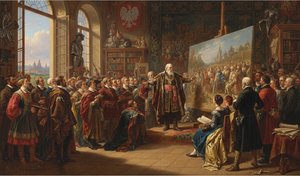
Jan Matejko: Historical Narrative & National Identity in 19th-Century Polish Painting
Explore the powerful historical paintings of Jan Matejko, Poland's national artist. Discover his iconic works & learn how he shaped Polish identity in the 19th century. High-quality reproductions available.


![The Battle of Grunwald [Tannenberg]](/media/artworks/images-thumb/76/63/7663bffc0e03f3032abe818c6c091ed6.jpg)


