Preview
 Send
Send Share
Share
 Details
 Guide
Guide

 Download
 Similars
 X-Ray
X-Ray Diaporama
 Stats
StatsNoah's Ark
 Oil On Canvas
- WallArt
- Baroque
 1710
1710- Renaissance
 374.0 x 374.0 cm
 Bristol Museum - Art Gallery
 Read More
Giclée / Art Print
Museum-quality giclée or canvas print with fast production and flexible finish options. ( Buy Hand Made Painting Switch to Digital Image)




P118B $10

P118H $10

P118W $10

P438Z $10

P508JH $12

P508YH $12

P805H $10

P805Z $10

P919BZ $10

P919G $10

P919XJ $10

P959ZH $10

P968JZ $12

W106C $8

W218G $10

W218JH $8

W218Y $10

W307PJ $10

W316G $10

W316PJ $8

W316Y $10

W398PJ $8

W4111J $10

W500HY $15

W500JH $15

W692G $12

W849H $8

W940BG $15

W953PJ $8




Pick from our preset sizes that match the artwork's original proportions.

Type the width and the height you need, to fit your frame or your wall. A print can only be cut, never made bigger than the picture, so a size with a different shape loses a part of the image. We send you a digital mockup to approve before we print anything. The picture shown on this page does not show the real cut — only the mockup does.
Worldwide Delivery () in 2 weeks instead of standard 4/5 weeks. (27 October)

Free Worldwide Express Shipping

High-Quality Linen Canvas

Full Shipping Insurance

Customs Tax Refund Guarantee

True Color Matching Guarantee

100-Day Return Policy (Defects Only)

100% Money-Back Guarantee

Bulk Discount Offer
 Glass option is only available in size under 110 CM

Noah's Ark
Giclée / Art Print
Reproduction Size
-


Total Price
$ 81
Jan Griffier I’s ‘Noah’s Ark’: A Baroque Vision of Abundance
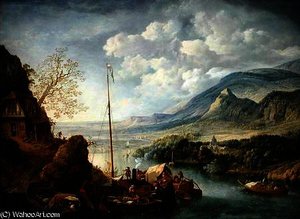
Jan Griffier I's “Noah’s Ark,” completed in 1710, is more than just a depiction of the biblical narrative; it’s a vibrant testament to the Dutch Golden Age’s fascination with nature and its capacity for lavish detail. Executed during a period when English patrons were commissioning works from Griffier – who had spent much of his career painting topographical views of England – this large-scale canvas (374 x 374 cm) embodies the artist's skill in rendering complex scenes teeming with life. The composition immediately draws the eye to a chaotic yet meticulously organized gathering of animals: ostriches, zebras, deer, swans, turkeys, and countless others, all interwoven within a richly detailed landscape. Griffier’s mastery is evident in his ability to capture both the individual character of each animal – from the proud stance of the peacock to the serene gaze of the swans – and their collective energy, creating an impression of lively movement and abundant wildlife.
- Style & Influence: The artwork firmly aligns with the Baroque and Flemish traditions, characterized by its dramatic lighting, dynamic composition, and emphasis on realism. Griffier’s training under Roelant Roghman is clearly visible in his precise line work and detailed rendering of textures – the smooth hides of the animals contrast sharply with the rougher surfaces of the ground and foliage.
- Technique: The painting's rich layering and blending of pigments, characteristic of oil paint, speaks to Griffier’s technical prowess. He skillfully employs a diffused light source, likely intended to evoke an overcast day or interior illumination, further enhancing the sense of depth and volume within the scene.
A Window into 18th-Century England
Griffier's work during this period reflects his time spent in England, where he produced views of Rhineland landscapes alongside depictions of the English countryside. This particular piece showcases a shift towards more narrative subjects, aligning with the tastes of his English patrons. The painting’s creation around 1710 places it squarely within the context of the Dutch Golden Age – a period marked by unprecedented artistic innovation and wealth, fueled in part by trade and colonial expansion. The inclusion of such a diverse array of animals suggests a broader engagement with themes of prosperity and fertility, common motifs in Baroque art.
Symbolism and Emotional Impact
"Noah’s Ark" transcends a simple biblical illustration; it's imbued with potent symbolism. The sheer abundance of life depicted can be interpreted as a celebration of nature’s bounty and diversity – a reflection of the Dutch Republic’s own flourishing economy and its mastery over the natural world. The composition evokes a feeling of wonder and delight, inviting the viewer to contemplate the beauty and power of creation. The artist's skillful use of color further amplifies this emotional impact, with splashes of vibrant hues from the birds and animal markings adding to the overall sense of dynamism and spectacle.
Provenance & Reproduction
Originally created around 1710 by Jan Griffier I, a prominent Dutch Golden Age painter active in both the Netherlands and England, this artwork represents a significant piece of art history. OriginalUniqueArt offers meticulously crafted hand-painted reproductions of “Noah’s Ark,” allowing you to bring this captivating Baroque masterpiece into your home or office. Our skilled artisans employ traditional techniques and high-quality materials to faithfully recreate Griffier's original vision, ensuring that your reproduction captures the full richness and emotional impact of this iconic work.
Questions & Answers
What use and space are recommended for "Noah's Ark" by Jan Griffier I?
Use (statement) and space (living room) are the two recommendations recorded for "Noah's Ark" by Jan Griffier I.
How is "Noah's Ark" by Jan Griffier I proportioned, and how big is it?
"Noah's Ark" by Jan Griffier I is a square composition measuring 374 x 374 cm in the original.
How do contrast and harmony combine in "Noah's Ark"?
The color analysis of "Noah's Ark" by Jan Griffier I records a gentle contrast and a strong color unity harmony.
Artist Biography
A Wanderer of the Golden Age: The Life and Legacy of Jan Griffier I
The story of Jan Griffier I is one of movement, maritime adventure, and a profound connection to the shifting landscapes of Northern Europe. A master of the Dutch Golden Age, Griffier’s life was as much defined by his travels across the English Channel as it was by the brushstrokes on his canvases. Born in Amsterdam around 1652, he emerged from a tradition of meticulous observation, having honed his skills under the guidance of the esteemed Roelant Roghman. This early training instilled in him a precision for draughtsmanship and an eye for the delicate textures of nature—qualities that would later allow him to capture both the sweeping vistas of the Rhineland and the intimate, pastoral charm of the English countryside.
Griffier’s career was marked by a remarkable duality, acting as a bridge between the artistic traditions of the Netherlands and England. After being admitted to the London Company of Painter-Stainers in 1677, he became a fixture in the English art scene, working alongside notable figures such as Jan Looten. His versatility was his greatest strength; while he is celebrated for his atmospheric landscapes, he was also a skilled etcher and mezzotint artist. Through his plates of birds and his reproductions of portraits by masters like Sir Peter Lely and Sir Godfrey Kneller, Griffier demonstrated an ability to translate the grandeur of portraiture into the nuanced language of printmaking.
Mastery of Light and Topography
To look upon a work by Griffier is to experience the atmospheric weight of a specific time and place. He possessed a rare talent for capturing the ephemeral qualities of weather—the biting chill of a winter scene with skaters or the soft, hazy light that settles over a riverbank. His city views serve as more than mere art; they are invaluable topographical records, offering a window into the architectural soul of the towns he visited during his extensive travels. These works possess a documentary importance, preserving the layout and character of 17th-century urban life with an artist's sensitive touch.
His technical repertoire was vast, ranging from the fine lines of engraving to the rich, tonal depths of mezzotint. This breadth allowed him to explore various facets of the natural world:
- Landscape Painting: Evocative depictions of both the Rhineland and English terrains, characterized by a sense of depth and seasonal atmosphere.
- Printmaking: Detailed etchings, including his famous series of birds inspired by Francis Barlow, which showcased his mastery of fine detail.
- Portrait Reproduction: Mezzotints that captured the likenesses of contemporary greats, bridging the gap between painting and print.
Resilience Amidst the Waves
Perhaps the most cinematic chapter of Griffier’s life involves his legendary resilience in the face of tragedy. In 1695, while attempting to return to the Netherlands with his family, he suffered a devastating shipwreck. The loss was total; the paintings he had carried with him—his life's work up to that point—were swallowed by the sea. Yet, rather than succumbing to despair, Griffier displayed the tenacity of a true survivor. He famously purchased a houseboat in Rotterdam, transforming it into a mobile studio and home, allowing him to navigate the waterways of Europe while continuing his creative pursuits.
This nomadic existence, driven by a need to sustain his family and his art, underscores the spirit of an artist who was never truly tethered to a single shore. Though he eventually returned to London, where he passed away, his legacy remained firmly rooted in the interconnected histories of the Dutch and English traditions. Through his sons, Robert and Jan the Younger, his artistic lineage continued, ensuring that the name Griffier would remain synonymous with the evocative, wandering spirit of the late 17th century.
Jan Griffier I
1652 - 1718 , Netherlands
Quick Facts
- Full Name: Bonaventura Peeters I
- Nationality: Flemish
- Date Of Birth: 1652
- Date Of Death: 1718
- Place Of Birth: Amsterdam, Netherlands
- Notable Artworks:
- Storms at Sea
- Shipwreck
- Mediterranean Port Scenes
- Artistic Movement Or Style: Marine painting
- Artists Who Influenced This Artist: ['Caravaggio']
- Artists Or Movements Influenced By This Artist: ['Dutch School']
Related Articles

The Visceral Stage: Exploring Dramatic Narratives & Emotional Intensity in Baroque Art
Explore the dramatic world of Baroque art! Discover iconic masters like Caravaggio & Rembrandt, their techniques, and the movement's lasting impact. Expert insights for collectors & enthusiasts at OriginalUniqueArt.

Baroque Masterpieces: 10 Paintings That Defined an Era |
Journey through the drama & grandeur of Baroque art! Explore 10 masterpieces by Caravaggio, Rembrandt, Rubens & more. Discover stunning oil paintings, rich colors & timeless stories. Find museum-quality reproductions at .

Baroque Classicism: The Grandeur of Order and Drama in 17th-Century Art History
Explore the profound elegance of Baroque Classicism. Discover how 17th-century masters synthesized dramatic emotion with classical order through the lens of the Counter-Reformation and the works of legends like Carlo Maratta and Andrea Sacchi.

Baroque Drama: Bringing Opulence & Emotion into Contemporary Interiors
Explore the opulent world of Baroque interior design! Discover key elements, modern applications & how to bring dramatic elegance into your home with OriginalUniqueArt.com's authentic reproductions.

The Dramatic Flourish: Exploring the Baroque Movement's Enduring Legacy in Art History
Explore the dramatic world of Baroque art! Discover iconic artists like Caravaggio & Rubens, defining techniques, and its lasting impact on art history. Expert insights for collectors & enthusiasts at OriginalUniqueArt.