Text size

() ·

A painting made for you, by hand

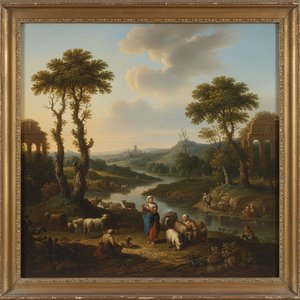
The Ford in the River

Hand Made Oil Reproduction

Hand-painted oil on canvas in your size and frame, made to order by our artists. ( Switch to Print Switch to Digital Image)

Collectible Description

Experience the dramatic light and Italianate vistas of Weenix's 1647 Dutch Golden Age masterpiece, The Ford in the River; discover this timeless scene today.

Artist Biography

Jan Baptist Weenix (1621-1659) was a Dutch Golden Age painter known for Italian landscapes, harbor scenes & still lifes of game/dogs. Pioneer of Italianate settings in Dutch art. Explore his versatile works!

from ·

Chapter 1

How large should it be?

Slide to change the size; the picture on the left shows the frame at its real width. The proportions of the original are kept.

Standard
custom
CM
INCH

Pick from our preset sizes that match the artwork's original proportions.

width
height

Type the width and the height you need, to fit your frame or your wall. This is hand-painted, so for a size with a different shape the artist can paint a bit more around the picture, or cut a bit — you choose. We send you a digital mockup to approve before the painting starts. The picture shown on this page does not show the real result — only the mockup does.

Chapter 2

How should it arrive?

Choose the edges of the stretched canvas

Choose your frame

Corner sample of the WhiteWrap canvas edge finish, stretched on solid wood bars
White $1
Corner sample of the BlurSideWrap canvas edge finish, stretched on solid wood bars
Blurside $1
Corner sample of the ExtendedWrap canvas edge finish, stretched on solid wood bars
Extended $1
Corner sample of the P118B picture frame: moulded polystyrene, 5 cm wide and 3 cm thick
P118B $10
Corner sample of the P118H picture frame: moulded polystyrene, 5 cm wide and 3 cm thick
P118H $10
Corner sample of the P118W picture frame: moulded polystyrene, 5 cm wide and 3 cm thick
P118W $10
Corner sample of the P438Z picture frame: moulded polystyrene, 5.5 cm wide and 3.5 cm thick
P438Z $10
Corner sample of the P508JH picture frame: moulded polystyrene, 7 cm wide and 3.5 cm thick
P508JH $12
Corner sample of the P508YH picture frame: moulded polystyrene, 7 cm wide and 3.5 cm thick
P508YH $12
Corner sample of the P805H picture frame: moulded polystyrene, 5 cm wide and 3.5 cm thick
P805H $10
Corner sample of the P805Z picture frame: moulded polystyrene, 5 cm wide and 3.5 cm thick
P805Z $10
Corner sample of the P919BZ picture frame: moulded polystyrene, 7 cm wide and 3.5 cm thick
P919BZ $10
Corner sample of the P919G picture frame: moulded polystyrene, 7 cm wide and 3.5 cm thick
P919G $10
Corner sample of the P919XJ picture frame: moulded polystyrene, 7 cm wide and 3.5 cm thick
P919XJ $10
Corner sample of the P959ZH picture frame: moulded polystyrene, 5 cm wide and 3 cm thick
P959ZH $10
Corner sample of the P968JZ picture frame: moulded polystyrene, 6 cm wide and 4 cm thick
P968JZ $12
Corner sample of the W106C picture frame: solid wood, 5 cm wide and 3 cm thick
W106C $8
Corner sample of the W218G picture frame: solid wood, 5 cm wide and 3 cm thick
W218G $10
Corner sample of the W218JH picture frame: solid wood, 5 cm wide and 3 cm thick
W218JH $8
Corner sample of the W218Y picture frame: solid wood, 5 cm wide and 3 cm thick
W218Y $10
Corner sample of the W307PJ picture frame: solid wood, 6 cm wide and 3 cm thick
W307PJ $10
Corner sample of the W316G picture frame: solid wood, 6 cm wide and 3 cm thick
W316G $10
Corner sample of the W316PJ picture frame: solid wood, 6 cm wide and 3 cm thick
W316PJ $8
Corner sample of the W316Y picture frame: solid wood, 6 cm wide and 3 cm thick
W316Y $10
Corner sample of the W398PJ picture frame: solid wood, 5 cm wide and 3 cm thick
W398PJ $8
Corner sample of the W4111J picture frame: solid wood, 6.5 cm wide and 3.5 cm thick
W4111J $10
Corner sample of the W500HY picture frame: solid wood, 7 cm wide and 5 cm thick
W500HY $15
Corner sample of the W500JH picture frame: solid wood, 7 cm wide and 5 cm thick
W500JH $15
Corner sample of the W692G picture frame: solid wood, 8 cm wide and 4 cm thick
W692G $12
Corner sample of the W849H picture frame: solid wood, 5 cm wide and 3 cm thick
W849H $8
Corner sample of the W940BG picture frame: solid wood, 7.5 cm wide and 4.5 cm thick
W940BG $15
Corner sample of the W953PJ picture frame: solid wood, 6 cm wide and 3.5 cm thick
W953PJ $8
Corner sample of the H24-GOLD picture frame: carved wood with gesso, 10 cm wide and 6 cm thick
H24-GOLD $30
Corner sample of the H24-SILVER picture frame: carved wood with gesso, 10 cm wide and 6 cm thick
H24-SILVER $30
Corner sample of the H36-GOLD picture frame: carved wood with gesso, 15 cm wide and 6.5 cm thick
H36-GOLD $45
Corner sample of the H36-SILVER picture frame: carved wood with gesso, 15 cm wide and 6.5 cm thick
H36-SILVER $45
Frame preview
Framed

Moulding: . Overall size with the frame: .

Chapter 3

Who paints it, and should anything change?

Examples of what can be changed: Replace face with customer photo; Add pet (e.g., replace cat with dog); Include hidden message in background; Change background landscape or elements.
After order, OriginalUniqueArt.com team will email client for instructions and provide a mockup preview

Worldwide Delivery () in 3/4 weeks instead of standard 5 weeks. (31 October). No compromise on quality.

Chapter 4

The finishing touches

A nameplate, as in a museum?

Engraved Bronze Plaque Details

This elegant plaque features the artist's name and the title of the artwork, finely engraved for a timeless presentation.

It is made from bronze with a refined, elegant finish. The text is precisely laser-engraved for a sharp and permanent result. Measuring 9x2 cm, the plaque is compact yet easy to read. It's built to be durable and scratch-resistant, offering a professional, museum-quality look. Mounting is simple thanks to the included adhesive backing.

Transparent Acrylic Plaque Details

The plaque includes essential engraved details such as the artist's name, the title of the artwork, the date it was created, the type of media used-like oil on canvas or watercolor-a brief description of the piece, and a QR code that links to the complete artwork information.

It is crafted from clear acrylic, offering a sleek, modern appearance. The text is UV-engraved in black to ensure strong visual contrast. With a size of 10x15 cm, it ensures optimal readability. It comes equipped with two metal hooks for secure wall mounting. The plaque is designed to be weather-resistant, making it suitable for various environments, and it includes interactive features that work seamlessly with smartphone scanning.

Black Acrylic Plaque Details

This elegant plaque includes engraved information such as the artist's name, the title of the artwork, the date it was created, the type of media used (like oil on canvas or watercolor), a short description of the artwork, and a QR code for quick access to more information.

The plaque itself is made from refined black acrylic with a premium finish. The text is laser-engraved in white for high contrast and readability. Its size is 10x15 cm, designed to be easy to read. It comes with two metal hooks for professional mounting. The design is sleek and fits any interior style. It is also weather-resistant and durable, with built-in digital integration for mobile compatibility.

A protective varnish?

When do you need it?

Chapter 5

Your painting, as you ordered it

The Ford in the River

Reproduction Medium

Reproduction Size

-

Elite Senior Artist

More detail, finesse, and extra production time

-

Reproduction Frame

-

-

For artworks or reproductions larger than 105 cm (approximately 41 inches) on any side, the frame will be shipped as a kit, disassembled. This method ensures safe delivery and prevents damage during transport.

Professional assembly required - this is not a DIY product.
The kit must be assembled and the canvas stretched by an experienced professional framer, using wood glue (not supplied), a canvas stretching plier and clamps to hold the bars square while the glue dries. Incorrect assembly or uneven canvas tension can permanently damage the artwork and is not covered by our warranty.

  • All solid wood bars are included, precisely cut to size.

  • Assembled with the screws provided, plus wood glue for the corner joints, which is not supplied and must be sourced by your framer.

  • Professional tools are required and not included: a canvas stretching plier (tensioner) and clamps to hold the bars square while the glue dries.

Important:
The corner joints require wood glue, the bars must be held with clamps until the glue is fully dry, and tightening the canvas on the assembled frame requires a canvas stretching plier. None of these are included in the kit. Please arrange an experienced professional framer before ordering this size.

Nameplate

-

-

Protective Varnish

Glossy Varnish (enhances colors, protects against light/moisture)

-

Customize My Artwork

Examples of what can be changed: Replace face with customer photo; Add pet (e.g., replace cat with dog); Include hidden message in background; Change background landscape or elements.

-

Urgent

Worldwide Delivery () in 3/4 weeks instead of standard 5 weeks. (31 October). No compromise on quality.

-

Express Shipping

Worldwide Delivery () in 5 weeks. (7 November).

Included

Total Price

$ 300

Total Price $ 300

Glass option is only available in size under 110 CM

Included with every order

  • Free Worldwide Express Shipping
  • High-Quality Linen Canvas
  • Full Shipping Insurance
  • Customs Tax Refund Guarantee
  • True Color Matching Guarantee
  • 100-Day Return Policy (Defects Only)
  • 100% Money-Back Guarantee
  • Bulk Discount Offer

A Timeless Encounter with the Dutch Golden Age

In the quiet depths of Jan Baptist Weenix’s 1647 masterpiece, "The Ford in the River," one finds much more than a mere landscape; one discovers a portal into the soul of the Dutch Golden Age. This monumental canvas, currently preserved within the hallowed halls of the Hermitage Museum, serves as a breathtaking testament to an era where art began to bridge the gap between the rugged reality of Northern Europe and the idealized grandeur of the Italian Renaissance. As your eyes wander across the textured surface, you are immediately swept into a scene of pastoral vitality, where the rhythmic pulse of rural life meets the enduring stillness of antiquity.

The composition is a masterclass in narrative depth, presenting a world teeming with anecdotal detail and human connection. At the heart of the river crossing, figures engage in the humble, everyday rituals of 17th-century existence—a horseman pauses in conversation, while nearby, the subtle movements of travelers and livestock create a sense of spontaneous motion. Weenix does not merely observe; he orchestrates a symphony of movement, where the glistening surface of the water and the heavy, brooding clouds above suggest a fleeting moment captured in the amber of time. For the discerning collector or interior designer, this painting offers an unparalleled sense of gravitas, bringing a sophisticated historical weight to any curated space.

The Alchemy of Light and Italianate Vision

What truly elevates Weenix above his contemporaries is his audacious embrace of the Italianate style. Having traveled through Rome, the artist infused the Dutch landscape with a sense of classical majesty that was revolutionary for its time. The presence of architectural ruins—majestic pillars that hint at a lost, glorious past—transforms a simple river ford into a stage for epic contemplation. This juxtaposition of the ephemeral (the flowing water and passing travelers) against the eternal (the stone ruins) invites the viewer to reflect on the cyclical nature of civilization and the persistence of beauty amidst decay.

Technically, the painting is a triumph of chiaroscuro. Weenix utilizes a dramatic interplay between light and shadow to sculpt the landscape, creating a three-dimensional relief that feels almost tactile. The way the late afternoon light catches the white coat of a prominent horse or illuminates the folds of a traveler's garment demonstrates a profound understanding of tonal richness. Through his meticulous use of oil on canvas, Weenix achieves a textural nuance—from the translucent ripples of the river to the coarse texture of animal hides—that continues to captivate the modern eye. To possess a reproduction of such a work is to invite this masterful manipulation of light into one's own environment, fostering an atmosphere of warmth, depth, and intellectual intrigue.

An Emotional Resonance for the Modern Collector

Beyond its technical brilliance, "The Ford in the River" resonates on a deeply emotional level. It evokes a profound sense of tranquility juxtaposed with endeavor. There is a nostalgic pull to the scene, a longing for a world where the pace of life was dictated by the movement of the seasons and the flow of the river. For those seeking to decorate a sanctuary or a professional study, this artwork provides a focal point that is both stimulating and calming. It does not demand attention through loud colors, but rather earns it through its intricate layers of meaning and its ability to transport the viewer to a different century.

Whether you are an art historian drawn to its stylistic evolution or an interior enthusiast looking for a piece that embodies classical elegance, Weenix’s vision remains strikingly relevant. The painting stands as a bridge between eras, blending the scientific realism of the Dutch tradition with the poetic idealism of the South. It is a piece that rewards repeated viewing, revealing new details—a hidden figure, a shift in the cloudscape, a subtle glint of light—each time it is encountered, making it an enduring investment for any collection dedicated to the heights of European art history.

Questions & Answers

What are the reproduction rights of "The Ford in the River" at the Hermitage Museum?

"The Ford in the River" by Jan Baptist Weenix, held at the Hermitage Museum, is in the public domain - its copyright has expired. This status determines whether reproductions of the image may be made.

Can I see "The Ford in the River" by Jan Baptist Weenix on my own wall before buying?

The AR Preview page of "The Ford in the River" by Jan Baptist Weenix uses augmented reality to show the artwork in your own space, on a compatible device.

What is "The Ford in the River" made with, and in which style?

"The Ford in the River" is made in oil on canvas, in the Dutch Golden Age style.

More about this painting

Preview AR preview Switch to Print Switch to Digital Image Send
Details Guide Add to favorites Download Similars X-Ray Diaporama Q&A Stats

In numbers

  • 1647the year it was painted
  • 29frames to choose from
  • standard sizes, in its own proportions
  • 5weeks to paint and deliver it
Jan Baptist Weenix

Jan Baptist Weenix

1621 - 1661, Netherlands

Quick facts about Jan Baptist Weenix

  • Artistic Movement Or Style: Dutch Golden Age, Italianate
  • Artists Or Movements Influenced By This Artist: ['Jan Weenix']
  • Artists Who Influenced This Artist:
    • Jan Micker
    • Abraham Bloemaert
    • Claes Corneliszoon Moeyaert
  • Full Name: Jan Baptist Weenix
  • Nationality: Dutch
  • Notable Artworks:
    • Goat Lying Down
    • The Dutch Ambassador on his Way to Isfahan
    • After the Hunt
    • A Dog and a Cat near a partially disembowelled Deer
  • Place Of Birth: Amsterdam, Netherlands
  • Date Of Birth: 1621
  • Date Of Death: 1661

Artist Biography

The Visionary of the Dutch Golden Age

Jan Baptist Weenix stands as a singular figure within the Dutch Golden Age, celebrated for his distinctive blend of meticulous observation and imaginative vision. Though his artistic output was relatively modest compared to contemporaries like Rembrandt or Vermeer, Weenix’s contribution to Dutch art history is undeniable—particularly his groundbreaking exploration of Italian landscapes infused with human figures, establishing a stylistic precedent that would resonate throughout subsequent generations. Born in Amsterdam near the bustling harbor in 1621, Weenix descended from a family of architects, a lineage that likely shaped his formative years amidst the intellectual and structural ferment of the era.

Despite facing personal challenges—accounts suggest he struggled with speech due to a medical condition—Weenix possessed an ardent passion for literature and art, fostered by a mother who proactively arranged for him to apprentice under Jan Micker, Rembrandt’s brother-in-law. This early training instilled in him a disciplined approach to drawing and observation that would become the hallmarks of his oeuvre. He further honed his skills at Utrecht under the guidance of Abraham Bloemaert and returned to Amsterdam to study with Claes Corneliszoon Moeyaert, cementing his grounding in the prevailing artistic currents of the Netherlands.

A Journey Through Light and Landscape

The trajectory of Weenix’s career was profoundly altered by his travels, most notably his journey to Rome in 1643 alongside Nicolaes Pieterszoon Berchem. This excursion allowed him to encounter the vibrant intellectual and artistic milieu of the Bentvueghels guild, an experience that propelled him towards a more expansive stylistic range. In Rome, he embraced the Italianate style, characterized by warm, golden light and classical landscapes that contrasted beautifully with the cooler, more somber tones of traditional Dutch painting. This period of Roman influence allowed him to master the art of the "Italianate landscape," where the rugged beauty of southern Europe was reimagined through a Northern European lens.

His work during this era often blended the grandeur of classical settings with intimate, human elements. Whether depicting harbor scenes that whispered of maritime commerce or expansive vistas that evoked a sense of timelessness, Weenix possessed a unique ability to capture the atmosphere of a place. His mastery was not limited to vast horizons; he was equally adept at capturing the quiet, often visceral reality of life through his still lifes. His depictions of dead game and animals were marked by a startling realism, where every texture—from the coarse fur of a hunting dog to the delicate sheen of feathers—was rendered with breathtaking precision.

Legacy of Realism and Artistry

The significance of Jan Baptist Weenix lies in his ability to bridge the gap between the gritty realism of Dutch tradition and the idealized beauty of the Italianate movement. His versatility allowed him to navigate diverse subject matters, from the dramatic tension found in works like After the Hunt to the quiet, almost somber intensity of his animal studies. Through his brush, the viewer is invited into a world where the boundaries between the observed natural world and the imagined classical past are beautifully blurred.

As we reflect on his life and work, several key elements define his enduring importance:

  • Stylistic Innovation: He was a pioneer in integrating Italianate landscape elements into the Dutch tradition, creating a new visual language for his contemporaries.
  • Technical Mastery: His disciplined training allowed for an extraordinary level of detail in both large-scale landscapes and intimate still lifes.
  • Versatility: His ability to move seamlessly between harbor scenes, hunting motifs, and animal portraits demonstrates a rare breadth of talent.
  • Historical Impact: As a member of the Bentvueghels, he helped foster the international exchange of artistic ideas that defined the 17th-century art world.

Though his life was relatively short, ending in 1661, the imprint left by Jan Baptist Weenix remains visible in the evolution of landscape painting. He taught future generations how to look at the horizon not just as a boundary, but as a canvas for light, history, and human emotion.

Quick Facts

  • Dimensions: 100 x 132 cm
  • Medium: Oil on Canvas
  • Title: The Ford in the River
  • Artist: Jan Baptist Weenix
  • Year: 1647
  • Notable elements or techniques: Detailed realism; Light & shadow play