Text size

() ·

A painting made for you, by hand

Dead Partridge

Hand Made Oil Reproduction

Hand-painted oil on canvas in your size and frame, made to order by our artists. ( Switch to Print Switch to Digital Image)

Collectible Description

Discover "Dead Partridge" by Jan Baptist Weenix! This Dutch Golden Age masterpiece captures the stillness of death with stunning realism and masterful light. A captivating oil painting reproduction awaits.

Artist Biography

Jan Baptist Weenix (1621-1659) was a Dutch Golden Age painter known for Italian landscapes, harbor scenes & still lifes of game/dogs. Pioneer of Italianate settings in Dutch art. Explore his versatile works!

from ·

Chapter 1

How large should it be?

Slide to change the size; the picture on the left shows the frame at its real width. The proportions of the original are kept.

Standard
custom
CM
INCH

Pick from our preset sizes that match the artwork's original proportions.

width
height

Type the width and the height you need, to fit your frame or your wall. This is hand-painted, so for a size with a different shape the artist can paint a bit more around the picture, or cut a bit — you choose. We send you a digital mockup to approve before the painting starts. The picture shown on this page does not show the real result — only the mockup does.

Chapter 2

How should it arrive?

Choose the edges of the stretched canvas

Choose your frame

Corner sample of the WhiteWrap canvas edge finish, stretched on solid wood bars
White $1
Corner sample of the BlurSideWrap canvas edge finish, stretched on solid wood bars
Blurside $1
Corner sample of the ExtendedWrap canvas edge finish, stretched on solid wood bars
Extended $1
Corner sample of the P118B picture frame: moulded polystyrene, 5 cm wide and 3 cm thick
P118B $10
Corner sample of the P118H picture frame: moulded polystyrene, 5 cm wide and 3 cm thick
P118H $10
Corner sample of the P118W picture frame: moulded polystyrene, 5 cm wide and 3 cm thick
P118W $10
Corner sample of the P438Z picture frame: moulded polystyrene, 5.5 cm wide and 3.5 cm thick
P438Z $10
Corner sample of the P508JH picture frame: moulded polystyrene, 7 cm wide and 3.5 cm thick
P508JH $12
Corner sample of the P508YH picture frame: moulded polystyrene, 7 cm wide and 3.5 cm thick
P508YH $12
Corner sample of the P805H picture frame: moulded polystyrene, 5 cm wide and 3.5 cm thick
P805H $10
Corner sample of the P805Z picture frame: moulded polystyrene, 5 cm wide and 3.5 cm thick
P805Z $10
Corner sample of the P919BZ picture frame: moulded polystyrene, 7 cm wide and 3.5 cm thick
P919BZ $10
Corner sample of the P919G picture frame: moulded polystyrene, 7 cm wide and 3.5 cm thick
P919G $10
Corner sample of the P919XJ picture frame: moulded polystyrene, 7 cm wide and 3.5 cm thick
P919XJ $10
Corner sample of the P959ZH picture frame: moulded polystyrene, 5 cm wide and 3 cm thick
P959ZH $10
Corner sample of the P968JZ picture frame: moulded polystyrene, 6 cm wide and 4 cm thick
P968JZ $12
Corner sample of the W106C picture frame: solid wood, 5 cm wide and 3 cm thick
W106C $8
Corner sample of the W218G picture frame: solid wood, 5 cm wide and 3 cm thick
W218G $10
Corner sample of the W218JH picture frame: solid wood, 5 cm wide and 3 cm thick
W218JH $8
Corner sample of the W218Y picture frame: solid wood, 5 cm wide and 3 cm thick
W218Y $10
Corner sample of the W307PJ picture frame: solid wood, 6 cm wide and 3 cm thick
W307PJ $10
Corner sample of the W316G picture frame: solid wood, 6 cm wide and 3 cm thick
W316G $10
Corner sample of the W316PJ picture frame: solid wood, 6 cm wide and 3 cm thick
W316PJ $8
Corner sample of the W316Y picture frame: solid wood, 6 cm wide and 3 cm thick
W316Y $10
Corner sample of the W398PJ picture frame: solid wood, 5 cm wide and 3 cm thick
W398PJ $8
Corner sample of the W4111J picture frame: solid wood, 6.5 cm wide and 3.5 cm thick
W4111J $10
Corner sample of the W500HY picture frame: solid wood, 7 cm wide and 5 cm thick
W500HY $15
Corner sample of the W500JH picture frame: solid wood, 7 cm wide and 5 cm thick
W500JH $15
Corner sample of the W692G picture frame: solid wood, 8 cm wide and 4 cm thick
W692G $12
Corner sample of the W849H picture frame: solid wood, 5 cm wide and 3 cm thick
W849H $8
Corner sample of the W940BG picture frame: solid wood, 7.5 cm wide and 4.5 cm thick
W940BG $15
Corner sample of the W953PJ picture frame: solid wood, 6 cm wide and 3.5 cm thick
W953PJ $8
Corner sample of the H24-GOLD picture frame: carved wood with gesso, 10 cm wide and 6 cm thick
H24-GOLD $30
Corner sample of the H24-SILVER picture frame: carved wood with gesso, 10 cm wide and 6 cm thick
H24-SILVER $30
Corner sample of the H36-GOLD picture frame: carved wood with gesso, 15 cm wide and 6.5 cm thick
H36-GOLD $45
Corner sample of the H36-SILVER picture frame: carved wood with gesso, 15 cm wide and 6.5 cm thick
H36-SILVER $45
Frame preview
Framed

Moulding: . Overall size with the frame: .

Chapter 3

Who paints it, and should anything change?

Examples of what can be changed: Replace face with customer photo; Add pet (e.g., replace cat with dog); Include hidden message in background; Change background landscape or elements.
After order, OriginalUniqueArt.com team will email client for instructions and provide a mockup preview

Worldwide Delivery () in 3/4 weeks instead of standard 5 weeks. (31 October). No compromise on quality.

Chapter 4

The finishing touches

A nameplate, as in a museum?

Engraved Bronze Plaque Details

This elegant plaque features the artist's name and the title of the artwork, finely engraved for a timeless presentation.

It is made from bronze with a refined, elegant finish. The text is precisely laser-engraved for a sharp and permanent result. Measuring 9x2 cm, the plaque is compact yet easy to read. It's built to be durable and scratch-resistant, offering a professional, museum-quality look. Mounting is simple thanks to the included adhesive backing.

Transparent Acrylic Plaque Details

The plaque includes essential engraved details such as the artist's name, the title of the artwork, the date it was created, the type of media used-like oil on canvas or watercolor-a brief description of the piece, and a QR code that links to the complete artwork information.

It is crafted from clear acrylic, offering a sleek, modern appearance. The text is UV-engraved in black to ensure strong visual contrast. With a size of 10x15 cm, it ensures optimal readability. It comes equipped with two metal hooks for secure wall mounting. The plaque is designed to be weather-resistant, making it suitable for various environments, and it includes interactive features that work seamlessly with smartphone scanning.

Black Acrylic Plaque Details

This elegant plaque includes engraved information such as the artist's name, the title of the artwork, the date it was created, the type of media used (like oil on canvas or watercolor), a short description of the artwork, and a QR code for quick access to more information.

The plaque itself is made from refined black acrylic with a premium finish. The text is laser-engraved in white for high contrast and readability. Its size is 10x15 cm, designed to be easy to read. It comes with two metal hooks for professional mounting. The design is sleek and fits any interior style. It is also weather-resistant and durable, with built-in digital integration for mobile compatibility.

A protective varnish?

When do you need it?

Chapter 5

Your painting, as you ordered it

Dead Partridge

Reproduction Medium

Reproduction Size

-

Elite Senior Artist

More detail, finesse, and extra production time

-

Reproduction Frame

-

-

For artworks or reproductions larger than 105 cm (approximately 41 inches) on any side, the frame will be shipped as a kit, disassembled. This method ensures safe delivery and prevents damage during transport.

Professional assembly required - this is not a DIY product.
The kit must be assembled and the canvas stretched by an experienced professional framer, using wood glue (not supplied), a canvas stretching plier and clamps to hold the bars square while the glue dries. Incorrect assembly or uneven canvas tension can permanently damage the artwork and is not covered by our warranty.

  • All solid wood bars are included, precisely cut to size.

  • Assembled with the screws provided, plus wood glue for the corner joints, which is not supplied and must be sourced by your framer.

  • Professional tools are required and not included: a canvas stretching plier (tensioner) and clamps to hold the bars square while the glue dries.

Important:
The corner joints require wood glue, the bars must be held with clamps until the glue is fully dry, and tightening the canvas on the assembled frame requires a canvas stretching plier. None of these are included in the kit. Please arrange an experienced professional framer before ordering this size.

Nameplate

-

-

Protective Varnish

Glossy Varnish (enhances colors, protects against light/moisture)

-

Customize My Artwork

Examples of what can be changed: Replace face with customer photo; Add pet (e.g., replace cat with dog); Include hidden message in background; Change background landscape or elements.

-

Urgent

Worldwide Delivery () in 3/4 weeks instead of standard 5 weeks. (31 October). No compromise on quality.

-

Express Shipping

Worldwide Delivery () in 5 weeks. (7 November).

Included

Total Price

$ 300

Total Price $ 300

Glass option is only available in size under 110 CM

Included with every order

  • Free Worldwide Express Shipping
  • High-Quality Linen Canvas
  • Full Shipping Insurance
  • Customs Tax Refund Guarantee
  • True Color Matching Guarantee
  • 100-Day Return Policy (Defects Only)
  • 100% Money-Back Guarantee
  • Bulk Discount Offer

A Moment of Stillness: Exploring the Haunting Beauty of "Dead Partridge"

Jan Baptist Weenix’s “Dead Partridge,” painted around 1650-1652 and now residing within the esteemed Mauritshuis in The Hague, is more than just a depiction of a fallen bird; it's a meticulously crafted meditation on mortality, observation, and the subtle poetry of the natural world. Born in Amsterdam during a period of burgeoning artistic innovation, Weenix emerged as a pivotal figure in Dutch Golden Age painting, particularly renowned for his pioneering approach to Italianate landscapes infused with human presence – a technique that profoundly influenced generations of artists to come. This particular work, rendered in oil on canvas measuring 50 x 43 cm, exemplifies his mastery of chiaroscuro and his uncanny ability to capture the fleeting essence of life’s transience.

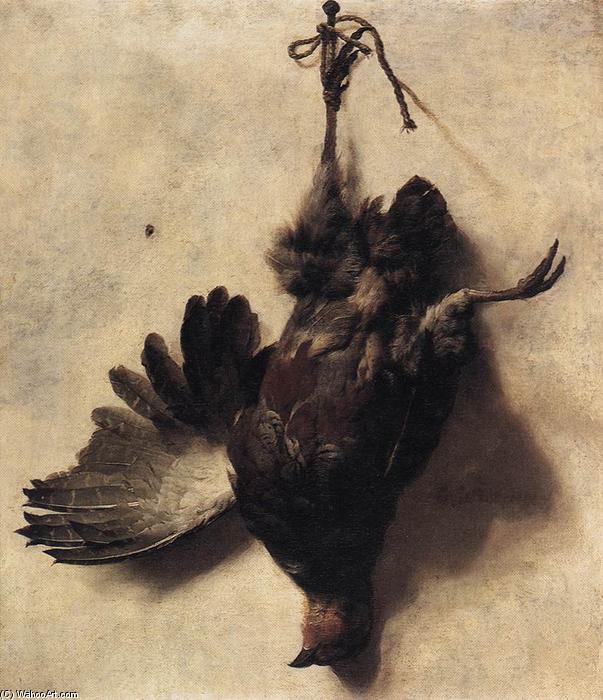
The composition is strikingly simple yet deeply resonant. A single, dead partridge hangs suspended from a nail, its feathers arranged in an almost deliberate, unsettling display against a muted beige background. The bird's posture – feet tied together, plumage spread wide – immediately evokes a sense of vulnerability and finality. Crucially, the scene isn’t presented with overt drama or pathos; instead, Weenix employs a quiet restraint that amplifies the painting’s contemplative mood. This deliberate lack of sentimentality is characteristic of his style, prioritizing precise observation and technical skill over emotional excess.

The Language of Light and Shadow: A Study in Technique

Weenix's genius lies not just in his subject matter but also in his masterful manipulation of light and shadow. The painting’s illumination is carefully controlled, creating a dramatic interplay between dark tones and subtle highlights that imbue the scene with depth and volume. The artist utilizes *chiaroscuro* – the contrasting of strong light and deep shadows – to sculpt the bird's form, drawing the viewer’s eye directly to its lifeless body. Notice how the folds of the feathers are rendered with painstaking detail, each strand appearing almost tangible. The subtle gradations of color—from the rich browns and ochres of the plumage to the cool grays and beiges of the background—further enhance the painting's realism and atmospheric quality.

Furthermore, Weenix’s technique is reminiscent of other prominent Dutch Masters like Willem Kalf and Balthasar van der Ast, both known for their meticulous attention to detail and their ability to capture the textures of everyday objects. The artist’s brushwork is remarkably smooth and controlled, contributing to the painting's overall sense of serenity and composure. The careful rendering of the nail itself—its rough texture and slightly tarnished surface—adds a layer of realism that elevates the work beyond mere representation.

Historical Context and Symbolic Resonance

“Dead Partridge” was painted during the Dutch Golden Age, a period of unprecedented artistic flourishing fueled by economic prosperity and intellectual curiosity. The painting reflects the era’s fascination with still life – a genre that allowed artists to explore themes of mortality, beauty, and the transient nature of earthly possessions. The partridge itself held symbolic significance in 17th-century Dutch culture, often associated with abundance, fertility, and even death—a poignant reminder of the cyclical nature of life and decay. The painting’s setting – a simple, neutral background – further emphasizes the bird's vulnerability and underscores its role as the central focus of attention.

Interestingly, Weenix’s work draws inspiration from Italianate traditions, particularly the depictions of hunting scenes found in the paintings of artists like Jacopo de’ Barbari. This influence is evident in the painting’s composition—the bird's pose and the arrangement of its feathers echo those seen in earlier Italian works. However, Weenix transforms these borrowed elements into something uniquely his own, imbuing them with a distinctly Dutch sensibility.

A Timeless Masterpiece: Reproduction Possibilities

Today, “Dead Partridge” stands as a testament to Jan Baptist Weenix’s artistic vision and technical skill. If you're captivated by this hauntingly beautiful painting, consider commissioning a high-quality reproduction from our skilled artisans. We meticulously recreate the original’s nuances—the subtle gradations of color, the delicate brushwork, and the evocative atmosphere—to ensure that your reproduction captures the essence and beauty of this timeless masterpiece. Explore our available reproductions here.

Questions & Answers

Which museum holds the original "Dead Partridge"?

The original "Dead Partridge" by Jan Baptist Weenix is held at the Mauritshuis, The Hague, Netherlands. A reproduction allows the work to be displayed at home.

How can I get a digital file of "Dead Partridge" by Jan Baptist Weenix?

A digital image of "Dead Partridge" by Jan Baptist Weenix can be purchased on its Digital Image page: a high-resolution digital image download.

What are the medium and date of "Dead Partridge" by Jan Baptist Weenix?

"Dead Partridge" was created in 1650 using the oil on canvas technique. Material and date describe how and when the original was made.

More about this painting

Preview AR preview Switch to Print Switch to Digital Image Send
Details Guide Add to favorites Download Similars X-Ray Diaporama Q&A Stats

In numbers

  • 1650the year it was painted
  • 29frames to choose from
  • standard sizes, in its own proportions
  • 5weeks to paint and deliver it
Jan Baptist Weenix

Jan Baptist Weenix

1621 - 1661, Netherlands

Quick facts about Jan Baptist Weenix

  • Artistic Movement Or Style: Dutch Golden Age, Italianate
  • Artists Or Movements Influenced By This Artist: ['Jan Weenix']
  • Artists Who Influenced This Artist:
    • Jan Micker
    • Abraham Bloemaert
    • Claes Corneliszoon Moeyaert
  • Full Name: Jan Baptist Weenix
  • Nationality: Dutch
  • Notable Artworks:
    • Goat Lying Down
    • The Dutch Ambassador on his Way to Isfahan
    • After the Hunt
    • A Dog and a Cat near a partially disembowelled Deer
  • Place Of Birth: Amsterdam, Netherlands
  • Date Of Birth: 1621
  • Date Of Death: 1661

Artist Biography

The Visionary of the Dutch Golden Age

Jan Baptist Weenix stands as a singular figure within the Dutch Golden Age, celebrated for his distinctive blend of meticulous observation and imaginative vision. Though his artistic output was relatively modest compared to contemporaries like Rembrandt or Vermeer, Weenix’s contribution to Dutch art history is undeniable—particularly his groundbreaking exploration of Italian landscapes infused with human figures, establishing a stylistic precedent that would resonate throughout subsequent generations. Born in Amsterdam near the bustling harbor in 1621, Weenix descended from a family of architects, a lineage that likely shaped his formative years amidst the intellectual and structural ferment of the era.

Despite facing personal challenges—accounts suggest he struggled with speech due to a medical condition—Weenix possessed an ardent passion for literature and art, fostered by a mother who proactively arranged for him to apprentice under Jan Micker, Rembrandt’s brother-in-law. This early training instilled in him a disciplined approach to drawing and observation that would become the hallmarks of his oeuvre. He further honed his skills at Utrecht under the guidance of Abraham Bloemaert and returned to Amsterdam to study with Claes Corneliszoon Moeyaert, cementing his grounding in the prevailing artistic currents of the Netherlands.

A Journey Through Light and Landscape

The trajectory of Weenix’s career was profoundly altered by his travels, most notably his journey to Rome in 1643 alongside Nicolaes Pieterszoon Berchem. This excursion allowed him to encounter the vibrant intellectual and artistic milieu of the Bentvueghels guild, an experience that propelled him towards a more expansive stylistic range. In Rome, he embraced the Italianate style, characterized by warm, golden light and classical landscapes that contrasted beautifully with the cooler, more somber tones of traditional Dutch painting. This period of Roman influence allowed him to master the art of the "Italianate landscape," where the rugged beauty of southern Europe was reimagined through a Northern European lens.

His work during this era often blended the grandeur of classical settings with intimate, human elements. Whether depicting harbor scenes that whispered of maritime commerce or expansive vistas that evoked a sense of timelessness, Weenix possessed a unique ability to capture the atmosphere of a place. His mastery was not limited to vast horizons; he was equally adept at capturing the quiet, often visceral reality of life through his still lifes. His depictions of dead game and animals were marked by a startling realism, where every texture—from the coarse fur of a hunting dog to the delicate sheen of feathers—was rendered with breathtaking precision.

Legacy of Realism and Artistry

The significance of Jan Baptist Weenix lies in his ability to bridge the gap between the gritty realism of Dutch tradition and the idealized beauty of the Italianate movement. His versatility allowed him to navigate diverse subject matters, from the dramatic tension found in works like After the Hunt to the quiet, almost somber intensity of his animal studies. Through his brush, the viewer is invited into a world where the boundaries between the observed natural world and the imagined classical past are beautifully blurred.

As we reflect on his life and work, several key elements define his enduring importance:

  • Stylistic Innovation: He was a pioneer in integrating Italianate landscape elements into the Dutch tradition, creating a new visual language for his contemporaries.
  • Technical Mastery: His disciplined training allowed for an extraordinary level of detail in both large-scale landscapes and intimate still lifes.
  • Versatility: His ability to move seamlessly between harbor scenes, hunting motifs, and animal portraits demonstrates a rare breadth of talent.
  • Historical Impact: As a member of the Bentvueghels, he helped foster the international exchange of artistic ideas that defined the 17th-century art world.

Though his life was relatively short, ending in 1661, the imprint left by Jan Baptist Weenix remains visible in the evolution of landscape painting. He taught future generations how to look at the horizon not just as a boundary, but as a canvas for light, history, and human emotion.

Quick Facts

  • Location: Mauritshuis, The Hague
  • Title: Dead Partridge
  • Influences:
    • Willem Kalf
    • Balthasar van der Ast
  • Dimensions: 50 x 43 cm
  • Artist: Jan Baptist Weenix

Art Quiz

There is only one correct answer for each question.

Question 1:
What is the primary subject depicted in Jan Baptist Weenix’s ‘Dead Partridge’?
Question 2:
In which museum can you find the painting ‘Dead Partridge’?
Question 3:
What artistic technique is prominently used in ‘Dead Partridge’ to create a sense of depth and volume?
Question 4:
Around what year was ‘Dead Partridge’ painted?
Question 5:
The composition of 'Dead Partridge' is characterized by its simplicity and attention to detail. What element contributes most to this effect?