

 Preview
 Send
Send Share
Share
 Details

 Download
 Similars
 X-Ray
X-Ray Diaporama
 Stats
StatsVow
 Oil On Panel
- Romanticism
 1860
1860- 19th Century
 45.0 x 36.0 cm
 Hermitage Museum
 Read More
Hand Made Oil Reproduction
Hand-painted oil on canvas in your size and frame, made to order by our artists. ( Switch to Print Switch to Digital Image)




P118B $10

P118H $10

P118W $10

P438Z $10

P508JH $12

P508YH $12

P805H $10

P805Z $10

P919BZ $10

P919G $10

P919XJ $10

P959ZH $10

P968JZ $12

W106C $8

W218G $10

W218JH $8

W218Y $10

W307PJ $10

W316G $10

W316PJ $8

W316Y $10

W398PJ $8

W4111J $10

W500HY $15

W500JH $15

W692G $12

W849H $8

W940BG $15

W953PJ $8




Pick from our preset sizes that match the artwork's original proportions.

You may enter your own dimensions to fit a specific frame or space. If your selected size does not match the original image's proportions, we will either crop the artwork or extend the painting with additional hand-painted elements. A digital mockup will be sent for your approval before production begins.
Please note that the on-screen preview does not reflect the actual cropping or extension. Only the mockup will accurately show the final composition.
While custom sizes are available, we recommend selecting a dimension from the predefined list to preserve the original proportions.
After order, OriginalUniqueArt.com team will email client for instructions and provide a mockup preview
Worldwide Delivery () in 3/4 weeks instead of standard 5 weeks. (8 September). No compromise on quality.

Free Worldwide Express Shipping

High-Quality Linen Canvas

Full Shipping Insurance

Customs Tax Refund Guarantee

True Color Matching Guarantee

100-Day Return Policy (Defects Only)

100% Money-Back Guarantee

Bulk Discount Offer
 Glass option is only available in size under 110 CM

Vow
Reproduction Medium
Reproduction Size
-


Total Price
$ 300
A Moment Suspended in Devotion: Exploring "Vow"
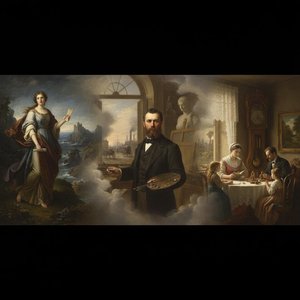
To stand before Jan August Hendrik Leys's "Vow" is to step across the threshold of time and into a sacred, hushed moment. This oil on panel, dating from 1860, does more than merely depict a scene; it captures the very essence of solemn commitment. The composition immediately draws the eye to the central figure—a woman clad in luminous white—whose posture speaks volumes of piety and profound dedication. She is engaged in the intimate ritual of lighting a candle, an act that serves as both a physical action within the painting and a potent metaphor for illumination, faith, or the beginning of a sacred promise.
The Tapestry of Figures and Setting
Leys masterfully populates this devotional tableau with three figures. The central woman, radiating a quiet dignity, is flanked by two children—one standing attentively beside her, another seated gently at her feet. Their presence anchors the narrative in familial devotion, suggesting that the vow being taken is not merely personal but communal, perhaps binding generations together under the watchful gaze of faith. The background architecture, with its suggestion of classical columns and arched recesses, situates this private ceremony within the grandeur of a church or chapel. This juxtaposition—the intensely human drama unfolding against an eternal, monumental backdrop—lends the piece an air of timeless significance.
Technique and Luminous Drama
Examining the technique reveals Leys's skill as both a Romantic visionary and a burgeoning Realist master. The handling of light is nothing short of breathtaking. Notice how the match flame, the source of immediate action, casts warm, flickering highlights that contrast sharply with the deeper shadows pooling in the recesses of the chapel. This dramatic interplay between chiaroscuro not only adds incredible depth to the panel but also directs the viewer's emotional focus squarely onto the act of illumination itself. The texture suggested in the woman’s white garments, alongside the intricate details on the children's clothing, speaks to a meticulous craftsmanship that elevates the genre scene to the level of high art.
Symbolism and Emotional Resonance
The symbolism woven throughout "Vow" is rich for contemplation. The candle, perpetually lit or about to be lit, universally represents knowledge, spiritual awakening, or the enduring nature of a promise. Coupled with the solemnity etched into the figures' faces, the painting invites us to consider what vows we make—to ourselves, to others, or to a higher ideal. It is a meditation on commitment under the glow of fragile hope. For collectors and designers alike, this piece offers more than mere decoration; it provides an emotional anchor, infusing any space with a palpable sense of reverence and enduring grace.
Artist Biography
Jan August Hendrik Leys: A Flemish Visionary Bridging Romanticism and Realism
Jan August Hendrik Leys (18 February 1815 – 26 August 1869) was a Belgian painter and printmaker. He was a leading representative of the historical or Romantic school in Belgian art and became a pioneer of the Realist movement in Belgium. His history and genre paintings and portraits earned him a European-wide reputation and his style was influential on artists in and outside Belgium. Leys was born in Antwerp as the son of Hendrik-Jozef-Martinus Leys and Maria-Theresia Craen. His father ran a printing business specializing in religious images printed from old copper plates. Henry Leys was not very interested in school but was very keen on drawing. His parents supported his proclivity and let him study under a furniture painter who lived next door. He began his artistic training at the Antwerp Academy of Fine Arts, where he studied from the Antique and from 1832 to 1833 he studied drawing from life. During this period, Leys absorbed influences from artists like Eugène Delacroix and Franz Hals, establishing a foundation for his distinctive style. He quickly gained recognition for his ability to capture emotion and atmosphere with remarkable precision. Leys’s artistic career flourished in Bruges, where he established himself as a respected teacher and mentor. He founded the Bruges Drawing School, nurturing young talent and promoting innovative approaches to painting. His students included Henri De Braekeleer and Mattheus Ignatius van Bree, who would later become prominent artists themselves, demonstrating Leys's enduring legacy within Belgian art education. Leys’s oeuvre encompasses a diverse range of subjects—historical narratives, portraits, landscapes, and genre scenes—each imbued with a palpable sense of Romantic idealism tempered by Realist observation. His paintings are characterized by luminous color palettes, meticulous detail, and expressive brushwork that convey both psychological depth and visual splendor. Notable works include “Frans Floris Going to Saint Luke’s Day Feast” (1840) and “The Boschi Di Stefano Museum,” which exemplify his masterful command of technique and artistic vision. Leys's contribution to Belgian art history extends beyond his individual creations; he championed a new aesthetic that prioritized emotional resonance alongside accurate representation—a distinction that foreshadowed the burgeoning Realist movement. His influence can be discerned in the works of subsequent generations of Belgian artists, cementing his place as a pivotal figure in shaping the artistic landscape of 19th-century Europe. He died prematurely in Antwerp at the age of fifty-four, leaving behind an impressive body of work that continues to inspire admiration and scholarly inquiry.Major Influences & Artistic Style
Leys’s artistic style was profoundly shaped by several key influences—primarily Romantic painters like Eugène Delacroix and Franz Hals—and he skillfully blended these inspirations with meticulous Realist observation. He embraced the expressive dynamism of Delacroix's canvases, capturing dramatic moments and conveying intense emotion through vibrant color palettes and sweeping brushstrokes. Simultaneously, Leys drew inspiration from Hals’s masterful portraits, prioritizing anatomical accuracy and psychological insight to portray his subjects with remarkable realism. His technique involved layering thin glazes over textured surfaces—a method he adopted from Flemish masters—to achieve luminous effects and convey subtle nuances of light and shadow. He meticulously studied the human form, rendering figures with anatomical precision while simultaneously capturing their inner life through expressive gestures and facial expressions. Leys’s brushwork was characterized by loose, impasto strokes that created a palpable sense of texture and movement—a stylistic hallmark that distinguished him from more polished academic painters. Leys's artistic vision centered on conveying emotion and atmosphere with unwavering conviction—a principle he articulated as “the painter must strive to express what he sees.” He believed that art should serve as a conduit for capturing the essence of human experience, mirroring both its beauty and its sorrow. This commitment to emotional authenticity permeated his entire oeuvre, informing his compositional choices, color harmonies, and brushstroke techniques.Notable Works & Artistic Achievements
Leys produced an impressive array of paintings—spanning historical narratives, portraits, landscapes, and genre scenes—each demonstrating his exceptional artistic skill and stylistic versatility. Among his most celebrated works are “Frans Floris Going to Saint Luke’s Day Feast” (1840), a monumental depiction of a medieval religious procession that exemplifies his masterful command of color and composition; “The Boschi Di Stefano Museum,” which showcases Leys's meticulous attention to detail and his ability to capture atmospheric light—a technique he honed through extensive studies of Flemish landscapes. Furthermore, Leys’s portraits captured the psychological complexity of his subjects with remarkable sensitivity—revealing their inner thoughts and emotions through subtle gestures and facial expressions. His depictions of individuals from diverse social strata—aristocrats, clergymen, merchants, and artisans—demonstrated his artistic prowess across a broad spectrum of stylistic approaches. Leys's legacy extends beyond his individual creations; he established the Bruges Drawing School, fostering artistic innovation and nurturing young talent—a testament to his dedication as an educator and mentor. His influence can be discerned in the works of subsequent generations of Belgian artists who embraced his pioneering aesthetic—solidifying his place as a pivotal figure in shaping the artistic landscape of 19th-century Europe.Historical Significance & Legacy
Leys’s contribution to Belgian art history transcends mere stylistic innovation; he championed a new aesthetic that prioritized emotional resonance alongside accurate representation—a distinction that foreshadowed the burgeoning Realist movement. His insistence on capturing the essence of human experience—mirroring both its beauty and its sorrow—challenged prevailing artistic conventions and paved the way for more psychologically nuanced depictions of the human condition. Leys’s influence can be discerned in the works of artists who followed him—particularly those associated with the Hague School, which embraced his stylistic principles and championed a similar commitment to atmospheric observation. His legacy continues to inspire admiration and scholarly inquiry—affirming his place as a pivotal figure in shaping the artistic landscape of 19th-century Europe. Leys’s enduring vision—expressed as “the painter must strive to express what he sees”—remains relevant today, urging artists to embrace authenticity and pursue creative exploration with unwavering conviction.
jan august hendrik leys
1815 - 1869 , Belgium
Quick Facts
- Artistic Movement Or Style: Romantic Painting
- Artists Or Movements Influenced By This Artist: ['Hans Memling']
- Artists Who Influenced This Artist: ['Henri De Braekeleer']
- Date Of Birth: February 18, 1815
- Full Name: Jan August Hendrik Leys
- Nationality: Belgian
- Notable Artworks:
- Frans Floris Going to a Saint Luke's Day Feast
- Mattheus Ignatius van Bree
- Place Of Birth: Antwerp, Belgium
Related Articles

The Enduring Legacy of Oil on Canvas: Technique, History & Aesthetic Impact
Explore the rich history & techniques of oil painting – from Renaissance masters to Impressionism. Discover pigments, layering methods, and why this timeless medium endures. Expert insights for artists & art enthusiasts.
Romantic Realism's Finest: 10 Masterpieces for Your Home | OriginalUniqueArt
Explore 10 defining masterpieces of Romantic Realism! Discover Courbet, Millet & Daumier's powerful paintings—capturing emotion and social realities. Find museum-quality reproductions for your home at OriginalUniqueArt.com.

The Enduring Legacy of Oil on Canvas: Technique, History & Contemporary Practice
Explore the rich history & enduring techniques of oil painting on canvas. Discover the science behind its longevity, conservation practices, and contemporary relevance. Expert insights for art enthusiasts.

The Enduring Power of Painting: A Historical & Contemporary Exploration of Form and Emotion
Explore the rich history & enduring techniques of oil painting with OriginalUniqueArt. Discover masterpieces, learn about art collecting, and find authentic handmade reproductions crafted by skilled artists.

Oil on Canvas: A Historical & Technical Exploration of a Timeless Artistic Medium
Explore the rich history & enduring techniques of oil painting on canvas. Discover the science behind its longevity, conservation practices, and contemporary relevance. Expert insights for art enthusiasts.


