Preview
 Send
Send Share
Share
 Details
 Guide
Guide

 Download
 Similars
 X-Ray
X-Ray Diaporama
 Stats
StatsLord Ronald Sutherland Gower


 Read More
Giclée / Art Print
Museum-quality giclée or canvas print with fast production and flexible finish options. ( Buy Hand Made Painting Switch to Digital Image)




P118B $10

P118H $10

P118W $10

P438Z $10

P508JH $12

P508YH $12

P805H $10

P805Z $10

P919BZ $10

P919G $10

P919XJ $10

P959ZH $10

P968JZ $12

W106C $8

W218G $10

W218JH $8

W218Y $10

W307PJ $10

W316G $10

W316PJ $8

W316Y $10

W398PJ $8

W4111J $10

W500HY $15

W500JH $15

W692G $12

W849H $8

W940BG $15

W953PJ $8




Pick from our preset sizes that match the artwork's original proportions.

Type the width and the height you need, to fit your frame or your wall. A print can only be cut, never made bigger than the picture, so a size with a different shape loses a part of the image. We send you a digital mockup to approve before we print anything. The picture shown on this page does not show the real cut — only the mockup does.
Worldwide Delivery () in 2 weeks instead of standard 4/5 weeks. (24 October)

Free Worldwide Express Shipping

High-Quality Linen Canvas

Full Shipping Insurance

Customs Tax Refund Guarantee

True Color Matching Guarantee

100-Day Return Policy (Defects Only)

100% Money-Back Guarantee

Bulk Discount Offer
 Glass option is only available in size under 110 CM

Lord Ronald Sutherland Gower
Giclée / Art Print
Reproduction Size
-


Total Price
$ 81
The Subject and Its Time
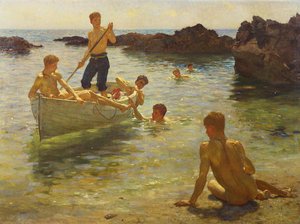
Henry Scott Tuke’s 1897 painting, “Lord Ronald Sutherland Gower,” isn't merely a likeness; it’s a carefully constructed tableau of late Victorian society. The subject himself, Lord Ronald Charles Sutherland-Leveson-Gower, was a figure of considerable standing – a sculptor renowned for his statue of William Shakespeare in Stratford-upon-Avon, and a man deeply embedded within the intellectual and artistic circles of London. Born into a distinguished lineage tracing back to the Earls of Carlisle, Gower’s life intersected with some of the most prominent artists and writers of the era, including Oscar Wilde. The painting captures him not as a flamboyant celebrity, but as a man of quiet authority, radiating an understated sense of dignity and bearing – a reflection of his social position and the expectations placed upon gentlemen of his station.
A Masterclass in Realist Detail
Tuke’s artistic approach is firmly rooted in realism, yet transcends simple representation. He employs a meticulous attention to detail, rendering every facet of Gower's appearance with remarkable precision. The artist skillfully captures the texture of his tailored suit, the subtle lines etched by age and experience on his face, and the carefully arranged poppy pinned to his lapel – a small emblem that subtly hints at remembrance or perhaps even loyalty. The brushwork is deliberately controlled, creating a sense of solidity and depth, while simultaneously conveying a remarkable level of intimacy. Notice how Tuke uses light and shadow to sculpt Gower’s form, imbuing the portrait with a palpable three-dimensionality.
Impressionistic Techniques in a Formal Setting
Despite its adherence to realism, “Lord Ronald Sutherland Gower” reveals subtle influences of Impressionism. Tuke's use of broken color and short brushstrokes creates a shimmering surface that captures the play of light on the subject’s clothing and features. The dark background serves not as mere emptiness but as a carefully considered element, drawing attention to the figure and enhancing its presence. The painting is executed in oil on canvas, a traditional medium that allowed Tuke to build up layers of color and texture with remarkable control. This combination of formal portraiture techniques with Impressionistic touches creates a captivating visual experience – a harmonious blend of tradition and innovation.
Symbolism and Emotional Resonance
Beyond the surface details, “Lord Ronald Sutherland Gower” is rich in symbolic meaning. The poppy, as mentioned earlier, carries connotations of remembrance and loyalty, potentially alluding to Gower’s service within Parliament or his connections to various noble families. The subject's stern expression – a hallmark of Victorian portraiture – suggests a man of seriousness and responsibility. Yet, there is also an underlying sense of melancholy in his gaze, hinting at the complexities and burdens of a life lived within the constraints of social expectations. The painting evokes a feeling of quiet contemplation, inviting viewers to consider not only Gower’s individual character but also the broader context of Victorian society – its values, its anxieties, and its aspirations.
A Legacy in Reproduction
Today, “Lord Ronald Sutherland Gower” stands as a testament to Henry Scott Tuke's artistic skill and his ability to capture the essence of his subjects. High-quality reproductions offer an accessible way to appreciate this remarkable portrait, bringing its beauty and historical significance into any home or gallery space. Consider commissioning a hand-painted reproduction from OriginalUniqueArt.com – a faithful recreation that preserves the painting’s original charm and detail, allowing you to experience the artistry of Tuke's vision firsthand.
Questions & Answers
How light is "Lord Ronald Sutherland Gower" overall?
Overall, "Lord Ronald Sutherland Gower" is recorded as deep_shadow. Perceived brightness describes how light or dark the work appears.
What aliases or alternate names does Henry Scott Tuke have?
Other names recorded for Henry Scott Tuke, creator of "Lord Ronald Sutherland Gower", include H.S. Tuke.
What placement suits the format of "Lord Ronald Sutherland Gower" by Henry Scott Tuke?
The portrait format of "Lord Ronald Sutherland Gower" by Henry Scott Tuke is recommended for a living room. Format and space together guide the placement of a reproduction.
Artist Biography
**early life and education**
henry scott tuke, a prominent english visual artist, was born on june 12, 1858, in lawrence street, york, into a quaker family. his father, daniel hack tuke, was a well-known medical doctor specializing in psychiatry. tuke's early life was marked by a strong inclination towards art, encouraged by his family.**artistic career**
tuke's artistic journey began with enrollment in the slade school of art under alphonse legros and sir edward poynter in 1875. he later won a scholarship that allowed him to continue his training at the slade and in italy in 1880. his time in paris from 1881 to 1883, where he met jules bastien-lepage, influenced his decision to paint en plein air.- henry scott tuke's most notable work was in the impressionist style.
- he is best known for his paintings of nude boys and young men, a subject matter that was both personal and professionally significant.
- tuke's prolific career resulted in over 1,300 works, including oil paintings of young men, maritime scenes, and portraits of sailing ships.
**notable works and legacy**
some of tuke's most notable works include:- the boy’s dream, a poignant example of his impressionist style.
- august, blue, showcasing his skill in capturing the essence of youth and nature.
- sailing ships at newlyn, highlighting his maritime artistry.
**later life and death**
tuke suffered a heart attack in 1928 and passed away on march 13, 1929. despite knowing that his work was no longer fashionable towards the end of his life, tuke's generosity to his models, many of whom were young men, speaks volumes about his character.- view more works by henry scott tuke at https://OriginalUniqueArt.com/@/henryscotttuke
- explore the impressionist movement and its notable artists at /en/art/list/
- discover more about tuke's life and art on wikipedia

Henry Scott Tuke
1858 - 1929 , United Kingdom
Quick Facts
- Full Name: Henry Scott Tuke
- Nationality: British
- Date Of Birth: 1858
- Date Of Death: 1929
- Place Of Birth: York, United Kingdom
- Notable Artworks:
- The Boy’s Dream
- August
- Sailing Ships at Newlyn
- Artistic Movement Or Style: Impressionism
- Artists Who Influenced This Artist:
- Alphonse Legros
- Sir Edward Poynter
- Artists Or Movements Influenced By This Artist: ['Newlyn School']
Related Articles
Henry Scott Tuke: Sunlit Masculinity & the Pastoral Ideal in Victorian Painting
Explore the captivating world of Henry Scott Tuke's paintings – a master of British Impressionism renowned for his intimate depictions of youth and sunlit maritime scenes. Discover his legacy & aesthetic influence.
The Refined Aesthetic of Victorian Illustration: A Study in Narrative & Technique
Explore the captivating world of Victorian illustration! Discover Pre-Raphaelite influences, key artists like Rossetti & Stephens, and the era's rich narrative detail. A deep dive for art enthusiasts.

Henry William Pickersgill: Narrative, Reform & the Victorian Domestic Interior
Explore the life & work of Henry William Pickersgill, a leading Victorian portrait artist. Discover his narrative style, realistic depictions of society, and lasting influence on British art history. Fine art reproductions available at OriginalUniqueArt.
Henry Thomas Dawson: Navigating Light, Sea & Sentiment in Victorian Marine Painting
Explore the captivating world of Henry Thomas Dawson (1811-1878), a master of Victorian marine painting. Discover his evocative coastal scenes, landscapes & lasting artistic legacy. Learn about collecting Dawson's work and find reproductions at OriginalUniqueArt.

Henri Matisse's Masterpieces: Explore 25 Iconic Paintings & Art Decor Ideas
Journey through Henri Matisse's 25 most iconic paintings! Explore Fauvism, vibrant colors & the stories behind masterpieces like 'The Dance'. Find museum-quality art reproductions and curated decor ideas to elevate your space. Discover all masterpieces on OriginalUniqueArt.com.