Preview
 Send
Send Share
Share
 Details
 Guide
Guide

 Download
 Similars
 X-Ray
X-Ray Diaporama
 Stats
StatsGoats


 Read More
Hand Made Oil Reproduction
Hand-painted oil on canvas in your size and frame, made to order by our artists. ( Switch to Print Switch to Digital Image)




P118B $10

P118H $10

P118W $10

P438Z $10

P508JH $12

P508YH $12

P805H $10

P805Z $10

P919BZ $10

P919G $10

P919XJ $10

P959ZH $10

P968JZ $12

W106C $8

W218G $10

W218JH $8

W218Y $10

W307PJ $10

W316G $10

W316PJ $8

W316Y $10

W398PJ $8

W4111J $10

W500HY $15

W500JH $15

W692G $12

W849H $8

W940BG $15

W953PJ $8




Pick from our preset sizes that match the artwork's original proportions.

Type the width and the height you need, to fit your frame or your wall. This is hand-painted, so for a size with a different shape the artist can paint a bit more around the picture, or cut a bit — you choose. We send you a digital mockup to approve before the painting starts. The picture shown on this page does not show the real result — only the mockup does.
After order, OriginalUniqueArt.com team will email client for instructions and provide a mockup preview
Worldwide Delivery () in 3/4 weeks instead of standard 5 weeks. (26 October). No compromise on quality.

Free Worldwide Express Shipping

High-Quality Linen Canvas

Full Shipping Insurance

Customs Tax Refund Guarantee

True Color Matching Guarantee

100-Day Return Policy (Defects Only)

100% Money-Back Guarantee

Bulk Discount Offer
 Glass option is only available in size under 110 CM

Goats
Reproduction Medium
Reproduction Size
-


Total Price
$ 300
A Symphony of Light and Rural Tranquility: Henri Edmond Cross’s “Goats”
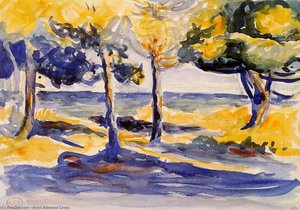
Henri Edmond Cross's "Goats," painted in 1895, is more than just a depiction of livestock; it’s an immersive experience of light, color, and the serene beauty of rural life. This captivating work, currently residing at the Musee du Petit Palais in Geneva, exemplifies the artist’s profound engagement with Post-Impressionism and his relentless pursuit of capturing the ephemeral qualities of nature. Cross, born Henri-Edmond-Joseph Delacroix in Douai, France, was a pivotal figure in the Neo-Impressionist movement, a group dedicated to exploring the scientific theories of color – particularly those championed by Michel Eugène Chevreul – to achieve unprecedented vibrancy and luminosity within their paintings. “Goats” stands as a testament to this dedication, showcasing his masterful manipulation of pigment and brushstroke to evoke a palpable sense of atmosphere.
- Subject Matter: The painting centers around a peaceful scene of goats grazing in a lush green pasture under a brilliant blue sky. Their white coats provide a striking contrast against the vibrant hues surrounding them, drawing the viewer’s eye and anchoring the composition.
- Style & Technique: Cross employs the techniques of Neo-Impressionism, utilizing small, distinct brushstrokes – known as “pointillé” – to build up color and create an optical mixing effect. This method allows the colors to vibrate and shimmer when viewed from a distance, intensifying the sense of light and atmosphere.
- Medium: Executed in chalk, a relatively uncommon medium for landscape painting at the time, adds a unique textural quality to the work. The chalk’s granular surface captures and reflects light differently than traditional oil paints, contributing to the painting's luminous effect.
Decoding the Palette: Color as Philosophy
Cross’s use of color is central to understanding “Goats.” He meticulously applied shades of blue, purple, and green, not merely for representational accuracy but as a deliberate philosophical statement. Inspired by Chevreul's theories on simultaneous contrast, Cross aimed to create an optical illusion – the colors appear brighter and more intense when viewed together than they would if seen individually. The twisted branches of the large tree in the background, painted in complementary blues and purples, further amplify this effect, creating a dynamic interplay of color that draws the eye across the canvas. This wasn’t simply about painting what he *saw*; it was about painting how he *felt* – a deep appreciation for the transformative power of light and color.
Historical Context & Symbolism
"Goats" was created during a period of significant artistic experimentation in France, marked by the rise of Neo-Impressionism and its challenge to traditional academic styles. The painting reflects the broader cultural shift towards valuing subjective experience and embracing new scientific discoveries about color. While seemingly straightforward in its subject matter – a rural scene – “Goats” can be interpreted as a meditation on themes of innocence, tranquility, and the harmony between humanity and nature. The goats themselves, symbols of pastoral life and fertility, evoke a sense of timelessness and connection to the earth.
Emotional Impact & Artistic Legacy
The enduring appeal of “Goats” lies in its ability to transport the viewer to a place of quiet contemplation. Cross’s masterful use of light and color creates an atmosphere of profound serenity, inviting us to pause and appreciate the simple beauty of the natural world. As a key work within Cross's oeuvre, "Goats" offers a valuable insight into the artist's artistic journey and his contribution to the development of modern art. A hand-painted reproduction allows one to experience this captivating artwork in its entirety, bringing its luminous qualities and evocative atmosphere directly into your space.
Questions & Answers
What are the medium and date of "Goats" by Henri Edmond Cross?
The medium of "Goats" by Henri Edmond Cross is acrylic, and the work is dated 1895.
Are the colors of "Goats" by Henri Edmond Cross vivid or muted?
The color of "Goats" is balanced soft in saturation and balanced in intensity.
What is "Goats" made with, and in which style?
"Goats" is made in acrylic, in the Post-Impressionist Neo-Impressionism style.
Artist Biography
A Life Bathed in Light: The Journey of Henri Edmond Cross
Henri Edmond Cross, born Henri-Edmond-Joseph Delacroix in 1856 in the northern French town of Douai, was an artist whose life and work were inextricably linked to a pursuit of light, color, and a harmonious vision of existence. His story is one of artistic evolution, driven by both personal circumstance and a fervent embrace of avant-garde ideals. The son of an adventurous father and a British mother, Cross’s early years saw a relocation to Lille, where his budding talent was recognized and nurtured by Dr. Auguste Soins, a patron who provided crucial financial support for lessons with the esteemed Carolus-Duran. This foundational training instilled in him a respect for classical technique—a grounding that would later be brilliantly subverted as he ventured into the revolutionary world of Neo-Impressionism. Even early on, a desire to forge his own artistic identity led him to adopt “Cross” as part of his name, and eventually fully transition to "Henri-Edmond Cross" in 1886, distancing himself from both the celebrated Eugène Delacroix and another contemporary artist sharing the same surname. This act was symbolic of a larger ambition: to define a unique artistic voice amidst a rapidly changing art world.From Realism to Radiant Divisionism
Cross’s initial artistic explorations leaned towards the Realist tradition, manifesting in portraits and still lifes that demonstrated technical skill but lacked a distinctive spark. However, the Parisian art scene of the 1880s was abuzz with new ideas, and Cross found himself increasingly drawn to the revolutionary principles of Neo-Impressionism—a movement spearheaded by Georges Seurat and Paul Signac. This encounter proved transformative. The scientific approach to color theory, the meticulous application of tiny, distinct brushstrokes (or “points”) designed to create optical mixing, resonated deeply with his artistic sensibilities. Simultaneously, recurring bouts of rheumatism led him to seek solace in the warmer climate of southern France, beginning in 1883 and culminating in a permanent settlement in Saint-Clair in 1891. The radiant light and vibrant landscapes of this region became integral to his artistic vision. He didn’t simply replicate Seurat's pointillism; instead, he evolved it, favoring larger, more mosaic-like brushstrokes that retained the luminosity of divided color while allowing for greater expressive freedom. This “second generation” Neo-Impressionism was characterized by its bold chromatic intensity and dynamic compositions—a style that would become his signature.Anarchist Ideals and Utopian Visions
Beyond technical innovation, Cross’s work was deeply informed by a strong sense of social and political idealism—specifically, anarchist beliefs. This conviction wasn't overtly propagandistic; rather, it manifested in his depictions of idyllic rural scenes, portraying harmonious coexistence between humanity and nature as an alternative to the perceived corruption and alienation of modern urban life. His paintings weren’t merely aesthetic exercises but visual statements advocating for a more equitable and peaceful world. The influence of this ideology is subtly woven into the fabric of his compositions, imbuing them with a sense of utopian longing. Works like *Before the Storm* and *The Farm, Evening* are not simply representations of nature; they are allegories for a just society—the vibrant colors and dynamic brushwork evoking energy and optimism, suggesting transformation and renewal. He sought to capture a world where humanity lived in balance with its surroundings, free from the constraints of industrialization and social hierarchy.Legacy and Influence on Modern Art
Henri-Edmond Cross’s artistic journey culminated in a significant body of work that profoundly impacted the course of modern art. His first individual exhibition at the Galerie Druet in 1905, followed by a retrospective organized by Félix Fénéon at the Galerie Bernheim-Jeune in 1908, cemented his reputation as a leading figure in Neo-Impressionism. However, his influence extended far beyond this movement. His bold use of non-local color—applying colors not according to their natural appearance but for expressive effect—and his willingness to distort forms paved the way for the radical experimentation of Fauvism. Artists like Henri Matisse and André Derain were deeply inspired by Cross’s work, recognizing in it a liberation from traditional constraints and a pathway towards greater artistic freedom. He demonstrated that color could be used not merely to represent reality but to evoke emotion and create a purely visual experience. He died of cancer in Saint-Clair in 1910, leaving behind a legacy that continues to resonate with artists and art lovers today. His paintings remain powerful testaments to the transformative potential of color, light, and form—and to the enduring power of art as a vehicle for social and political expression.Key Works & Continuing Relevance
Several works stand out as particularly representative of Cross’s artistic vision:- Before the Storm (aka The Storm): A quintessential example of his Neo-Impressionist landscapes, capturing dramatic skies and hinting at underlying anarchist themes.
- The Washerwoman: Showcases his mastery of Pointillism and divisionism, depicting a scene of everyday life with vibrant color and dynamic composition.
- The Farm, Evening: A serene depiction of rural life, embodying his utopian vision of harmonious coexistence between humanity and nature.

Henri Edmond Cross
1856 - 1910 , France
Quick Facts
- Artistic Movement Or Style: Neo-Impressionism
- Artists Or Movements Influenced By This Artist:
- Henri Matisse
- Fauvism
- Artists Who Influenced This Artist:
- Georges Seurat
- Paul Signac
- Date Of Birth: 1856
- Date Of Death: 1910
- Full Name: Henri Edmond Cross
- Nationality: French
- Notable Artworks:
- Before the Storm
- The Washerwoman
- The Farm, Evening
- Place Of Birth: Douai, France
Related Articles
Henri Matisse's Masterpieces: Explore 25 Iconic Paintings & Art Decor Ideas
Journey through Henri Matisse's 25 most iconic paintings! Explore Fauvism, vibrant colors & the stories behind masterpieces like 'The Dance'. Find museum-quality art reproductions and curated decor ideas to elevate your space. Discover all masterpieces on OriginalUniqueArt.com.
Beyond Impressionism: Exploring the Emotional Depth of Post-Impressionist Painting
Explore the profound emotional depth & innovative techniques of Post-Impressionism with OriginalUniqueArt. Discover Cézanne, Van Gogh, Gauguin & more – and their lasting impact on modern art.
Post-Impressionism's 10 Defining Masterpieces: Art for Your Home |
Journey through Post-Impressionism's 10 defining masterpieces – Van Gogh, Monet & more. Explore iconic paintings, art history & find museum-quality reproductions for your home at . Discover all masterpieces online!

Henri Edmond Cross: A Pioneer of Neo-Impressionism & the Divisionist Aesthetic
Explore the life & art of Henri Edmond Cross, a pivotal Neo-Impressionist painter. Discover his innovative divisionist technique, political affiliations, and lasting influence on modern art movements like Fauvism. Learn about key works & legacy.

Beyond Light & Color: Impressionism vs. Post-Impressionism for the Discerning Collector
Explore the nuances of Impressionism & Post-Impressionism with . Expert insights for collectors on style, investment, and acquiring museum-quality reproductions.