Preview
 Send
Send Share
Share
 Details
 Guide
Guide

 Download
 Similars
 X-Ray
X-Ray Diaporama
 Stats
StatsHonorable Mr. Cat
 Acrylic On Canvas
- WallArt
- Japonism
 1903
1903 21.0 x 9.0 cm
 Smithsonian American Art Museum
 Read More
Hand Made Oil Reproduction
Hand-painted oil on canvas in your size and frame, made to order by our artists. ( Switch to Print Switch to Digital Image)




P118B $10

P118H $10

P118W $10

P438Z $10

P508JH $12

P508YH $12

P805H $10

P805Z $10

P919BZ $10

P919G $10

P919XJ $10

P959ZH $10

P968JZ $12

W106C $8

W218G $10

W218JH $8

W218Y $10

W307PJ $10

W316G $10

W316PJ $8

W316Y $10

W398PJ $8

W4111J $10

W500HY $15

W500JH $15

W692G $12

W849H $8

W940BG $15

W953PJ $8




Pick from our preset sizes that match the artwork's original proportions.

Type the width and the height you need, to fit your frame or your wall. This is hand-painted, so for a size with a different shape the artist can paint a bit more around the picture, or cut a bit — you choose. We send you a digital mockup to approve before the painting starts. The picture shown on this page does not show the real result — only the mockup does.
After order, OriginalUniqueArt.com team will email client for instructions and provide a mockup preview
Worldwide Delivery () in 3/4 weeks instead of standard 5 weeks. (28 October). No compromise on quality.

Free Worldwide Express Shipping

High-Quality Linen Canvas

Full Shipping Insurance

Customs Tax Refund Guarantee

True Color Matching Guarantee

100-Day Return Policy (Defects Only)

100% Money-Back Guarantee

Bulk Discount Offer
 Glass option is only available in size under 110 CM

Honorable Mr. Cat
Reproduction Medium
Reproduction Size
-


Total Price
$ 300
A Moment Frozen in Time: Helen Hyde’s “Honorable Mr. Cat”
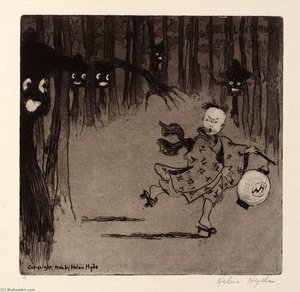
Helen Hyde's "Honorable Mr. Cat," painted in 1903, isn’t merely a charming depiction of a feline; it’s a poignant window into the burgeoning Japonism movement and a subtle commentary on Victorian social dynamics. This color woodcut, rendered with exquisite detail on paper, captures a fleeting moment of quiet observation – a gentleman cat, impeccably dressed in a miniature suit and tie, pausing his pursuits to regard the viewer with an air of dignified curiosity. Hyde’s masterful use of line and shading imbues the scene with a remarkable sense of depth and texture, transforming what could have been a simple illustration into a richly layered work of art.
The piece belongs firmly within the late 19th and early 20th-century aesthetic landscape, a period profoundly influenced by European artistic trends, particularly those emanating from France and Japan. Hyde’s journey to Europe – specifically Berlin and Paris – was pivotal in shaping her style. She studied under renowned instructors like Franz Skarbina, Raphael Collin, and Félix Régamey, absorbing the techniques of etching and printmaking while simultaneously encountering the captivating aesthetics of Japonism. This movement, which celebrated Japanese art forms—woodblock prints, ink painting, and decorative arts—introduced a new emphasis on asymmetry, flattened perspective, and a focus on naturalistic detail, all of which are subtly reflected in “Honorable Mr. Cat.” The influence of Régamey’s extensive collection of Japanese art is particularly evident in the composition's delicate balance and the subject’s serene demeanor.
The Language of Symbolism
Beyond its technical brilliance, "Honorable Mr. Cat" resonates with layers of symbolic meaning. The cat itself, a recurring motif in Victorian art and literature, often represented domesticity, grace, and even a touch of mischievousness. Here, however, Hyde presents the feline as something more refined – an “honorable” gentleman, suggesting a quiet dignity and perhaps a subtle critique of the rigid social conventions of the era. The miniature suit and tie are not simply decorative; they’re a visual shorthand for societal expectations and the constraints placed upon men during that time. The cat's pose—a deliberate pause, a direct gaze—invites the viewer to contemplate his thoughts, prompting us to question what he might be observing or considering.
Furthermore, the setting – a simple street scene with a fence in the background – is deliberately understated. It’s not a grand vista or an elaborate composition; rather, it focuses our attention entirely on the central figure. This minimalist approach reinforces the painting's contemplative mood and elevates the cat to a position of importance. The subtle use of color—primarily muted browns, grays, and blues—contributes to the overall sense of quietness and formality.
Technique and Artistic Process
Hyde’s skill as an etcher is immediately apparent in the intricate detail of “Honorable Mr. Cat.” She employed a complex color woodcut technique, meticulously carving into blocks of linoleum or wood to create varying shades and tones. This process demanded immense patience and precision, resulting in a remarkably nuanced image. The subtle gradations of tone—achieved through careful manipulation of line weight and pressure—give the cat’s fur a tangible quality, while the background elements are rendered with a delicate sense of atmosphere. Her work demonstrates a mastery of light and shadow, creating a three-dimensional effect that draws the viewer into the scene.
The painting's small size (21 x 9 cm) further emphasizes its intimacy and immediacy. It’s a piece designed to be savored—a quiet moment captured on paper. Hyde’s dedication to capturing subtle details and her ability to imbue a simple subject with such profound emotion are hallmarks of her distinctive artistic style.
A Legacy of Quiet Elegance
"Honorable Mr. Cat" stands as a testament to Helen Hyde's remarkable talent and her unique vision. It’s a work that transcends its humble size and unassuming subject matter, offering viewers a glimpse into a bygone era and inviting them to contemplate the complexities of human nature. Reproductions of this captivating artwork offer an opportunity to bring this moment of quiet elegance into any space, serving as a reminder of the beauty found in simplicity and the power of observation.
Questions & Answers
Which artist is "Honorable Mr. Cat" attributed to?
The artist behind "Honorable Mr. Cat" is Helen Hyde. The work is catalogued under Helen Hyde's name.
For what occasion is "Honorable Mr. Cat" by Helen Hyde suggested as a present?
"Honorable Mr. Cat" by Helen Hyde is recommended as a gift for birthday. A reproduction of the artwork can be given as a present.
How light is "Honorable Mr. Cat" overall?
The perceived brightness of "Honorable Mr. Cat" by Helen Hyde is brilliant. It can be matched to the light of the intended space.
Artist Biography
Early Life and Education
- Born: Lima, New York (April 6, 1868)
- Died: Pasadena, California (May 13, 1919)
- Helen Hyde's artistic journey began early. She received initial instruction from Ferdinand Richardt at the age of twelve.
- Her family moved to San Francisco, where she continued her education at the California School of Design.
- Further studies took her to Europe, including Berlin and Paris, where she studied with Franz Skarbina, Raphael Collin, and Félix Régamey.
- Régamey's extensive Japanese art collection significantly influenced Hyde’s artistic direction, introducing her to Japonism.
Artistic Development and Influences
- Upon returning to California, Hyde experimented with color etching and began depicting scenes of San Francisco's Chinatown.
- A pivotal moment was her 1899 journey to Japan, where she immersed herself in Japanese culture and artistic techniques.
- She studied traditional ink painting with Kano Tomonobu and learned woodblock printing from Emil Carlsen.
- Key Influences: Japonism, Mary Cassatt's prints, and the traditional Japanese art forms she encountered during her time in Japan.
- Her style blended Western artistic training with Japanese aesthetics, creating a unique visual language.
Major Works and Techniques
- Notable Works: "A Monarch of Japan" (1901), "Baby Talk" (1909), "Sausalito," "Footbridge," and "Her Bit."
- Techniques: Hyde was primarily known for her color etching and woodblock prints. She employed a divided labor system in Japan, utilizing Japanese carvers and printers.
- “A Monarch of Japan” earned first place at the Nihon Kaiga Kyokai exhibition in 1901.
- "Baby Talk" received a gold medal at the Alaska–Yukon–Pacific Exposition in 1909.
- Her prints often depicted Japanese women and children, reflecting her fascination with their daily lives and cultural traditions.
Achievements and Recognition
- Exhibitions: Hyde’s work was exhibited widely both nationally and internationally.
- Awards: She received numerous awards for her prints, including medals at the Alaska–Yukon–Pacific Exposition and the Panama-Pacific International Exposition.
- Collections: Her works are held in prestigious collections such as the Brooklyn Museum, the Art Institute of Chicago, the Library of Congress, and the Smithsonian American Art Museum.
- Membership: She was a member of several art societies, including the Chicago Society of Etchers and the Printmakers Society of California.
Historical Significance
- Helen Hyde played a significant role in bridging Western and Japanese artistic traditions.
- Her innovative use of color etching and woodblock printing techniques contributed to the development of American printmaking.
- She is recognized as one of the foremost American artists working within the Japonism movement.
- Hyde's depictions of Japanese life offer valuable insights into a period of cultural exchange and artistic innovation.
- Her legacy continues to inspire contemporary artists and collectors alike, with her works remaining highly sought after.

Helen Hyde
1868 - 1919 , United States of America
Quick Facts
- Full Name: Helen Hyde
- Nationality: American
- Date Of Birth: 1868
- Date Of Death: 1919
- Place Of Birth: Lima, United States of America
- Notable Artworks:
- A Monarch of Japan
- Baby Talk
- Sausalito
- Footbridge
- Her Bit
- Artistic Movement Or Style: Color etching, Woodblock prints
- Artists Who Influenced This Artist:
- Franz Skarbina
- Raphael Collin
- Félix Régamey
- Emil Carlsen
- Kano Tomonobu
Related Articles

Helen Hyde: Narrative & Symbolism in Contemporary Botanical Illustration
Explore the captivating world of Helen Hyde (1868-1919), a pioneering American artist renowned for her exquisite Japanese woodblock prints and evocative botanical illustrations. Discover her legacy & symbolism.

Hablot Knight Browne: Phiz & the Victorian Social Canvas – A Critical Legacy
Explore the life & art of Hablot Knight Browne ('Phiz'), Dickens's iconic illustrator. Discover his masterful social commentary, technical innovations, and enduring legacy in Victorian illustration. A critical examination for history lovers.
Victorian Illustration: The Golden Age of Narrative Art and Intricate Detail
Explore the exquisite world of Victorian Illustration. Discover the masters of the Golden Age, from Arthur Rackham to Edmund Dulac, through an in-depth historical journey into the era's unparalleled detail and narrative artistry.

Angelo Chiacchio: A Mid-Century American Illustration Master & the Rise of Commercial Art
Explore the captivating world of Angelo Chiacchio, a master of mid-century American illustration. Discover his evolution, signature style, and lasting impact on commercial art & design. Learn about his legacy at the Museum of American Illustration.

The Refined Aesthetic of Victorian Illustration: A Study in Narrative & Technique
Explore the captivating world of Victorian illustration! Discover Pre-Raphaelite influences, key artists like Rossetti & Stephens, and the era's rich narrative detail. A deep dive for art enthusiasts.