Early Life & Apprenticeship: The Foundations of a Victorian Illustrator
Hablot Knight Browne, forever known as ‘Phiz’ to the reading public, emerged from a surprisingly complex familial background for an artist so intimately associated with the moral clarity of Charles Dickens. Born in Lambeth on July 10th, 1815 – though dates vary slightly across historical records – he was the fourteenth child of Catherine and William Loder Browne. However, a recent biographical investigation by Valerie Browne Lester, a direct descendant, suggests a more nuanced origin story: Phiz may have been the illegitimate son of his eldest sister, Kate, and Captain Nicholas Hablot of Napoleon’s Imperial Guard. This early ambiguity perhaps instilled in him a keen observational eye for societal facades, a quality that would later define his artistic prowess.
The Browne family experienced financial hardship following William’s abandonment when Hablot was just seven years old, leaving Catherine to manage a large household with limited resources. Young Hablot's path led him to an apprenticeship under the engraver William Finden in 1832. While this provided foundational technical skills, it quickly became apparent that Browne possessed a temperament ill-suited for the meticulous precision of engraving. He yearned for more expressive forms, finding early recognition with a prize from the Society of Arts in 1833 for his drawing of John Gilpin’s Ride – a testament to his burgeoning talent for capturing movement and character, particularly horses, which would remain a recurring motif throughout his career.
The Rise of 'Phiz': Collaboration with Dickens and Defining a Style
 Wikipedia: Hablot Knight Browne
Hablot Knight Browne (10 July 1815 – 8 July 1882) was a British artist and illustrator. Well known by his pen name, Phiz, he illustrated books by Charles Dickens, Charles Lever, Augustus Septimus Mayhew and Harrison Ainsworth. == Early life == Of F...
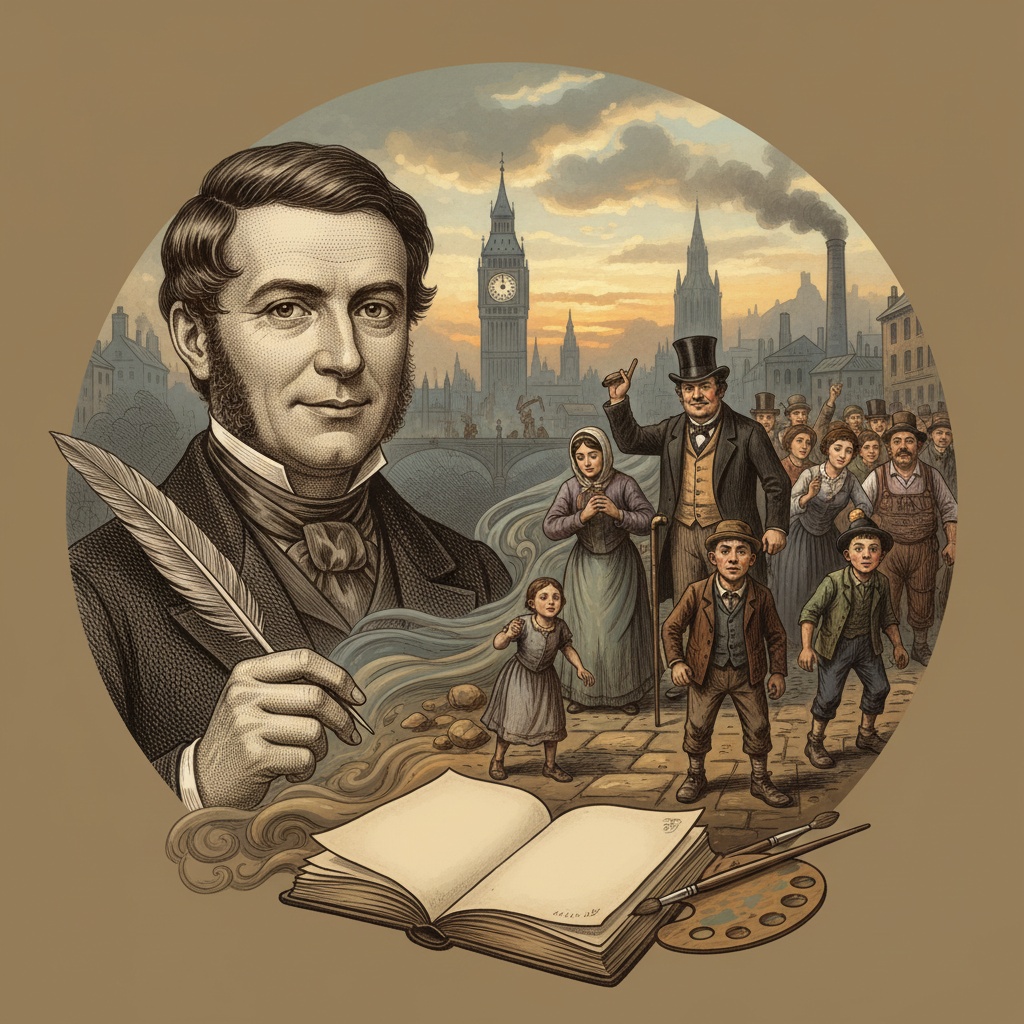
The pivotal moment in Browne's artistic trajectory arrived in 1836 with his introduction to Charles Dickens. Dickens, already gaining prominence with *Sketches by Boz*, sought an illustrator for his new venture, a comic series reminiscent of Pierce Egan’s *Life in London*. Initially commissioned for the pamphlet *Sunday under Three Heads*, this encounter sparked a collaboration that would reshape Victorian illustration and cement Phiz's reputation. The original illustrations for *The Pickwick Papers* were begun by Robert Seymour, but his untimely suicide led to a period of uncertainty before Dickens recognized Browne’s potential.
Browne initially adopted the pseudonym “N.E.M.O.” – Latin for ‘Nobody’ – a playful nod to Ulysses's deceptive self-introduction in Homer’s *Odyssey*. However, he soon transitioned to "Phiz," a moniker Dickens felt harmonized better with his own pen name, 'Boz'. This marked not just a change of signature but the birth of an artistic identity perfectly suited for capturing the effervescent humor and vibrant characters that populated Dickens's novels. Phiz’s early plates demonstrated a remarkable ability to translate Dickens’s prose into compelling visual narratives, quickly establishing him as the preeminent illustrator of the era.
Capturing Victorian Society: Phiz’s Social Commentary Through Illustration
 Nicholas Nickleby
Explore Hablot Knight Browne’s satirical illustration of ‘Theatrical Emotion,’ a dynamic 18th-century scene from Dickens' Nicholas Nickleby. A captivating engraving, rich in detail & humor.
Phiz wasn’t merely an interpreter of Dickens's stories; he was a keen observer and commentator on Victorian society itself. His illustrations transcended simple depiction, offering subtle yet powerful critiques of class disparities, poverty, and the hypocrisy prevalent in 19th-century England. Characters like Sam Weller from *The Pickwick Papers* weren’t just comedic figures; they embodied a particular social type, reflecting the energy and resilience of the working classes. Similarly, his portrayals of characters within *Nicholas Nickleby*, such as Squeers, the cruel schoolmaster, exposed the dark underbelly of educational institutions.
The artist’s skill lay in his ability to blend humor with pathos, creating images that were both entertaining and thought-provoking. He masterfully depicted bustling street scenes, crowded interiors, and the nuances of human interaction, providing a visual record of Victorian life rarely found elsewhere. His work wasn't overtly political, but it subtly challenged societal norms and fostered empathy for those marginalized by the rigid social structures of the time.
Technical Mastery & Innovation: Etching, Wood-Engraving, and the ‘Dark Plate’ Technique
Phiz’s artistic success stemmed not only from his narrative skill but also from his technical proficiency. He primarily worked with steel engraving, a process that allowed for larger editions than copper etching, crucial given the immense popularity of Dickens's novels. However, he wasn’t content to simply replicate existing techniques. He experimented constantly, pushing the boundaries of what was possible within the constraints of Victorian printmaking.
A particularly innovative technique Phiz developed later in his career involved “dark plates.” For *Bleak House* and *Little Dorrit*, he utilized a ruling-machine to create richly textured backgrounds, adding depth and atmosphere to his illustrations. This method, while laborious, resulted in images of remarkable tonal complexity and visual impact. His mastery of both etching and wood engraving allowed him to adapt his style to suit the specific needs of each project, ensuring that every illustration perfectly complemented Dickens’s text.
Beyond Dickens: Browne's Diverse Portfolio and Lasting Influence
While inextricably linked with Charles Dickens, it is crucial to recognize the breadth of Hablot Knight Browne’s artistic output. He illustrated over twenty novels by Charles Lever, including *The Confessions of Harry Lorrequer* and *Charles O’Malley*, showcasing his talent for depicting Irish life and military adventures. He also collaborated with Harrison Ainsworth on works like *Old St. Paul's* and Frank Smedley, demonstrating a versatility that extended beyond the confines of Dickensian London.
Towards the end of his career, Phiz contributed to periodicals such as *Punch*, offering satirical commentary on contemporary events. Despite suffering from paralysis in 1867, he continued to work, focusing primarily on woodcuts. He was granted an annuity by the Royal Academy in 1878, a testament to his enduring contribution to British art. His illustrations weren’t simply accompaniments to novels; they were independent works of art that captured the spirit of the Victorian age.
Phiz’s Enduring Legacy: A Critical Examination of His Artistic Impact
Hablot Knight Browne, or Phiz as he was universally known, left an indelible mark on Victorian illustration and continues to captivate audiences today. His ability to translate complex narratives into compelling visual form, coupled with his keen social observation and technical mastery, established him as the preeminent illustrator of his time. He didn’t just *illustrate* Dickens; he helped define how Dickens was *read*. His characters became instantly recognizable through Phiz's depictions, shaping public perception of Victorian England.
His legacy extends beyond the realm of book illustration. Phiz’s work provides invaluable insights into the social dynamics, cultural norms, and everyday life of 19th-century Britain. He remains a vital figure for scholars studying Victorian art, literature, and history. At OriginalUniqueArt.com, we celebrate Phiz's enduring artistry by offering high-quality reproductions of his iconic illustrations, allowing you to experience the magic of Dickens’s world through the eyes of its most celebrated visual interpreter. Explore our collection today and discover the captivating power of Phiz’s artistic vision.