Send
Send Share
Share
 Details
 Guide
Guide

 Download
 Similars
 Diaporama
 Stats
StatsContact Sheet B1,
 Black and White Photography
- Photo
- Documentary Realism
 1948
1948- Modern
 21.0 x 27.0 cm
 The Gordon Parks Foundation
 Read More
The artwork displayed on this page is protected by copyright law, which means we cannot legally create or sell an identical reproduction. This protection is enforced under international agreements such as the Berne Convention and by national laws, including those outlined by the U.S. Copyright Law - Title 17.
As a respectful and legal alternative, we offer custom, hand-painted artworks inspired by the original. Our skilled and professional artists carefully study the original's style, mood, and artistic essence to create a new, unique piece that evokes the same feeling - while remaining an original creation in its own right.
This method fully complies with copyright regulations because it does not involve copying or duplicating the protected artwork. Instead, it is a creative reinterpretation - a new painting that is influenced by the original but not identical to it.
Hand Made Oil Reproduction
Hand-painted oil on canvas in your size and frame, made to order by our artists. ( Switch to Print Switch to Digital Image)




































Pick from our preset sizes that match the artwork's original proportions.

Type the width and the height you need, to fit your frame or your wall. This is hand-painted, so for a size with a different shape the artist can paint a bit more around the picture, or cut a bit — you choose. We send you a digital mockup to approve before the painting starts. The picture shown on this page does not show the real result — only the mockup does.
After order, OriginalUniqueArt.com team will email client for instructions and provide a mockup preview
Worldwide Delivery () in 3/4 weeks instead of standard 5 weeks. (21 October). No compromise on quality.

Free Worldwide Express Shipping

High-Quality Linen Canvas

Full Shipping Insurance

Customs Tax Refund Guarantee

True Color Matching Guarantee

100-Day Return Policy (Defects Only)

100% Money-Back Guarantee

Bulk Discount Offer
 Glass option is only available in size under 110 CM

Contact Sheet B1,
Reproduction Medium
Reproduction Size
-


Total Price
$ 575
A Window Into Harlem’s Soul
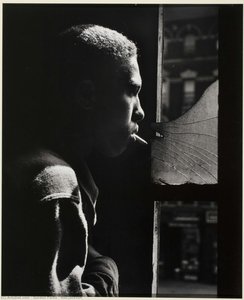
In the quiet, grayscale expanse of Gordon Parks’ Contact Sheet B1, one finds much more than a mere collection of photographic frames; one discovers a profound, unvarnished window into the heart of mid-century America. Created in 1948, this contact sheet serves as a raw, cinematic precursor to his legendary work for Life magazine, capturing the pulse of Harlem during a period of intense social transformation. As we gaze upon this grid of moments, we are not merely looking at film; we are witnessing the meticulous documentation of gang warfare and the resilient daily rhythms of a community navigating the complexities of urban existence. The sheet transcends its technical function to become a poignant testament to social realism, where every frame acts as a heartbeat within a larger, unfolding narrative of survival and human dignity.
The power of this work lies in Parks’ unique ability to blend the role of a journalist with that of a visual poet. Through his lens, the streets of Harlem are transformed into a stage of deep emotional resonance. There is an inherent intimacy in these images—children playing on rooftops, men locked in tense, whispered conversations, and figures seeking solace against weathered brick facades. Parks’ approach was fundamentally rooted in humanist observation, eschewing staged perfection in favor of the spontaneous and the authentic. This commitment to truth allows the viewer to feel the weight of the era's anxieties alongside the quiet aspirations of its residents, making the piece an essential study for anyone moved by the intersection of art and social justice.
The Artistry of the Monochrome Frame
Technically, Contact Sheet B1 is a masterclass in the use of 35mm film to create depth and movement within a static medium. The composition is structured by the very geometry of the photographic process itself; the rectangular edges of each frame create a rhythmic, grid-like pattern that guides the eye across a landscape of varying intensities. Parks utilized strong diagonal lines—formed by architectural elements like doorways and building edges—to instill a sense of dynamism within the scenes. These linear perspectives are balanced by the organic, fluid shapes of human figures, bicycles, and trees, grounding the historical gravity of the subject matter in a tangible, lived reality.
The monochrome palette is perhaps the most vital element in establishing the work's timeless atmosphere. By stripping away the distraction of color, Parks forces our focus onto the interplay of light and shadow, texture, and form. The grainy texture characteristic of mid-century film photography adds a layer of immediacy, as if we are peering through a veil of time directly into 1948. Shadows are not merely absences of light but are sculptural tools used to create depth and contrast, highlighting the rugged textures of pavement and fabric while shrouding certain moments in mystery. For the collector or interior designer, this piece offers a sophisticated aesthetic that brings a sense of historical weight and intellectual depth to any curated space.
A Legacy for the Modern Collector
To possess a reproduction of such a significant historical document is to hold a piece of the American consciousness. Contact Sheet B1 is not just an object of beauty; it is a vessel of memory. It evokes a profound sense of nostalgia, not for a romanticized past, but for a period of raw, unadorned truth. The emotional impact of the work lies in its ability to evoke empathy, inviting us to reflect on the enduring human spirit amidst turbulent social landscapes. Whether displayed as a focal point in a contemporary gallery or integrated into a sophisticated residential design, this work continues to inspire conversation about identity, resilience, and the transformative power of the photographic lens.
Questions & Answers
What does "Contact Sheet B1," by Gordon Parks bring to an interior?
With its nostalgic mood, "Contact Sheet B1," is suggested for a living room.
Can I see "Contact Sheet B1," by Gordon Parks under different lights?
"Contact Sheet B1," can be examined layer by layer on the artwork's X-Ray page, a viewer inspired by a conservator's light bench with eleven optical readings of the image.
What orientation does "Contact Sheet B1," by Gordon Parks have?
"Contact Sheet B1," by Gordon Parks has a landscape format. The format describes the proportions of the composition.
Artist Biography
early life and career
gordon roger alexander buchanan parks, an american photographer, musician, writer, and film director, was born on november 30, 1912, in fort scott, kansas. he was the youngest of fifteen children to sarah (née ross) and jackson parks. parks' early life was marked by segregation, which he experienced firsthand in his hometown.as a self-taught artist, parks began his career as a photographer, eventually becoming the first african american to work for life and vogue magazines. his iconic photos of poor americans during the 1940s, taken for a federal government project, are a testament to his skill and dedication.
notable works and achievements
- shaft (1971), a film directed by parks, which became a cultural phenomenon.
- the learning tree (1969), a semiautobiographical film that marked parks' directorial debut.
- a choice of weapons (1985), a memoir that showcases parks' writing prowess.
- life magazine's photographic essays, which cemented parks' status as a prominent photojournalist.
museums and collections
- the melvin holmes collection, featuring an extensive collection of parks' work. [https://www.holmesartgallery.com/gordonparks](https://www.holmesartgallery.com/gordonparks)
- moma (the museum of modern art), which has an impressive collection of parks' photographs. [https://www.moma.org/artists/8083](https://www.moma.org/artists/8083)
awards and legacy
- naacp image award (2003)
- pga oscar micheaux award (1993)
- national medal of arts (1988)
- spingarn medal (1972)
gordon parks' legacy extends beyond his impressive body of work, as he paved the way for future generations of african american artists. his contributions to photojournalism, filmmaking, and music continue to inspire and influence artists today.
selected works on OriginalUniqueArt.com
- emerging man (gelatin silver print), a powerful photograph showcasing parks' skill. [https://OriginalUniqueArt.com/d3xgfc-gordon-parks-emerging-man](https://OriginalUniqueArt.com/d3xgfc-gordon-parks-emerging-man)
- portrait of mrs. lucy johnson (gelatin silver print), a poignant portrait that highlights parks' storytelling ability. [https://OriginalUniqueArt.com/d4dblu-gordon-parks-portrait-of-mrs-lucy-johnson](https://OriginalUniqueArt.com/d4dblu-gordon-parks-portrait-of-mrs-lucy-johnson)

Gordon Parks
1912 - 2006 , United States of America
Quick Facts
- Full Name: Gordon Roger Alexander Buchanan Parks
- Nationality: American
- Date Of Birth: 1912
- Date Of Death: 2006
- Place Of Birth: Fort Scott, United States of America
- Notable Artworks:
- Shaft
- The Learning Tree
- Emerging Man
- Harlem Gang Wars
- Night Rumble
- Artistic Movement Or Style: Photojournalism, Social Realism
- Artists Or Movements Influenced By This Artist: Future African American artists
Related Articles
Witnessing History Through Lens & Light: Documentary Photography's Enduring Legacy
Explore the powerful history of documentary photography – from its origins to contemporary masters like Gordon Parks & W. Eugene Smith. Discover how this art form shapes our understanding of society and witness pivotal moments in time.
Witnessing History: Documentary Photography as an Art Movement
Explore the powerful history of documentary photography – from its origins to contemporary masters like Gordon Parks. Discover how this art form shapes our understanding of society and witness pivotal moments in time.

The Lens of Truth: A Comprehensive History and Legacy of Documentary Photography
Explore the profound history of documentary photography. From early daguerreotypes to social reform movements, discover how the lens captures truth, preserves vanishing cultures, and shapes our global visual narrative through an expert art-historical lens.
Gordon Parks: A Poetic Lens on American Life – Photography, Social Justice & Storytelling
Explore the profound work of Gordon Parks, a groundbreaking photographer who documented American life with unparalleled empathy and artistry. Discover his iconic images & lasting impact on social justice through Life magazine & beyond.

Documentary Photography's Defining Moments: 10 Masterpieces for Your Home |
Explore 10 defining documentary photography masterpieces – from Dorothea Lange to Robert Capa. Discover powerful stories, iconic images & timeless art for your home. Museum-quality prints at .