

 Send
Send Share
Share
 Details
 Guide
Guide

 Download
 Similars
 Diaporama
 Stats
StatsThe Annunciation
 Fresco
- Baroque Painting
 1610
1610- Early Modern
 74.0 x 54.0 cm
 Hermitage Museum
 Read More
Hand Made Oil Reproduction
Hand-painted oil on canvas in your size and frame, made to order by our artists. ( Switch to Print Switch to Digital Image)




































Pick from our preset sizes that match the artwork's original proportions.

Type the width and the height you need, to fit your frame or your wall. This is hand-painted, so for a size with a different shape the artist can paint a bit more around the picture, or cut a bit — you choose. We send you a digital mockup to approve before the painting starts. The picture shown on this page does not show the real result — only the mockup does.
After order, OriginalUniqueArt.com team will email client for instructions and provide a mockup preview
Worldwide Delivery () in 3/4 weeks instead of standard 5 weeks. (23 October). No compromise on quality.

Free Worldwide Express Shipping

High-Quality Linen Canvas

Full Shipping Insurance

Customs Tax Refund Guarantee

True Color Matching Guarantee

100-Day Return Policy (Defects Only)

100% Money-Back Guarantee

Bulk Discount Offer
 Glass option is only available in size under 110 CM

The Annunciation
Reproduction Medium
Reproduction Size
-


Total Price
$ 300
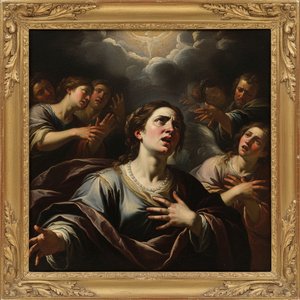
Giovanni Lanfranco’s “The Annunciation”: A Symphony of Baroque Drama
Giovanni Lanfranco (1582-1647), born in Parma, Italy, stands as a pivotal figure within the flourishing Baroque artistic movement. His oeuvre is characterized by an unparalleled ability to convey emotion and grandeur through meticulously crafted compositions—a skill particularly evident in “The Annunciation,” painted circa 1610. This monumental fresco resides within San Carlo ai Catinari church in Rome, marking Lanfranco’s contribution to the ambitious project undertaken by Cardinal Scipione Borghese to transform the palazzo into a veritable temple of art.A Dramatic Narrative Illuminated by Light
The painting depicts the biblical narrative of Mary receiving the divine messenger Gabriel announcing her conception of Jesus Christ. Lanfranco skillfully employs theatrical staging and dramatic lighting—a hallmark of Baroque aesthetics—to heighten the emotional intensity of the scene. The central figures, Mary kneeling in prayer and Gabriel hovering above her, dominate the canvas with their serene yet palpable vulnerability. Lanfranco’s masterful use of chiaroscuro – the interplay between light and shadow – sculpts the forms of the saints, creating a sense of depth and realism that transcends mere representation. Light emanates from an unseen source, bathing Mary in a luminous glow while casting Gabriel's figure into deep shadow, symbolizing divine grace penetrating earthly darkness.Technique and Composition: Correggio’s Influence
Lanfranco’s technique demonstrates a profound understanding of perspective and anatomical accuracy—traits inherited from the influential Correggio, whose frescoes at Parma Cathedral established new standards for illusionistic painting. The fresco utilizes a pyramidal composition, anchoring Mary's posture at its base and directing the viewer's gaze upwards towards Gabriel. This deliberate structuring reinforces the narrative’s spiritual significance, elevating Mary’s piety and Gabriel’s proclamation to positions of prominence. Lanfranco meticulously rendered drapery folds with painstaking detail, capturing the texture and movement of fabric—a technique that contributes significantly to the fresco’s immersive quality.Symbolism: Lily and Scroll – Representations of Divine Grace
Beyond its technical prowess, “The Annunciation” is laden with symbolic significance. Gabriel holds aloft a lily, representing purity and virginity—attributes traditionally associated with Mary. Simultaneously, he presents a scroll bearing an angelic inscription, symbolizing divine revelation and the promise of salvation. These emblems underscore the central theme of the painting: God’s intervention in human affairs and the miraculous birth of Jesus Christ. The inclusion of additional figures flanking Mary and Gabriel – representing witnesses to this sacred event—further amplifies the fresco's grandeur and reinforces its theological message.Emotional Resonance: Capturing Sacred Reverence
“The Annunciation” transcends mere visual depiction; it aspires to evoke profound emotional resonance within the viewer. Lanfranco’s masterful rendering of facial expressions conveys Mary’s humility, apprehension, and unwavering faith—qualities that resonate deeply with audiences across centuries. The painting's luminous palette and dynamic composition instill a sense of awe and reverence, transporting viewers into the heart of this pivotal moment in Christian history. It remains a testament to Lanfranco’s artistic genius and his ability to translate theological concepts into breathtaking visual artistry.Questions & Answers
Can I see an X-ray view of "The Annunciation" by Giovanni Lanfranco?
The X-Ray view of "The Annunciation" by Giovanni Lanfranco is on the artwork's X-Ray page: an interactive examination of the image through eleven optical layers.
Is "The Annunciation" by Giovanni Lanfranco a well-known artwork?
"The Annunciation" by Giovanni Lanfranco has an iconic popularity level. This classification reflects how widely the work is recognized.
Is "The Annunciation" more bright or more dark overall?
The recorded values for "The Annunciation" by Giovanni Lanfranco are: shadow brightness, soft shadow luminance.
Artist Biography
Giovanni Lanfranco: A Leading Figure of Baroque Painting
- Born: Parma, Italy (1582)
- Died: 1647
Early Life and Training
Giovanni Gaspare Lanfranco was born in Parma in 1582, the third son of Stefano and Cornelia Lanfranchi. His artistic talent was recognized early on, leading to an apprenticeship with Agostino Carracci, brother of Annibale Carracci, a prominent Bolognese artist. He also worked alongside Sisto Badalocchio in the Farnese palaces of Parma. Lanfranco's training continued within Annibale Carracci’s large workshop in Rome, where he contributed to projects like the Galleria Farnese, including work on the panel of Polyphemus and Galatea. This period exposed him to a vibrant artistic environment and laid the foundation for his future career.
Development and Artistic Style
Following Annibale Carracci's death in 1609, Lanfranco briefly returned to Parma before re-establishing himself in Rome by 1612. He developed a distinctive style characterized by dynamic compositions, theatrical lighting, and a visionary approach particularly suited for ceiling frescoes. While influenced by the late works of Ludovico Carracci and possibly Caravaggio, he also demonstrated a strong affinity for Correggio’s decorative style. His early works show an eclectic range, incorporating elements from various masters while gradually forging his own path. A key aspect of his development was his ability to create illusionistic effects in fresco painting, contributing significantly to the Baroque aesthetic.
Major Achievements and Commissions
Lanfranco’s career flourished under Pope Paul V, who commissioned numerous works from him. Some of his most significant achievements include:
- Frescoes at Palazzo Mattei: Demonstrating his growing mastery of perspective and illusionism.
- Villa Borghese Ceiling (Gods of Olympus): A monumental work showcasing a complex narrative and dynamic figures.
- Sala de' Corazzieri and Sala Regia at the Quirinale Palace: Further establishing his reputation as a leading fresco artist in Rome.
- The Assumption of the Virgin at Sant’Andrea della Valle: Considered his masterpiece, this ambitious dome fresco is renowned for its dramatic lighting, crowded composition, and innovative use of perspective. It exemplifies the Baroque style's emphasis on grandeur and emotional impact.
Influence and Historical Significance
Giovanni Lanfranco played a crucial role in shaping the artistic landscape of 17th-century Rome. He rivaled Domenichino for major commissions, contributing to a period of intense competition among leading artists. His innovative approach to fresco painting, particularly his mastery of illusionistic techniques and dramatic compositions, influenced subsequent generations of artists. Lanfranco’s work reflects the broader trends of the Baroque era—a focus on dynamism, emotion, and grandeur—and cemented his place as one of the most important painters of his time. His influence can be seen in later works by Francesco Solimena and other Italian artists.

Giovanni Lanfranco
1582 - 1647 , Italy
Quick Facts
- Full Name: Giovanni Lanfranco
- Nationality: Italian
- Date Of Birth: 1582
- Date Of Death: 1647
- Place Of Birth: Parma, Italy
- Notable Artworks:
- The Prophet Elijah Awakened
- Saint Luke
- Venus Playing the Harp
- Gods of Olympus fresco
- Artistic Movement Or Style: Baroque painting
- Artists Who Influenced This Artist:
- Correggio
- Annibale Carracci
- Ludovico Carracci
- Artists Or Movements Influenced By This Artist: ['Francesco Solimena']
Related Articles

Giclée Prints: Archival Quality & Aesthetic Nuances for the Discerning Collector
Explore the world of giclée prints with OriginalUniqueArt. Learn about archival quality, aesthetic nuances & investment potential. Expert guidance for discerning art collectors seeking museum-quality reproductions and lasting value.
Chiaroscuro and Soul: A Definitive Guide to the Drama and Emotion of Italian Baroque Masterpieces
Embark on a sophisticated journey through Italian Baroque art. Discover the dramatic interplay of light and emotion in Caravaggio’s masterpieces and explore how to bring this timeless grandeur into your collection with expert art insights.

Baroque Drama: Bringing Opulence & Emotion into Contemporary Interiors
Explore the opulent world of Baroque interior design! Discover key elements, modern applications & how to bring dramatic elegance into your home with OriginalUniqueArt.com's authentic reproductions.

The Dramatic Flourish: Exploring the Baroque Movement's Enduring Legacy in Art History
Explore the dramatic world of Baroque art! Discover iconic artists like Caravaggio & Rubens, defining techniques, and its lasting impact on art history. Expert insights for collectors & enthusiasts at OriginalUniqueArt.

The Visceral Stage: Exploring Dramatic Narratives & Emotional Intensity in Baroque Art
Explore the dramatic world of Baroque art! Discover iconic masters like Caravaggio & Rembrandt, their techniques, and the movement's lasting impact. Expert insights for collectors & enthusiasts at OriginalUniqueArt.


