 Preview
 Send
Send Share
Share
 Details
 Guide
Guide

 Download
 Similars
 X-Ray
X-Ray Diaporama
 Stats
StatsStudio for iridescent interpenetration (ceiling round)
 Acrylic On Canvas
- WallArt
- Futurist Divisionism
 Modern
 7.0 x 22.0 cm
 Galleria Civica di Arte Moderna e Contemporanea Torino
 Read More
Giclée / Art Print
Museum-quality giclée or canvas print with fast production and flexible finish options. ( Buy Hand Made Painting Switch to Digital Image)




P118B $10

P118H $10

P118W $10

P438Z $10

P508JH $12

P508YH $12

P805H $10

P805Z $10

P919BZ $10

P919G $10

P919XJ $10

P959ZH $10

P968JZ $12

W106C $8

W218G $10

W218JH $8

W218Y $10

W307PJ $10

W316G $10

W316PJ $8

W316Y $10

W398PJ $8

W4111J $10

W500HY $15

W500JH $15

W692G $12

W849H $8

W940BG $15

W953PJ $8




Pick from our preset sizes that match the artwork's original proportions.

You may enter your own dimensions to fit a specific frame or space. If your selected size does not match the original image's proportions, we will either crop the artwork or extend the image with a mirrored or solid-fill edge. A digital mockup will be sent for your approval before production begins.
Please note that the on-screen preview does not reflect the actual cropping or extension. Only the mockup will accurately show the final composition.
While custom sizes are available, we recommend selecting a dimension from the predefined list to preserve the original proportions.
Worldwide Delivery () in 2 weeks instead of standard 4/5 weeks. (30 September)

Free Worldwide Express Shipping

High-Quality Linen Canvas

Full Shipping Insurance

Customs Tax Refund Guarantee

True Color Matching Guarantee

100-Day Return Policy (Defects Only)

100% Money-Back Guarantee

Bulk Discount Offer
 Glass option is only available in size under 110 CM

Studio for iridescent interpenetration (ceiling round)
Giclée / Art Print
Reproduction Size
-


Total Price
$ 81
Studio for iridescent interpenetration (ceiling round) – A Window into Balla’s Vision
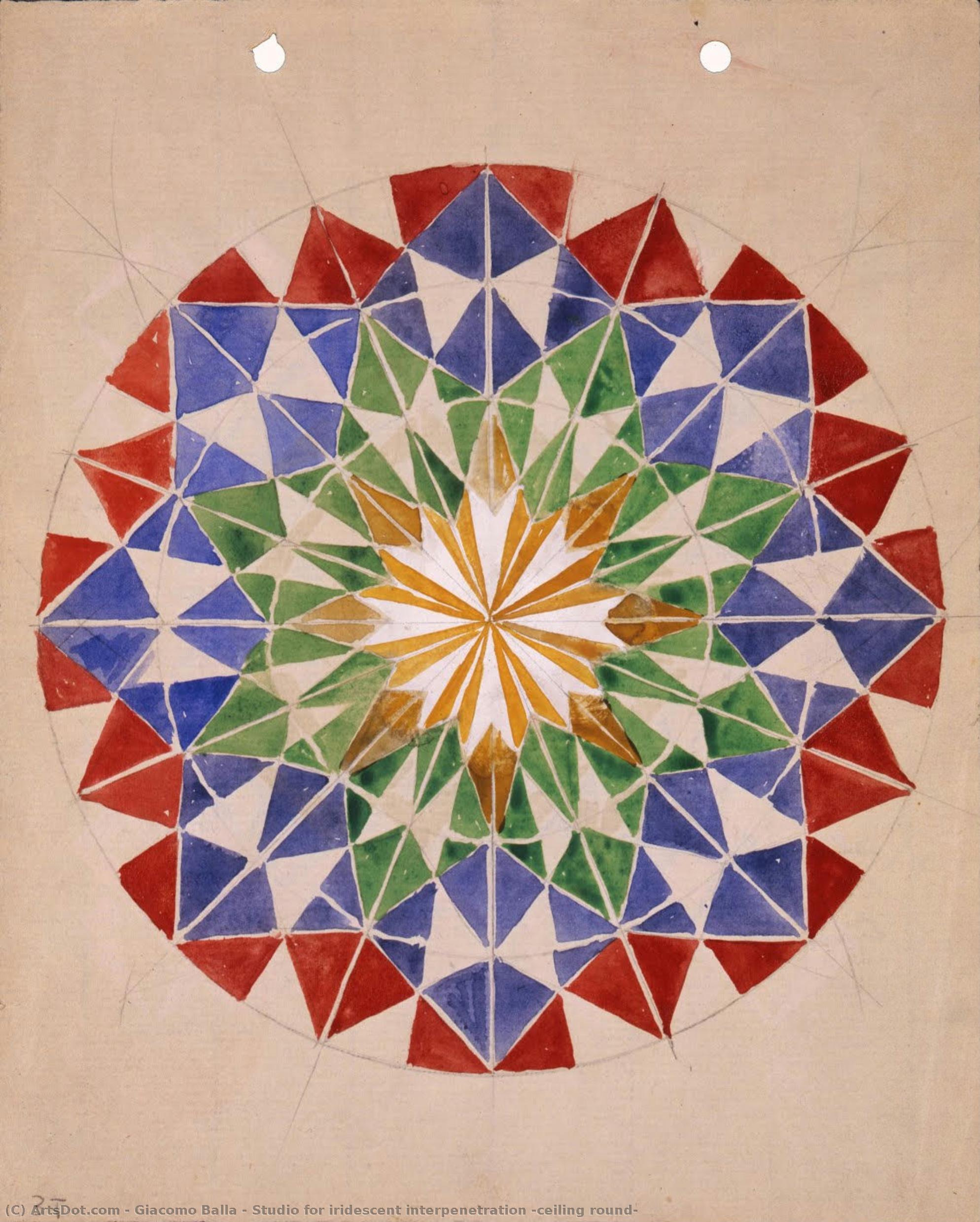
Giacomo Balla's "Studio for iridescent interpenetration (ceiling round)" is more than just a watercolor; it’s a concentrated distillation of the artist’s revolutionary approach to depicting movement and light. Measuring a modest 7 x 22 cm, this seemingly simple circular composition pulsates with an energy born from Balla’s pivotal embrace of Futurism. Painted in 1913, during a period of intense experimentation within the movement, it offers a rare glimpse into the artist's early explorations of key futurist concepts – ideas that would profoundly influence his later, more celebrated works.
- Subject Matter: The painting’s central subject is an abstract circle, dominated by a vibrant yellow core. This isn’t a literal representation of a sun or star, but rather a carefully constructed visual device designed to capture the fleeting effects of light and movement.
- Technique: Balla employs Divisionist techniques – small, distinct brushstrokes of pure color – to create an illusion of shimmering iridescence. The layering of reds, greens, blues, oranges, and yellows isn’t haphazard; it's meticulously planned to evoke the sensation of light refracting and overlapping, a core tenet of futurist aesthetics.
The Genesis of Futurist Ideas
Balla’s artistic journey began with a grounding in traditional techniques, initially through music lessons and later working in a lithograph print shop. However, his life took a decisive turn upon meeting Filippo Tommaso Marinetti and becoming a signatory of the Futurist Manifesto in 1910. This encounter ignited a passion for capturing dynamism – speed, movement, and the perceived chaos of modern urban life – on canvas. “Studio for iridescent interpenetration (ceiling round)” represents an early manifestation of this shift, predating many of Balla’s more iconic futurist paintings.
The painting's circular form itself is significant. Circles are often associated with wholeness, unity, and the cyclical nature of time – concepts central to futurist thought. The deliberate fragmentation of color within the circle mirrors the futurists’ desire to break down traditional representational forms and embrace a more dynamic, multi-faceted view of reality.
Symbolism and Emotional Impact
Beyond its technical brilliance, the artwork resonates with a profound sense of dynamism. The overlapping colors suggest an interpenetration of light and space, creating a visual experience that is both stimulating and slightly unsettling. It’s a testament to Balla's ambition to capture not just what he *saw*, but how he *felt* about the world – a world in constant motion.
The painting’s small size adds to its intimacy, inviting the viewer to contemplate this complex visual puzzle with focused attention. It is a poignant reminder of Balla's early experimentation and his unwavering commitment to pushing the boundaries of artistic expression.
Historical Context & Provenance
Created in 1913 and currently housed at the Galleria Civica di Arte Moderna e Contemporanea Torino, “Studio for iridescent interpenetration (ceiling round)” offers a valuable window into the formative years of one of Italy’s most important modern artists. Balla's work is inextricably linked to the broader artistic and intellectual currents of the early 20th century – a period marked by rapid technological advancements, social upheaval, and a fervent desire to redefine art’s role in society. This piece stands as a testament to that ambition.
Artist Biography
Early Life and Training
- Born: Turin, Italy (July 18, 1871)
- Died: 1958
- Giacomo Balla was born into a family with artistic connections; his father was a photographer.
- Initially studied music until the age of nine.
- Following his father's passing, he worked in a lithograph print shop, developing an interest in visual art.
- Studied at local academies and later at the University of Turin.
- Moved to Rome in 1895 where he began working as an illustrator, caricaturist, and portrait painter.
Development and Key Artistic Periods
- Divisionism: Early works were influenced by Divisionism, a technique employing small strokes of pure color to create luminosity. This period demonstrated his interest in capturing light effects.
- Futurism: A pivotal moment was his embrace of Futurism after meeting Filippo Tommaso Marinetti. He became a signatory of the Futurist Manifesto in 1910.
- Futurist Principles: Balla's futurist works focused on depicting light, movement, and speed, often incorporating abstract elements. He extended Futurist principles to furniture design and clothing.
- Later Work: In later years, he distanced himself from the more radical aspects of Futurism, returning to a more traditional figurative style.
Major Works and Artistic Style
- Abstract Speed + Sound (Velocità Astratta + Rumore): A significant work exploring speed symbolized by an automobile.
- The Street Light: Exemplifies his exploration of light, atmosphere, and motion.
- Dynamism of a Dog on a Leash: A key piece demonstrating efforts to express movement through painting.
- Boccioni's Fist: Showcases his work as a sculptor within the Futurist movement.
- Style: Balla’s style evolved from Divisionist techniques to dynamic and abstract representations of motion, light, and modern life. He utilized fragmented forms, overlapping planes, and vibrant colors to convey a sense of energy and speed.
Influences and Historical Significance
- Etienne-Jules Marey: Influenced by Marey's chronophotographic experiments which recorded successive stages of movement.
- Filippo Tommaso Marinetti: The Futurist Manifesto and Marinetti’s ideas were crucial in shaping Balla’s artistic direction.
- Historical Significance: As a founding member of the Futurist movement, Balla played a vital role in developing its aesthetic principles and promoting its influence across various art forms. His work helped define early 20th-century modernism and continues to be celebrated for its innovative approach to representing motion and technology.
Legacy and Recognition
- Membership: Became a member of Rome's Accademia di San Luca in 1935.
- Exhibitions: Participated in Documenta 1 in Kassel (1955) and had works exhibited at Documenta 8 (1987).
- Museum Collections: His artworks are held in collections such as the Albright-Knox Art Gallery, the National Academy of Saint Luke in Rome, and the Estorick Collection.
- Balla's legacy lies in his pioneering exploration of movement and dynamism in art, contributing significantly to the development of Futurism and modern artistic expression.

Giacomo Balla
1871 - 1958 , Italy
Quick Facts
- Artistic Movement Or Style: Divisionism and Futurism
- Artists Who Influenced This Artist: ['Etienne-Jules Marey']
- Full Name: Giacomo Balla
- Nationality: Italian
- Notable Artworks:
- Abstract Speed + Sound
- The Street Light
- Dynamism of a Dog on a Leash
- Boccioni's Fist
- Nuns and Landscape
- Girl Running on a Balcony
- Farmer
- Place Of Birth: Turin, Italy
- Date Of Birth: 1871
- Date Of Death: 1958
Related Articles

Ephemeral Visions: Exploring the Artistic Legacy & Nuances of Watercolor Painting
Explore the captivating world of watercolor painting! Discover its rich history, essential techniques, influential artists & collecting tips from art experts. A comprehensive guide for enthusiasts.

The Enduring Appeal of Watercolor: History, Techniques & Contemporary Practice
Explore the captivating world of watercolor painting! Discover its rich history, essential techniques, influential artists, and collecting tips. A comprehensive guide for art enthusiasts.

Ephemeral Visions: Exploring the History & Emotional Resonance of Watercolor Painting
Explore the captivating history of watercolor painting, from ancient techniques to modern masters like Kandinsky & Blake. Discover essential artists, collecting tips & the emotional power of this luminous medium. Expert insights for art enthusiasts.

Ephemeral Visions: Exploring the Artistic Legacy & Contemporary Practice of Watercolor Painting
Explore the captivating world of watercolor painting! Discover its rich history, essential techniques, influential artists & collecting tips. A comprehensive guide for art enthusiasts from OriginalUniqueArt.

Watercolor Wonders: 10 Masterpieces That Redefined Art History | OriginalUniqueArt
Journey through 10 legendary watercolor masterpieces by Sargent, Turner & Homer! Explore iconic landscapes, portraits & floral art that redefined history. Find museum-quality reproductions and curated decor ideas at OriginalUniqueArt.com.