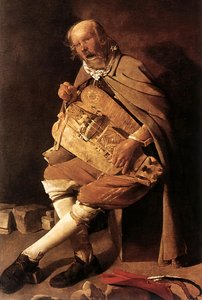
The Life of Georges de La Tour
Born in 1593 in Vic-sur-Seille, a town within the Diocese of Metz, Georges de La Tour entered a world shaped by the shifting borders of the Duchy of Lorraine. He was the second of seven children born to Jean de La Tour, a baker, and Sybille de La Tour, née Molian. His early years were rooted in this provincial landscape, far from the grand centers of the French Baroque, yet his origins provided the foundation for a life spent navigating the complexities of both religious fervor and political change.
His existence was defined by a steady movement through the social and political structures of his time. After establishing himself, he eventually settled in Lunéville, where he would remain for much of his professional life. This stability allowed him to develop a distinct presence in the region, eventually earning the title of "Painter to the King" under Louis XIII. He lived through an era of profound transformation, moving between the service of the French court and the Dukes of Lorraine, maintaining a presence in the local community even as his reputation grew.
The end of his life arrived in 1652 in Lunéville. He passed away shortly after his wife, leaving behind a body of work that reflected the quiet, often nocturnal, realities of the seventeenth century. His life followed the arc of a man deeply embedded in the local fabric of Lorraine, a painter whose presence was felt in the courts and the chapels of his home region.
Early Life and Artistic Training
The origins of Georges de La Tour remain partially obscured by the shadows of the early seventeenth century. Born in 1593 in Vic-sur-Seille, he emerged from a family of modest means, the son of a baker. While the specific details of his formative years are elusive, the trajectory of his talent suggests a rapid and disciplined development. By 1616, he had already established himself as a fully trained painter, possessing a technical maturity that would define his subsequent career.
Scholars continue to debate the specific influences that shaped his early vision. There is significant speculation regarding potential travels to Italy, a common path for ambitious painters of the era seeking to master the nuances of light. Other theories suggest he may have sought instruction under Jacques Bellange in Nancy, or perhaps traveled to the Netherlands during the early stages of his professional life. These possible movements would have exposed him to the diverse stylistic currents circulating through Europe, helping to refine the quiet, geometric precision that would eventually become his signature.
Marriage and Life in Lunéville
In 1617, Georges de La Tour married Diane Le Nerf, a union that brought both stability and social standing to his developing career. His wife arrived from a wealthy family, providing a foundation of security that allowed him to focus on his craft. By 1620, he had established himself as a resident of Lunéville, where he set up his studio and began to navigate the complexities of local life. He lived the life of a prosperous local gentleman, moving within the social circles of the Duchy of Lorraine.
This period of settlement provided the quietude necessary for his artistic evolution. The domestic stability of his Lunéville years offered a stark contrast to the political upheavals occurring across the region. While his social position grew, his focus remained on the intimate details of his surroundings. His studio became a place of steady production, supported by the resources of his marriage and his rising status in the community.
Patrons and Royal Recognition
The stability of De La Tour's career was anchored by the patronage of the powerful figures who governed the Duchy of Lorraine. Between 1623 and 1624, he provided works for the Dukes of Lorraine, a period that helped establish his reputation within the region. His reach extended beyond the local nobility to the highest echelons of the French state. He was appointed "Painter to the King" by Louis XIII in 1638, a distinction that signaled his acceptance into the inner circles of the French court.
His influence was felt in the private collections of the era's most significant administrators and architects. He painted for Cardinal Richelieu and the superintendent of finances, Claude de Bullion. Even the architect Le Nôtre was among those for whom he produced work. This network of support was not limited to the capital; he also provided paintings for the governor of Lorraine, the maréchal de La Ferté. These connections ensured that his quiet, candlelit compositions found their way into the most influential households of the seventeenth century.
Technique and Mastery of Light
The essence of his method lay in a profound command of chiaroscuro. He did not merely use light to illuminate a scene; he used it to define the very boundaries of existence. Through the application of tenebrism, he plunged his subjects into a deep, heavy gloom, allowing intense beams of light to carve out forms against an impenetrable void. This was particularly evident in his nocturnal scenes, where the flickering glow of a single candle became the primary architect of the composition. In these dark interiors, his color palette was intentionally restrained, often narrowing to a dialogue between earthy grey-brown tones and sharp vermillion.
As his career progressed, his approach underwent a quiet transformation. His later phase moved away from the dynamic energy of his youth toward a more meditative stillness. He began to favor simplified forms and careful geometrical compositions, stripping away unnecessary detail to focus on the essential. This economy of means lent his work a sense of profound introspection. The light in these later pieces often felt metaphysical, casting a soft, diffused glow that emphasized the quiet dignity of the human figure. He achieved a sense of permanence through this reduction, turning a fleeting moment of candlelight into a study of stillness.
Key Religious and Genre Works
The artist’s early output often focused on the social frictions of daily life. Around 1630, he produced The Fortune-Teller, a work that captures a moment of deception. This interest in human vulnerability and trickery continued with The Cheat with the Ace of Clubs, currently held in the Kimbell Art Museum. These genre scenes rely on sharp observation to depict the quiet, often unsettling, interactions of ordinary people.
As his focus shifted toward the spiritual, his compositions grew more restrained. He turned his attention to the lives of saints, using candlelight to define the contours of faith. Adoration of the Shepherds was created around 1640, presenting a scene of quiet devotion. During this same period, he painted Magdalene with the Smoking Flame, an oil-on-canvas work that uses a single light source to pull the subject from the surrounding gloom. His later years saw a move toward even greater simplicity, as seen in Saint Joseph the Carpenter.
The weight of human emotion became more pronounced in his final decade. He captured the profound grief of the apostle in The Tears of Saint Peter, painted in the 1650s. This psychological depth was also present in The Denial of Saint Peter, which he completed in 1650. In these works, the darkness is not merely a background but a presence that emphasizes the solitude of the figures.
Legacy and Historical Rediscovery
The quietude that defines his canvases eventually extended to his reputation. Following his death in 1652, the artist fell into a long period of relative obscurity. For centuries, his identity was obscured by time and misattribution, as many of his works were credited to other hands. The specific nuances of his style—the way he used light to bridge the gap between Caravaggism and French Classicism—were largely lost to the broader historical memory.
This silence was broken in the early 20th century. A concerted effort to re-evaluate his oeuvre led to a significant rediscovery, bringing his name back into the light of art history. This resurgence allowed scholars to recognize the originality of his compositions and his unique ability to handle shadow. His work moved from the margins of forgotten collections back into the center of study, revealing a painter of profound psychological depth.
- The Fortune-Teller (about 1630)
- Adoration of the Shepherds (about 1640)
- The Tears of Saint Peter (1650s)
Where to See His Works Today
The presence of his canvases is felt across several major institutions, scattered between the quiet halls of Europe and the expansive galleries of the Americas. In France, the Louvre in Paris maintains a significant collection of his paintings. The Musée d'Arts de Nantes also holds several of his works, while the Musée Départemental des Vosges preserves Job Mocked by his Wife. These pieces offer a chance to observe his specific handling of light within a controlled, historical setting.
Across the Atlantic, his influence is preserved in the collections of the Metropolitan Museum of Art in New York. In the United States, the Cleveland Museum of Art holds The Tears of St. Peter, a work that captures the psychological weight of his later years. Further west, the Los Angeles County Museum of Art contains a version of Magdalene with the Smoking Flame, allowing viewers to encounter his nocturnal themes in a different light.
Beyond these primary locations, other significant holdings can be found in Germany and elsewhere. The Staatliche Museen zu Berlin maintains works that reflect his distinctive approach to shadow and form. To see his output in its entirety requires a pilgrimage through these diverse institutions, each offering a different perspective on his quiet, candlelit compositions.

 Switch to Print
 Read More







































 For artworks or reproductions larger than 105 cm (approximately 41 inches) on any side, the frame will be shipped as a kit, disassembled. This method ensures safe delivery and prevents damage during transport.


 Preview
 Send
Send Share
Share
 Details
 Guide
Guide

 Download
 Similars
 X-Ray
X-Ray Diaporama
 Q&A
Q&A Stats
Stats