

 Preview
 Send
Send Share
Share
 Details
 Guide
Guide

 Download
 Similars
 X-Ray
X-Ray Diaporama
 Stats
StatsHeath Paddock, Hawthorn
 Heidelberg School
 1886
1886 51.0 x 76.0 cm
 Read More
Giclée / Art Print
Museum-quality giclée or canvas print with fast production and flexible finish options. ( Buy Hand Made Painting Switch to Digital Image)




































Pick from our preset sizes that match the artwork's original proportions.

Type the width and the height you need, to fit your frame or your wall. A print can only be cut, never made bigger than the picture, so a size with a different shape loses a part of the image. We send you a digital mockup to approve before we print anything. The picture shown on this page does not show the real cut — only the mockup does.
Worldwide Delivery () in 2 weeks instead of standard 4/5 weeks. (14 October)

Free Worldwide Express Shipping

High-Quality Linen Canvas

Full Shipping Insurance

Customs Tax Refund Guarantee

True Color Matching Guarantee

100-Day Return Policy (Defects Only)

100% Money-Back Guarantee

Bulk Discount Offer
 Glass option is only available in size under 110 CM

Heath Paddock, Hawthorn
Giclée / Art Print
Reproduction Size
-


Total Price
$ 81
Artist's Background
Frederick McCubbin was a leading member of the Heidelberg School, also known as Australian Impressionism. His works often depicted scenes of rural life, showcasing his ability to capture the essence of the Australian landscape. Some of his notable works include On the Wallaby Track, Violet and Gold, and Golden Sunlight, which can be found on https://OriginalUniqueArt.com.Painting Description
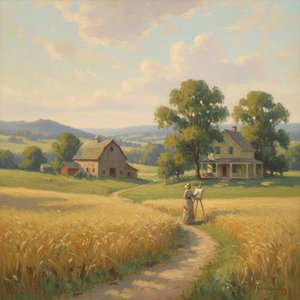
The painting Heath Paddock, Hawthorn features a man standing in a field with a house in the background. The man appears to be looking at something off to his left, while two other people are visible in the scene. A dog is also present, adding to the natural atmosphere of the painting. The field itself has some grass and trees scattered throughout, creating a sense of depth and dimension. Key Features of the painting include:- The use of oil on canvas, which gives the painting a rich and vibrant texture
- The depiction of rural Australian life, showcasing the artist's ability to capture the essence of the landscape
- The presence of figures in the scene, adding a sense of human interaction and emotion
The painting Heath Paddock, Hawthorn is a beautiful representation of Australian art and culture. With its rich history and stunning depiction of rural life, it is a must-see for anyone interested in art and history. Visit https://OriginalUniqueArt.com to explore more hand-made oil painting reproductions, including works by Frederick McCubbin.
Questions & Answers
Is Frederick McCubbin, creator of "Heath Paddock, Hawthorn", known under other names?
Other names recorded for Frederick McCubbin, creator of "Heath Paddock, Hawthorn", include Fred McCubbin.
How many people view "Heath Paddock, Hawthorn"?
The Stats page of "Heath Paddock, Hawthorn" by Frederick McCubbin presents public visit statistics: monthly visits of this artwork, a comparison with the artist's most viewed works, and where its visitors come from.
What are the author and date of "Heath Paddock, Hawthorn"?
"Heath Paddock, Hawthorn" was created by Frederick McCubbin in 1886.
Artist Biography
A Life Rooted in the Australian Landscape
Frederick McCubbin, born in Melbourne on February 25th, 1855, stands as a cornerstone of Australian art, inextricably linked to the nation’s evolving identity and its unique visual language. His journey from humble beginnings – the son of bakers who instilled in him a strong work ethic – to becoming a pivotal figure in the Heidelberg School is a testament to his dedication and artistic vision. McCubbin's early life was marked by diverse experiences, working as a solicitor’s clerk and assisting in the family bakery before fully embracing his calling as a painter. These formative years, though seemingly disparate, imbued him with a deep understanding of everyday Australian life, a theme that would resonate profoundly throughout his oeuvre. He received foundational training at the National Gallery of Victoria's School of Design, studying under esteemed artists like Eugene von Guerard and George Folingsby, honing his skills in landscape painting while absorbing the prevailing artistic currents of the time. A crucial turning point arrived with his enduring friendship with Tom Roberts, a bond that would shape the course of Australian art history.The Heidelberg School and Defining a National Aesthetic
In 1885, McCubbin and Roberts established the Box Hill Artists' Camp, a landmark event in the development of the Heidelberg School movement. This plein air collective – soon joined by Arthur Streeton and Charles Conder – sought to capture the essence of Australian life and landscapes with an unprecedented immediacy and authenticity. Rejecting the conventions of European academic painting, they ventured into the bush, embracing the raw beauty and harsh realities of the Australian environment. McCubbin’s contributions during this period were instrumental in defining a distinctly Australian aesthetic. His works from this era, such as Down on His Luck (1889), On the Wallaby Track (1896), and The Pioneer (1904), are now iconic representations of pioneering life, depicting the struggles and resilience of early settlers against the backdrop of a vast and often unforgiving landscape. These paintings weren’t merely depictions of scenery; they were narratives imbued with social commentary, exploring themes of solitude, hardship, and the complex relationship between European settlers and the Indigenous land. Heidelberg School artists aimed to paint what was uniquely Australian, moving away from imported styles and subjects.Evolution of Style and a Continued Exploration of Identity
While deeply committed to capturing the spirit of Australia, McCubbin wasn’t immune to external influences. A pivotal journey to Europe in 1907 exposed him to the works of J.M.W. Turner and French Impressionists, prompting a subtle yet significant shift in his artistic approach. He began experimenting with freer brushwork, lighter colors, and a more abstracted style, evident in later paintings like An Interior, which many critics consider among his strongest achievements. This evolution wasn’t a rejection of his earlier themes but rather a refinement of his ability to convey emotion and atmosphere. Despite these stylistic changes, McCubbin remained steadfast in his exploration of Australian identity and the human condition. He continued to depict scenes of rural life, often focusing on the interplay between light and shadow, creating works that are both visually stunning and emotionally resonant. His later landscapes demonstrate a growing interest in atmospheric effects and a more subjective interpretation of the natural world.Legacy and Enduring Influence
Frederick McCubbin’s impact on Australian art is undeniable. His work is held in prestigious collections, including the National Gallery of Victoria and the Art Gallery of Ballarat, ensuring his legacy endures for generations to come. He served as a mentor to countless aspiring artists, both through his teaching position at the National Gallery School and through his influence as a leading figure in the art community. He was president of the Victorian Artists’ Society and played a key role in establishing the Australian Art Association. McCubbin's contribution extends beyond his individual paintings; he helped establish a national artistic identity, fostering a sense of pride in Australia’s unique landscape and culture. He remains celebrated as one of Australia's most important and beloved painters, whose works continue to resonate with audiences today, offering poignant glimpses into the nation’s past and enduring reflections on the human spirit. His ability to capture the essence of Australian life – its beauty, hardship, and resilience – has cemented his place in art history as a true pioneer and visionary.
Frederick McCubbin
1855 - 1917 , Australia
Quick Facts
- Full Name: Frederick McCubbin
- Nationality: Australian
- Date Of Birth: 1855
- Date Of Death: 1917
- Place Of Birth: Melbourne, Australia
- Notable Artworks:
- On the Wallaby Track
- Down on His Luck
- The Pioneer
- Artistic Movement Or Style: Impressionism
- Artists Who Influenced This Artist:
- Eugene von Guerard
- George Folingsby
- Artists Or Movements Influenced By This Artist: ['Heidelberg School']
Related Articles

Impressionism's Masterpieces: 10 Paintings That Defined a Movement | OriginalUniqueArt
Journey through Impressionism's heart with 10 iconic paintings by Monet, Renoir & Degas. Explore light, color & the stories behind these masterpieces. Find museum-quality art reproductions and elevate your home decor on OriginalUniqueArt.com.

Cézanne's Masterpieces: 25 Iconic Artworks to Transform Your Space
Journey through 25 iconic artworks by Paul Cézanne – a master of Impressionism and Post-Impressionism. Explore his landscapes, still lifes, and the stories behind these timeless masterpieces. Discover museum-quality reproductions & curated decor at OriginalUniqueArt.com.

Beyond Light & Color: Impressionism vs. Post-Impressionism for the Discerning Collector
Explore the nuances of Impressionism & Post-Impressionism with . Expert insights for collectors on style, investment, and acquiring museum-quality reproductions.
Arthur Stockdale Cope: A Study in American Impressionism & Rural Life's Poetics
Explore the life & work of Arthur Stockdale Cope, a prominent British portraitist influenced by American Impressionism. Discover his captivating rural landscapes and royal commissions at OriginalUniqueArt.

Frederick Childe Hassam: American Impressionism's Chronicler of Light & Modern Life
Explore the captivating world of Frederick Childe Hassam, a pioneer of American Impressionism. Discover his iconic paintings capturing light, urban life & coastal beauty. Learn about his legacy and influence on American art history.


