Preview
 Send
Send Share
Share
 Details
 Guide
Guide

 Download
 Similars
 X-Ray
X-Ray Diaporama
 Q&A
Q&A Stats
StatsMountain Goats

- 74.0 x 59.0 cm


 Read More
Giclée / Art Print
Museum-quality giclée or canvas print with fast production and flexible finish options. ( Buy Hand Made Painting Switch to Digital Image)




P118B $10

P118H $10

P118W $10

P438Z $10

P508JH $12

P508YH $12

P805H $10

P805Z $10

P919BZ $10

P919G $10

P919XJ $10

P959ZH $10

P968JZ $12

W106C $8

W218G $10

W218JH $8

W218Y $10

W307PJ $10

W316G $10

W316PJ $8

W316Y $10

W398PJ $8

W4111J $10

W500HY $15

W500JH $15

W692G $12

W849H $8

W940BG $15

W953PJ $8




Pick from our preset sizes that match the artwork's original proportions.

Type the width and the height you need, to fit your frame or your wall. A print can only be cut, never made bigger than the picture, so a size with a different shape loses a part of the image. We send you a digital mockup to approve before we print anything. The picture shown on this page does not show the real cut — only the mockup does.
Worldwide Delivery () in 2 weeks instead of standard 4/5 weeks. (10 November)

Free Worldwide Express Shipping

High-Quality Linen Canvas

Full Shipping Insurance

Customs Tax Refund Guarantee

True Color Matching Guarantee

100-Day Return Policy (Defects Only)

100% Money-Back Guarantee

Bulk Discount Offer
 Glass option is only available in size under 110 CM

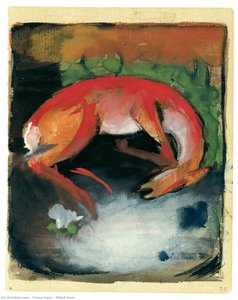
Mountain Goats
Giclée / Art Print
Reproduction Size
-


Total Price
$ 81
A Symphony of Color and Spirit: The Essence of Franz Marc’s Mountain Goats
In the pantheon of German Expressionism, few works capture the raw, spiritual pulse of nature as intimately as Franz Marc’s "Mountain Goats." Painted in 1913, this masterpiece serves as a profound window into the artist's soul, moving far beyond a mere depiction of alpine life to offer a visionary experience. At its heart, the painting is an exploration of the primal forces that govern our world. Marc, a pioneer of the Der Blaue Reiter movement, sought to strip away the superficial layers of reality to reveal the vibrant, energetic essence beneath. Through a deliberate and bold palette dominated by earthy reds, luminous yellows, and deep, soulful blues, he creates a landscape that feels less like a physical place and more like a spiritual manifestation.
The technique employed in this work is nothing short of visceral. Marc utilizes a thick impasto, applying oil paint with such density that the canvas itself begins to pulsate with life. This tactile approach creates a textured surface where light and shadow dance across the ridges of the brushstrokes, lending an incredible sense of movement to the scene. His style aligns beautifully with Synaesthetic Expressionism, where color is not merely decorative but functions as a primary language of emotion. To witness this painting is to feel the weight and warmth of the pigment, making it an extraordinary centerpiece for any collection that values the physical presence of art.
Symbolism and the Mythic Landscape
Beyond its striking colors, "Mountain Goats" is steeped in a complex layer of mythological and symbolic meaning. The central figures—often interpreted through the lens of Marc’s fascination with the duality of existence—evoke a sense of the archetypal. The presence of figures that hint at winged or horned beings suggests a struggle between the earthly and the divine, or perhaps the tension between instinct and consciousness. This reflects the broader Expressionist preoccupation with confronting existential questions during the turbulent years leading up to World War I. Marc famously believed that animals possessed a purity and spiritual clarity that humanity had lost; thus, his depiction of these creatures is an act of reverence for a more innocent, uncorrupted state of being.
Every element within the composition, from the sharp, spiky mountain peaks to the subtle inclusion of symbolic objects like clocks or vessels, contributes to a narrative of cosmic interconnectedness. The painting invites the viewer to look past the literal and engage with the metaphorical. For the discerning collector or interior designer, this depth of meaning provides a continuous source of contemplation. It is a work that does not merely sit upon a wall but actively engages the room, offering a sense of profound mystery and intellectual stimulation.
An Invitation to Transform Your Space
For those looking to infuse their living or professional environments with inspiration, a high-quality reproduction of "Mountain Goats" offers an unparalleled opportunity. The painting’s dynamic energy and rich, saturated tones make it a versatile choice for sophisticated interiors, ranging from modern minimalist galleries to classic, richly textured studies. It serves as a focal point that commands attention while simultaneously providing a sense of grounded, natural beauty.
Owning a piece that captures the spirit of Franz Marc is an investment in emotional resonance. Whether you are drawn to its historical significance within the German Expressionist movement or simply captivated by its rhythmic use of color, this artwork promises to transform any space into a sanctuary of thought and feeling. It is more than a decoration; it is a window into a world where color and spirit are one.
Questions & Answers
What is "Mountain Goats" about, and what atmosphere does it have?
"Mountain Goats" by Franz Marc combines mythology, animal symbolism, religious imagery, color palette, horned figure, trumpet motif, symbolic composition with a mystical atmosphere.
In which year and which movement was "Mountain Goats" made?
"Mountain Goats" by Franz Marc is dated 1913 and belongs to German Expressionism.
In what year was "Mountain Goats" by Franz Marc created?
"Mountain Goats" by Franz Marc was created in 1913.
Artist Biography
Early Life, Family and Training
Franz Marc was born in Munich, Germany, into a household where the visual language of landscape was already established. His father, Wilhelm Marc, worked as a professional landscape painter, providing a direct, if not entirely certain, introduction to the mechanics of art. This familial connection meant that the tools of the trade were present from the beginning, yet Marc’s path was not a straight line from inheritance to canvas. Before committing to a life of painting, he spent time grappling with theology, a period of spiritual inquiry that would later dictate the intensity of his visual output. This tension between the sacred and the material is what gives his later work its specific, heavy weight.
His formal training began in 1900 when he enrolled in the arts program at the Ludwig-Maximilians-Universität München. This academic foundation was not a mere formality; it provided the technical rigor necessary to eventually dismantle traditional representation. Following his time at Munich University, he moved on to the Academy of Fine Arts, Munich. This sequence of study moved him from general academic principles toward the specialized, intense focus required for the radical shifts he would eventually lead. He was not a product of accidental talent, but of a deliberate, structured immersion in the formal traditions of Munich.
Artistic Development and Influences
Marc’s early output reflects the heavy weight of academic painting and Impressionism. These traditional foundations provided the technical structure he would eventually dismantle. His time in France, specifically during visits to Paris in 1903 and 1907, acted as a catalyst for this departure. It was in Paris that he encountered the work of Vincent van Gogh. This encounter provided a necessary alternative to the rigid structures of his training, offering a way to use color as a direct tool for emotional expression rather than mere description.
The shift toward abstraction was not a sudden leap but a calculated response to the evolving visual language of the early 20th century. Robert Delaunay’s exploration of abstract forms and intense color palettes provided a blueprint for Marc’s own movement toward simplification. He moved away from the literal representation of the landscape, seeking instead to strip subjects down to their essential shapes. This process allowed him to move past the surface of the natural world to reach a more subjective, charged style of expression.
The Blue Rider and Expressionism
The shift from mere representation to a search for spiritual truth defines Marc's most significant contribution to modernism. Before establishing his own movement, he experimented with the Neue Künstlervereinigung München. This period of trial and error was necessary to break away from the academic constraints of the time. By 1911, Marc co-founded Der Blaue Reiter alongside Wassily Kandinsky. This was not a mere social club; it was a radical departure from the status quo. The group used the Der Blaue Reiter journal to push a specific agenda: the use of abstraction and symbolic color to express inner spiritual realities. They wanted to bypass the surface of the physical world to reach something more essential.
This movement was a direct challenge to the industrial, gray reality of the early 20th century. Marc and his colleagues sought a visual language that could communicate the soul rather than just the eye. They moved toward a style where color functioned as a spiritual frequency. This wasn't about painting what was seen, but about capturing the internal essence of a subject. The focus shifted from the external landscape to a rhythmic, symbolic interpretation of life. This period marked the moment when German Expressionism found its most potent, non-literal voice.
Technique and Symbolic Style
Marc’s visual language relies on a rigid, deliberate system of color symbolism that rejects descriptive accuracy. He did not use hues to mimic the natural world, but to map out a spiritual hierarchy. In his palette, blue represents masculinity and spirituality. Yellow signifies femininity and joy. Red embodies materiality and violence. This was not a loose aesthetic choice; it was a structured attempt to communicate internal truths through external pigment. By stripping away the literal, he forced the viewer to engage with the emotional weight of the color itself.
His technique moved toward a radical simplification of form. He reduced complex biological structures into essential, rhythmic shapes. This reductionism, combined with bold, non-naturalistic colors, created a sense of tension between the subject and its environment. He used short, deliberate brushstrokes and impasto to build texture, giving his compositions a physical presence that contradicts the abstraction of his subjects. The result is a style where the animal is no longer a creature of flesh, but a vessel for a specific, coded energy.
- The Tower of Blue Horses (1913)
- The World-Cow (1913)
- The Foxes (1913)
Key Works and Subject Matter
Marc’s mature output centers on the animal kingdom. He moved away from static landscapes to focus on creatures like horses, deer, and foxes. These subjects functioned as vessels for spiritual energy rather than mere biological studies. In 1911, he produced The Large Blue Horses, a work that established his preference for non-naturalistic color. By 1912, his compositions became more aggressive and structured, seen in Tiger and Red Deer. These paintings demonstrate a shift toward capturing the inherent qualities of his subjects through simplified, rhythmic forms.
The evolution of his style shows a clear trajectory toward abstraction. His 1913 work The Foxes reflects the influence of French Cubism, utilizing a crystalline composition to break down form. This approach reached a peak in The World-Cow, painted in 1913, where the subject becomes a symbol of cosmic existence. His work relies on a specific color logic: blue for masculinity and spirituality, yellow for femininity and joy, and red for violence and materiality. This system turned every animal portrait into a philosophical statement rather than a literal depiction.
- The Large Blue Horses (1911)
- Tiger (1912)
- Red Deer (1912)
- The Foxes (1913)
- The World-Cow (1913)
Later Years and Death
The trajectory of Marc's career was abruptly severed by the onset of World War I in 1914. Despite his status as an artist, he was drafted into the German army to serve as a cavalryman. The conflict forced a shift from his pursuit of spiritual abstraction to the grim realities of military service. Even amidst the chaos of the war, he continued to paint, attempting to find meaning through his brush even as the world around him fractured.
His life ended on March 4, 1916, at the Battle of Verdun. This death occurred two years after the outbreak of the war. He was killed by a shell splinter, a violent end that cut short a career defined by the search for purity. The suddenness of his death at Verdun left a void in the development of German Expressionism, halting his movement toward even more radical abstraction before he could reach its logical conclusion.
Legacy and Influence
Franz Marc remains a central figure in the history of German Expressionism. His impact is measured by how his approach to color and form shifted the focus of modern art from external observation to internal spiritual truth. While his career was cut short, his influence persists through the continued presence of his works in major museums across the globe. His ability to distill the essence of animals into symbolic, non-naturalistic shapes changed the trajectory of early 20th-century painting.
The political landscape of the 1930s attempted to erase this contribution. The Nazi regime labeled Marc a degenerate artist, part of a broader effort to suppress modernism. Despite this systematic campaign, the majority of his output survived the destruction of World War II. This survival ensures that his visual language remains accessible to contemporary audiences. His work continues to resonate because it offers a direct, emotive response to the natural world that avoids the constraints of literal representation.
- The Foxes (1913)
- The World-Cow (1913)
- Red Deer (1912)
Where to See the Works Today
To encounter the physical reality of Marc's vision, one must look to specific institutional collections that preserved his output through the turbulence of the 20th century. The Franz Marc Museum in Kochel am See, Germany, functions as a primary site for his legacy, housing over 150 of his works. This collection provides a direct look at the artist's development within the Bavarian landscape. In Munich, the Lenbachhaus maintains an extensive collection, offering a concentrated look at his contribution to German Expressionism. The Staatsgalerie Moderner Kunst in Munich also holds significant pieces, ensuring his presence remains central to the city's art history.
His reach extends far beyond German borders, with major international museums holding his canvases. In the United States, the Art Institute of Chicago possesses The Enchanted Mill. These scattered locations allow for a global understanding of his impact on modern abstraction. Seeing these works in person reveals the actual texture of his brushwork and the specific intensity of his color choices, which often lose their weight in digital reproductions.
- The Enchanted Mill (1913)
- The Tower of Blue Horses (1913)
- Red Deer II (1912)
- The Tiger (1912)

Franz Marc
1880 - 1916 , Germany
Quick Facts
- Artistic Movement Or Style: German Expressionism
- Artists Or Movements Influenced By This Artist: ['German Expressionism']
- Artists Who Influenced This Artist:
- Vincent van Gogh
- Robert Delaunay
- Full Name: Franz Moritz Wilhelm Marc
- Nationality: German
- Notable Artworks:
- The Large Blue Horses
- Tiger
- Red Deer II
- The World-Cow
- Place Of Birth: Munich, Germany
- Date Of Birth: 1880
- Date Of Death: 1916
Related Articles

Franz Marc: Expressionism, Spirituality & the Animal Symbolism of a Modern Master
Explore the profound world of Franz Marc's Expressionist paintings. Discover his spiritual connection to animals, innovative use of color, and lasting impact on modern art history. Learn more at OriginalUniqueArt.
The Visceral Cry of a Nation: Exploring Emotion & Distortion in German Expressionism
Explore the powerful world of German Expressionism with OriginalUniqueArt. Discover Kirchner, Nolde & Die Brücke's emotive masterpieces. Learn about this pivotal art movement and its lasting impact on modern art.

German Expressionism's 10 Defining Masterpieces | Art for Your Home
Explore 10 defining German Expressionism masterpieces – from Munch's 'The Scream' to Kandinsky’s abstracts. Discover the artists, stories & bold colors behind this powerful art movement. Find museum-quality reproductions at OriginalUniqueArt.com.

Unmasking Emotion: A Journey Through the Raw Power and Visceral Beauty of German Expressionism
Explore the raw emotional power of German Expressionism. From Kirchner to Die Brücke, discover how artists used distortion and vibrant color to unmask the human psyche. A deep dive into art history for the discerning collector and enthusiast.
Animalia: Exploring the Enduring Presence of Animals in Art & Interior Design
Explore the rich history of animal symbolism in art, from ancient mythology to modern masterpieces. Discover how animals have inspired artists for centuries and learn how to incorporate these powerful motifs into your home décor.