Preview
 Send
Send Share
Share
 Details
 Guide
Guide

 Download
 Similars
 X-Ray
X-Ray Diaporama
 Stats
StatsLE COMTE DE NOGENT


 Read More
Hand Made Oil Reproduction
Hand-painted oil on canvas in your size and frame, made to order by our artists. ( Switch to Print Switch to Digital Image)




P118B $10

P118H $10

P118W $10

P438Z $10

P508JH $12

P508YH $12

P805H $10

P805Z $10

P919BZ $10

P919G $10

P919XJ $10

P959ZH $10

P968JZ $12

W106C $8

W218G $10

W218JH $8

W218Y $10

W307PJ $10

W316G $10

W316PJ $8

W316Y $10

W398PJ $8

W4111J $10

W500HY $15

W500JH $15

W692G $12

W849H $8

W940BG $15

W953PJ $8




Pick from our preset sizes that match the artwork's original proportions.

Type the width and the height you need, to fit your frame or your wall. This is hand-painted, so for a size with a different shape the artist can paint a bit more around the picture, or cut a bit — you choose. We send you a digital mockup to approve before the painting starts. The picture shown on this page does not show the real result — only the mockup does.
After order, OriginalUniqueArt.com team will email client for instructions and provide a mockup preview
Worldwide Delivery () in 3/4 weeks instead of standard 5 weeks. (26 October). No compromise on quality.

Free Worldwide Express Shipping

High-Quality Linen Canvas

Full Shipping Insurance

Customs Tax Refund Guarantee

True Color Matching Guarantee

100-Day Return Policy (Defects Only)

100% Money-Back Guarantee

Bulk Discount Offer
 Glass option is only available in size under 110 CM

LE COMTE DE NOGENT
Reproduction Medium
Reproduction Size
-


Total Price
$ 300
A Portrait of Youthful Grace: François Hubert Drouais’s “Le Comte de Nogent”
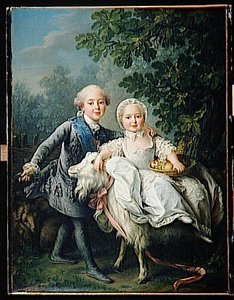
François Hubert Drouais's "Le Comte de Nogent," painted in the heart of 18th-century France, is more than just a portrait; it’s a meticulously crafted window into a world of aristocratic leisure and refined beauty. Executed with the characteristic delicacy of the Rococo style, this oval oil painting captures a young nobleman – likely a member of the Nogent family, from which the work derives its title – in an exquisitely posed moment of contemplative grace. The scene unfolds against a subtly textured dark green backdrop, partially obscured by a landscape that hints at the pleasures of the countryside, creating a sense of both intimacy and expansive possibility.
Drouais, a prominent painter of his era, was deeply embedded within the artistic circles of Paris, serving as a favored artist for royalty and nobility. His skill lay in capturing not just physical likeness but also the very essence of his subjects – their personalities, social standing, and even their inner lives. “Le Comte de Nogent” exemplifies this approach; the young man’s posture, the tilt of his head, and the subtle expression on his face all speak volumes about his character and status.
The Rococo Palette: Technique and Detail
The painting's beauty is rooted in Drouais’s masterful command of the Rococo technique. Notice the smooth, almost porcelain-like quality of the skin tones – a hallmark of the style, achieved through layering thin glazes of oil paint to create an illusion of luminosity and depth. The fabrics are rendered with astonishing detail; the elaborate pink and gold jacket, adorned with delicate frills, appears incredibly tactile, while the lace trim around his collar and cuffs is meticulously depicted. The artist’s use of light is particularly noteworthy – it's soft, diffused, bathing the subject in a gentle glow that enhances his youthful appearance.
Close examination reveals Drouais’s meticulous approach to texture. The wig, a symbol of status during this period, is rendered with individual strands meticulously painted to mimic its voluminous form. Similarly, the roses in the ornate pot – a recurring motif in Rococo art symbolizing love and beauty – are depicted with vibrant color and realistic detail, adding a touch of romanticism to the scene. The artist skillfully employs linear perspective to create a sense of depth, guiding the viewer’s eye through the composition from the foreground figure to the distant landscape.
Symbolism and Context: A Portrait of an Era
“Le Comte de Nogent” is deeply embedded within the cultural context of 18th-century France. The portrait reflects the aristocratic values of the time – a focus on elegance, refinement, and leisure. The young nobleman’s pose, with his hand resting lightly on a book (often a signifier of intellect and status), suggests a cultivated mind and a life devoted to intellectual pursuits. The inclusion of the roses further reinforces this theme, linking the subject to ideals of beauty and romance.
Furthermore, the painting offers a glimpse into the social dynamics of the era. The young nobleman’s reaching gesture towards the bouquet of roses can be interpreted as an invitation – a subtle display of charm and confidence. The setting itself, with its hints of the countryside, speaks to the importance of rural estates and the aristocratic lifestyle centered around them. It's a scene frozen in time, capturing a moment of youthful indulgence within a world of privilege and social decorum.
A Timeless Masterpiece: Reproduction and Inspiration
Reproductions of “Le Comte de Nogent” offer a remarkable opportunity to bring this exquisite work of art into your home or office. Whether you’re an art collector, an interior designer seeking to evoke the elegance of the Rococo period, or simply someone who appreciates beautiful artistry, this painting holds enduring appeal. The meticulous detail, vibrant colors, and evocative symbolism create a captivating visual experience that transcends time.
Consider how the painting's composition – the balanced arrangement of figures and elements, the use of light and shadow – can inform your own design choices. The delicate textures and rich color palette can be echoed in fabrics, furnishings, and decorative objects to create a space that is both sophisticated and inviting. “Le Comte de Nogent” serves as a timeless reminder of the power of art to transport us to another era and inspire our creativity.
Questions & Answers
How can I get a print of "LE COMTE DE NOGENT" by François Hubert Drouais?
"LE COMTE DE NOGENT" is available as a fine art print on cotton canvas or archival canvas paper. Orders are placed on its Fine Art Print page, in the size of your choice.
How do the colors of "LE COMTE DE NOGENT" relate to each other?
"LE COMTE DE NOGENT" by François Hubert Drouais displays a balanced harmony color harmony.
Is "LE COMTE DE NOGENT" a famous Rococo artwork?
Within the Rococo movement, "LE COMTE DE NOGENT" has a recognized popularity level.
Artist Biography
The Master of Rococo Elegance
In the luminous and opulent atmosphere of mid-eighteenth-century France, few artists captured the essence of aristocratic grace as intimately as François Hubert Drouais. A leading portrait painter during the latter years of Louis XV's reign, Drouais possessed a singular ability to translate the refinement and charm of the French court onto canvas. His work serves as a breathtaking window into the Rococo era, a period defined by its pursuit of an idealized sense of beauty and a carefully orchestrated symphony of light and texture.
Born in Paris, France, Drouais was immersed in the world of fine art from his earliest years. He followed in the footsteps of his father, Hubert Drouais, receiving his initial artistic instruction from him. This lineage of portraiture provided a foundation of technical mastery that would later allow him to navigate the highest echelons of Parisian society. His talent was not merely confined to capturing likenesses; he had a profound ability to imbue his subjects with a psychological presence that transcends the centuries, making his portraits feel both personal and timeless.
A Canvas of Aristocratic Splendor
The rise of Drouais's popularity was inextricably linked to his increasing presence at the French court. As his reputation grew, his clientele expanded to include the French royal family, the nobility, foreign aristocracy, and the wealthy fermiers-généraux. His portraits became a fashionable necessity for the members of Parisian society and their favorites, who sought to immortalize their status through his exquisite brushwork.
Drouais's technique was characterized by a delicate layering of thin, translucent glazes of oil paint. This method allowed him to achieve a porcelain-like luminosity in the skin of his subjects, creating a soft, diffused lighting that seemed to emanate from within the canvas. His mastery extended beyond the human form to the very textures of the Rococo lifestyle:
- Luminous Skin Tones: The use of glazes to create a radiant, lifelike glow.
- Textural Realism: A tactile approach to depicting fine fabrics, silks, and lace.
- Atmospheric Light: The interplay of light and shadow to create depth and emotional resonance.
- Color Palette: A preference for the soft, muted tones characteristic of the era, such as beiges, grays, blues, and delicate pinks.
Legacy and Historical Significance
The historical significance of François Hubert Drouais lies in his role as a definitive chronicler of the Ancien Régime. Through his eyes, we witness the quiet dignity and understated elegance of figures such as Madame Jacques Benoit Loys and the Comte de Vaudreuil. His work does more than document historical individuals; it captures the very soul of a period defined by its pursuit of refinement.
His influence also extended through his family, notably to his son, Jean Germain Drouais, who continued the tradition of portraiture and historical painting. While the era of the Rococo would eventually give way to new artistic movements, the works of François Hubert Drouais remain enduring monuments to a lost age of French splendor, preserved in prestigious collections such as the National Gallery, London and the National Gallery of Art.

François Hubert Drouais
1727 - 1775 , France
Quick Facts
- Artistic Movement Or Style: Rococo
- Artists Or Movements Influenced By This Artist: ['Jean Germain Drouais']
- Artists Who Influenced This Artist: ['Hubert Drouais']
- Full Name: François-Hubert Drouais
- Notable Artworks:
- Madame Jacques Benoit Loys
- Portrait d'homme, dit autrefois Antoine Michaut
- Marie-Joséphine de Savoie
- Madame Drouais
- Portrait of the Comte de Vaudreuil
- Family Portrait
- Place Of Birth: Paris, France
- Date Of Birth: 1727
- Date Of Death: 1775
Related Articles
Rococo Art Guide: Elegance, Ornamentation, and the Era of Luxury
Explore the elegance of Rococo art. From Watteau to Fragonard, discover the history, aesthetics, and masters of 18th-century luxury in this expert guide for art lovers and collectors.

Illuminating the Enlightenment: A Comprehensive Exploration of 18th-Century Painting
Explore the captivating world of 18th-century painting! Discover Rococo's playful elegance & Neoclassicism’s Enlightenment ideals with expert insights into Fragonard, David, and more. A comprehensive guide for art enthusiasts.

Rococo's Radiant Legacy: 10 Masterpieces for Your Home |
Indulge in the elegance of Rococo! Explore 10 masterpieces by Fragonard, Boucher & Watteau. Discover the stories behind these iconic paintings and bring timeless art to your home with museum-quality reproductions from .
Blush & Brilliance: 10 Iconic Paintings Dominated by Light Pink Tones |
Explore 10 iconic paintings bathed in captivating light pink tones! From Monet's Impressionism to Renoir’s romance, discover the stories behind these blush-hued masterpieces. Find museum-quality art reproductions & decor inspiration at .

The Rococo Aesthetic: Opulence, Rebellion & the Pursuit of Pleasure in 18th-Century Art
Explore the opulent world of Rococo art! Discover its origins, key artists like Watteau & Boucher, and lasting influence on design. Expert insights for collectors & enthusiasts.