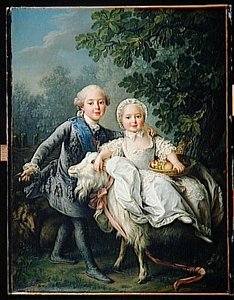
The Master of Rococo Elegance
In the luminous and opulent atmosphere of mid-eighteenth-century France, few artists captured the essence of aristocratic grace as intimately as François Hubert Drouais. A leading portrait painter during the latter years of Louis XV's reign, Drouais possessed a singular ability to translate the refinement and charm of the French court onto canvas. His work serves as a breathtaking window into the Rococo era, a period defined by its pursuit of an idealized sense of beauty and a carefully orchestrated symphony of light and texture.
Born in Paris, France, Drouais was immersed in the world of fine art from his earliest years. He followed in the footsteps of his father, Hubert Drouais, receiving his initial artistic instruction from him. This lineage of portraiture provided a foundation of technical mastery that would later allow him to navigate the highest echelons of Parisian society. His talent was not merely confined to capturing likenesses; he had a profound ability to imbue his subjects with a psychological presence that transcends the centuries, making his portraits feel both personal and timeless.
A Canvas of Aristocratic Splendor
The rise of Drouais's popularity was inextricably linked to his increasing presence at the French court. As his reputation grew, his clientele expanded to include the French royal family, the nobility, foreign aristocracy, and the wealthy fermiers-généraux. His portraits became a fashionable necessity for the members of Parisian society and their favorites, who sought to immortalize their status through his exquisite brushwork.
Drouais's technique was characterized by a delicate layering of thin, translucent glazes of oil paint. This method allowed him to achieve a porcelain-like luminosity in the skin of his subjects, creating a soft, diffused lighting that seemed to emanate from within the canvas. His mastery extended beyond the human form to the very textures of the Rococo lifestyle:
- Luminous Skin Tones: The use of glazes to create a radiant, lifelike glow.
- Textural Realism: A tactile approach to depicting fine fabrics, silks, and lace.
- Atmospheric Light: The interplay of light and shadow to create depth and emotional resonance.
- Color Palette: A preference for the soft, muted tones characteristic of the era, such as beiges, grays, blues, and delicate pinks.
Legacy and Historical Significance
The historical significance of François Hubert Drouais lies in his role as a definitive chronicler of the Ancien Régime. Through his eyes, we witness the quiet dignity and understated elegance of figures such as Madame Jacques Benoit Loys and the Comte de Vaudreuil. His work does more than document historical individuals; it captures the very soul of a period defined by its pursuit of refinement.
His influence also extended through his family, notably to his son, Jean Germain Drouais, who continued the tradition of portraiture and historical painting. While the era of the Rococo would eventually give way to new artistic movements, the works of François Hubert Drouais remain enduring monuments to a lost age of French splendor, preserved in prestigious collections such as the National Gallery, London and the National Gallery of Art.