Cubism · 1924
Three Characters (Fernand Léger, 1924)
Fernand Léger (1881–1955) made Three Characters. It dates from 1924. It belongs to the Cubism movement. It is made in acrylic on canvas.
- 1924
- Acrylic On Canvas

 Preview

 Hand Made Oil Painting
 Send
 Share
 Guide


 Download
 Similars
 X-Ray
 Diaporama
 Q&A

 Stats
Three Characters: the essentials
- Title
- Three Characters
- Artist
- Fernand Léger (1881–1955)
- Artist born in
- Argentan, France
- Date
- 1924
- Medium
- Acrylic On Canvas
- Movement
- Cubism
- Period
- Modern
- Subject
- geometric figures, modern composition, cubist style art, human interaction, bold color palette, everyday objects
What does Three Characters depict?
A Symphony of Form and Feeling: Exploring Fernand Léger’s “Three Characters”
Fernand Léger's 1924 painting, *“Three Characters,”* is a pivotal work exemplifying his distinctive contribution to Cubism – a style he uniquely evolved into what became known as ‘Tubism.’ More than just an exercise in geometric abstraction, this piece offers a compelling glimpse into the artist’s vision of modern life and human connection amidst industrialization.Deconstructing the Composition: Style & Technique
Léger masterfully employs simplified, cylindrical forms to depict three figures positioned closely together. This isn't about realistic representation; it’s a deliberate fragmentation and reassembly of reality through a Cubist lens. The painting eschews traditional perspective, presenting multiple viewpoints simultaneously within a flattened picture plane. The technique is characterized by smooth brushstrokes and carefully blended colors, creating a polished surface despite the angularity of the forms. This creates a sense of solidity and monumentality, grounding the abstracted figures.A Palette of Modernity: Color & Symbolism
While rooted in Cubism’s analytical approach, *“Three Characters”* distinguishes itself through its vibrant color palette. Léger moves beyond the muted tones often associated with early Cubism, embracing bold hues that inject energy and warmth into the composition. The inclusion of symbolic objects – a baseball bat and a book – adds layers of meaning. These aren’t merely decorative elements; they represent facets of everyday life, leisure, and intellectual pursuit, hinting at Léger's interest in portraying the modern individual within their environment. The figures themselves are not portraits but archetypes, representing universal aspects of human experience.Historical Context: Cubism & Beyond
Created in the aftermath of World War I, *“Three Characters”* reflects a broader cultural shift towards embracing modernity and industrialization. Léger, alongside Picasso and Braque, was at the forefront of the Cubist revolution, challenging traditional artistic conventions. However, he diverged from his peers by incorporating elements of machine aesthetics and popular culture into his work. His style evolved toward “Crystal Cubism,” emphasizing large, overlapping geometric planes and a strong focus on surface activity. This painting stands as a testament to that evolution, bridging the gap between abstract experimentation and representational form.Emotional Resonance & Lasting Influence
*“Three Characters”* evokes a sense of quiet contemplation and interconnectedness. Despite their abstracted forms, the figures possess a palpable presence, suggesting a shared experience or unspoken dialogue. The painting’s enduring appeal lies in its ability to resonate with viewers on an emotional level, prompting reflection on themes of identity, community, and the human condition. Léger's work profoundly influenced subsequent art movements, including Futurism, Abstract Art, and Surrealism, solidifying his legacy as a visionary artist who redefined the possibilities of painting in the 20th century.Collecting & Interior Design Considerations
- Style Compatibility: This artwork complements modern, minimalist, or Art Deco interiors. Its geometric forms and bold colors create a striking focal point.
- Color Palette Integration: The painting’s color scheme can be echoed in accent furniture, textiles, or wall colors to create a cohesive design aesthetic.
- Placement Suggestions: Ideal for living rooms, dining areas, or home offices. Consider pairing it with contemporary sculptures or abstract artwork.
- Investment Potential: As a seminal work by a highly influential artist, a high-quality reproduction of *“Three Characters”* represents not only an aesthetic addition but also a potential investment in art history.
Three Characters in high resolution

Fernand Léger, Three Characters (1924). Public domain.
A digital expert checks the colors against the original painting and retouches the file, faithful to the artist's brushwork.
Buy the high-resolution imageQuestions about Three Characters
What is the recommended print size for "Three Characters" by Fernand Léger?
The recommended print size for "Three Characters" by Fernand Léger is large.
What are the date and style of "Three Characters" by Fernand Léger?
"Three Characters" was made in 1924, within the Cubism movement.
Do the colors of "Three Characters" appear strong or soft?
The colors in "Three Characters" by Fernand Léger have a monochromatic intensity.
Why is the copyright status of "Three Characters" what it is?
"Three Characters" by Fernand Léger is in the public domain - its copyright has expired. Copyright duration runs from the artist's death, which occurred in 1955.
What underlying hue runs through "Three Characters" by Fernand Léger?
"Three Characters" leans toward an ochre to sepia tone.
Where can I download "Three Characters" by Fernand Léger?
"Three Characters" by Fernand Léger can be downloaded from the artwork's Download page, as a high-resolution digital image download.
Where does "Three Characters" stand among Fernand Léger's recurring subjects?
Fernand Léger's recurring themes include exploration of flat planes, expansion of color usage, cubism's geometric forms, early 20th-century modernism, urban life & modernity, human connection & interaction; "Three Characters" focuses on geometric figures, modern composition, cubist style art, human interaction, bold color palette, everyday objects, abstract forms.
Can I examine "Three Characters" in more detail?
The X-Ray page of "Three Characters" by Fernand Léger is an interactive viewer that lets you slide through eleven optical layers of the artwork's image, including an X-ray style view.
How is "Three Characters" situated historically?
Historically, "Three Characters" is a Cubism work of the broader Modern era.
About the artist, Fernand Léger

1881–1955, France
Fernand Léger
The Life of Fernand Léger The story of Fernand Léger begins in the village of Argentan, located in the Orne region of Lower Normandy. He arrived into this world on February 4, 1881, as an only son. His early years were shaped by the quietude of the French countryside and the presence of his mother, Marie-Adèle Daunou. His father, a man who made his living as a cattle dealer, passed away when Fernand was still a young boy, leaving the child to be raised by his mother in a household marked by her piety and a certain self-effacing nature.
Also by Fernand Léger
 The City1919
 The Mechanic1920
 Three Women1921
 Nudes in the Forest1910

Essays around Three Characters
 Masterpieces of Fernand Léger: The Top 25 Essential WorksExplore the top 25 masterpieces by Fernand Léger. Discover the essence of Cubism and modernism. Explore the full collection online at Origi…
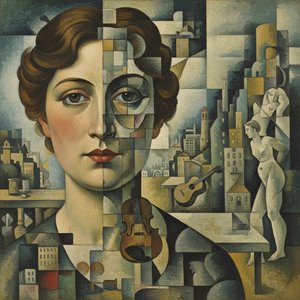 Deconstructing Reality: Cubism's Revolutionary Impact on 20th-Century ArtExplore the revolutionary world of Cubism with OriginalUniqueArt. Discover Picasso & Braque's groundbreaking techniques, its philosophical …
 Industrial Revolution on Canvas: 10 Artworks That Define a Modern AestheticExplore 10 iconic artworks capturing the Industrial Revolution’s grit & beauty. From Monet to Manet, discover realism, impressionism & powe…