Oil Edition
 Everything about Staircase 19







































 For artworks or reproductions larger than 105 cm (approximately 41 inches) on any side, the frame will be shipped as a kit, disassembled. This method ensures safe delivery and prevents damage during transport.


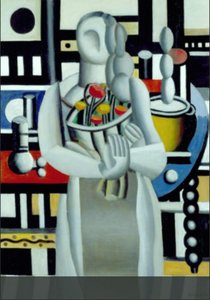
Fernand Léger, a prominent figure in the Cubism movement, created "Staircase" in 1914. This painting is a quintessential example of Cubist art, characterized by its geometric forms and fragmented objects.
Composition and Elements
The scene depicts a stairwell with various objects scattered throughout the space. Multiple cups of different sizes are placed on the steps, some closer to the viewer and others further away. A bowl is located near the center of the painting, while a vase is positioned towards the left side. Several bottles are scattered throughout the scene, with one close to the top right corner, another in the middle-right area, and two more on the bottom right side. A chair can be seen near the center of the painting, while a clock is located towards the upper left corner.Cubism and Proto-Cubism
Cubism, pioneered by Pablo Picasso and Georges Braque, revolutionized painting and visual arts in the early 20th century. The movement influenced artistic innovations in music, ballet, literature, and architecture. Cubist subjects are analyzed, broken up, and reassembled in an abstract form, depicting multiple perspectives to represent the subject in a greater context. Proto-Cubism, also referred to as Protocubism, Early Cubism, and Pre-Cubism or Précubisme, is an intermediary transition phase in the history of art chronologically extending from 1906 to 1910. This period is characterized by a move towards the radical geometrization of form and a reduction or limitation of the color palette.Artistic Influences
Fernand Léger's "Staircase" reflects the influence of Paul Cézanne's late works, which represented three-dimensional forms in a more geometric manner. The painting also showcases the artist's adherence to the principles of Cubism, as seen in the fragmented objects and multiple perspectives.Relevance and Legacy
Cubism has been considered the most influential art movement of the 20th century. Its impact was far-reaching and wide-ranging in the arts and popular culture. The movement introduced collage as a modern art form and influenced various offshoots, including Orphism, abstract art, Futurism, Suprematism, Dada, Constructivism, De Stijl, and Art Deco. In conclusion, Fernand Léger's "Staircase" is a significant work in the Cubist movement, showcasing the artist's skillful use of geometric forms and fragmented objects. The painting reflects the influence of Cézanne and the principles of Cubism, contributing to the movement's lasting impact on modern art.Questions & Answers
Is this Staircase 19 painted by hand or printed?
Painted by hand: a trained painter copies Staircase 19 in oil on linen canvas.
What size should I choose for Staircase 19?
Sizes run from 28.3 x 35.4 cm ($200) to 196.6 x 245.8 cm ($1772); the table on this page lists the main steps and their prices.
How long does delivery take?
Delivery takes 4 to 5 weeks, with free worldwide express shipping; an urgent production option is offered on this page. You can return it within 100 days for a full refund, with no condition.
Where is the original Staircase 19?
The original is in the collection of the Kunstmuseum Basel, Basel.
What medium did Fernand Léger use for Staircase 19?
Acrylic On Canvas.
More about this painting
 Preview

 Send
 Share
 Details
 Fact sheet


 Download
 Similars
 X-Ray
 Diaporama
 Q&A

 Stats