Symbolism · 1899
Composition study (Ferdinand Hodler, 1899)
Ferdinand Hodler (1853–1918) made Composition study. It dates from 1899. It belongs to the Symbolism movement. It is made in acrylic. It is kept at National Gallery of Bosnia and Herzegovina in Sarajevo, Bosnia and Herzegovina. It measures 28 × 39 cm.
- 1899
- Acrylic
- 28 × 39 cm
- National Gallery of Bosnia and Herzegovina, Sarajevo

 Preview

 Hand Made Oil Painting
 Send
 Share
 Fact sheet


 Download
 Similars
 X-Ray
 Diaporama
 Q&A

 Stats
Composition study, in brief
- Title
- Composition study
- Artist
- Ferdinand Hodler (1853–1918)
- Artist born in
- Bern, Switzerland
- Date
- 1899
- Medium
- Acrylic
- Dimensions
- 28 × 39 cm
- Where to see it
- National Gallery of Bosnia and Herzegovina, Sarajevo, Bosnia and Herzegovina
- Movement
- Symbolism
- Subject
- swiss painting, symbolism, drawing, weightlifters, composition, monochrome
What does Composition study depict?
A Study in Quiet Tension: Decoding Ferdinand Hodler’s “Composition Study”
Ferdinand Hodler's "Composition Study," executed in 1899, isn’t merely a depiction of figures; it’s an exploration of psychological depth and the subtle interplay between stillness and movement—a hallmark of Symbolist art. The photograph captures a meticulously crafted painting that speaks volumes about its era and Hodler’s artistic sensibilities. Measuring 28 x 39 cm, this piece exemplifies Hodler's signature style: characterized by muted tones, flattened perspectives, and an almost dreamlike quality that prioritizes mood over precise realism.- Subject Matter & Context: The scene portrays a group of men wielding swords—a potent visual metaphor for power, defense, and perhaps even aggression—standing before what appears to be a larger assemblage. Hodler’s work emerged during the Symbolist movement, which reacted against Impressionism's focus on capturing fleeting sensory impressions. Instead, Symbolists sought to express inner emotions and spiritual truths through evocative imagery and symbolic references.
- Technique: Hodler employed tempera paint on canvas—a technique known for its luminosity and durability—allowing him to achieve a velvety surface finish that contributes significantly to the painting’s ethereal atmosphere. The artist skillfully utilized chiaroscuro, manipulating light and shadow to sculpt forms and heighten dramatic effect.
- Symbolism & Emotional Resonance: Beyond the obvious depiction of weaponry, “Composition Study” delves into themes of vulnerability and resilience. The central figure's gaze directs towards his right, suggesting introspection and a confrontation with inner turmoil amidst the surrounding presence of armed men. Hodler’s deliberate simplification of form—the flattened planes and muted palette—amplifies this emotional impact, inviting viewers to contemplate the complexities of human experience.
- Historical Significance: The painting reflects the anxieties of its time – a period marked by political instability and burgeoning militarism. However, Hodler transcends mere historical documentation; he transforms these concerns into universal meditations on courage, contemplation, and the enduring spirit of humanity.
Which museum holds Composition study?
National Gallery of Bosnia and Herzegovina
Sarajevo, Bosnia and Herzegovina
A Sanctuary of Resilience: The Soul of Sarajevo In the beating heart of Sarajevo, a city that has weathered the most profound storms of the twentieth century, stands the National Gallery of Bosnia and Herzegovina as a luminous testament to the enduring power of human creativity. To walk through its doors is to enter a space where the scars of history meet the triumph of the artistic spirit, offering a profound dialogue between a turbulent past and an aspirational future. It serves as a sanctuary where the collective memory of a people is preserved within the delicate strokes of paint and the heavy textures of stone.


High-resolution images of Composition study

Ferdinand Hodler, Composition study (1899), National Gallery of Bosnia and Herzegovina. Public domain.
Questions on Composition study, answered
Which museum holds the original "Composition study"?
You can see the original "Composition study" at the National Gallery of Bosnia and Herzegovina, Sarajevo, Bosnia and Herzegovina.
When was "Composition study" made?
"Composition study" dates from 1899. The date places the work within Ferdinand Hodler's career and its era.
What technique was used for "Composition study" by Ferdinand Hodler?
The medium of "Composition study" by Ferdinand Hodler is acrylic. Reproductions aim to render the appearance of this technique.
How big is the original "Composition study"?
The recorded dimensions of "Composition study" by Ferdinand Hodler are 28 x 39 cm. Reproductions can be ordered in other sizes while keeping the same proportions.
What does "Composition study" by Ferdinand Hodler depict?
The themes present in "Composition study" by Ferdinand Hodler include swiss painting, symbolism, drawing, weightlifters, composition, monochrome, anatomy. Together they summarize the artwork's subject matter.
Is "Composition study" free of copyright?
The copyright answer for "Composition study" by Ferdinand Hodler: the work is in the public domain - its copyright has expired. This determines whether reproductions of the image may be freely made.
Who is the artist behind "Composition study"?
"Composition study" was created by Ferdinand Hodler. The information on this page describes Ferdinand Hodler's original work.
What style does "Composition study" belong to?
The movement associated with "Composition study" by Ferdinand Hodler is Symbolism. This classification situates the work among related artists and artworks.
Where does "Composition study" fall in Ferdinand Hodler's career?
Within Ferdinand Hodler's career, "Composition study" falls in the Blue Rider Period. The phase helps compare it with the artist's other works.
About the artist, Ferdinand Hodler
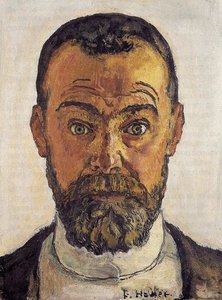
1853–1918, Switzerland
Ferdinand Hodler
The Architecture of Mortality Born in Bern, Switzerland, in 1853, Ferdinand Hodler’s early years were defined by a quiet, persistent grief. Before he reached adolescence, the tuberculosis that claimed his father and two younger brothers left a void in his household. This early encounter with loss became a recurring motif in his work, a shadow that would follow him from the modest beginnings of his apprenticeship to the heights of his professional career. He began his training as a decorative painter, assisting his stepfather with commercial sign-work, a practical education that instilled in him a precise command of line and form.
Also by Ferdinand Hodler
 Eiger, Monch and Jungfrau in Moonlight1908
 Woman in Ecstasy1911
 Sunset on Lake Geneva1915
 Study of two figures1897

Essays around Composition study
 Espresso Tones in Art: 10 Masterpieces for a Richly Layered Home DecorDelve into 10 famous paintings with captivating 'espresso tones'! Explore masterpieces by Rembrandt, Caravaggio & Vermeer. Find museum-qual…
 Mastering Parallelism: The 25 Most Iconic Artworks by Ferdinand HodlerImmerse yourself in the rhythmic beauty of Ferdinand Hodler. Explore 25 iconic masterpieces of Swiss Symbolism and Parallelism. From soulfu…
 Friedrich von Amerling: Capturing Viennese Aristocracy & the Biedermeier SpiritExplore the elegant portraits of Friedrich von Amerling, a master of Viennese Biedermeier art. Discover his life, style, and lasting influe…