Read More


 For artworks or reproductions larger than 105 cm (approximately 41 inches) on any side, the frame will be shipped as a kit, disassembled. This method ensures safe delivery and prevents damage during transport.


More about this painting
Text size

() ·
A painting made for you, by hand
Hand Made Oil Reproduction
Hand-painted oil on canvas in your size and frame, made to order by our artists. ( Switch to Print Switch to Digital Image)
Artist Biography
Eugène Laermans (1864-1940): Belgian painter known for evocative genre scenes of laborers & peasants, influenced by Bruegel & Decadent movements. Explore his powerful portrayals of social realism and haunting compositions.
from ·
Chapter 1
How large should it be?
Slide to change the size; the picture on the left shows the frame at its real width. The proportions of the original are kept.
Standard
custom
CM
INCH
Pick from our preset sizes that match the artwork's original proportions.
Loading sizes...

width
height
Type the width and the height you need, to fit your frame or your wall. This is hand-painted, so for a size with a different shape the artist can paint a bit more around the picture, or cut a bit — you choose. We send you a digital mockup to approve before the painting starts. The picture shown on this page does not show the real result — only the mockup does.
Chapter 2
How should it arrive?
Choose the edges of the stretched canvas
Choose your frame

White $1

Blurside $1

Extended $1

P118B $10

P118H $10

P118W $10

P438Z $10

P508JH $12

P508YH $12

P805H $10

P805Z $10

P919BZ $10

P919G $10

P919XJ $10

P959ZH $10

P968JZ $12

W106C $8

W218G $10

W218JH $8

W218Y $10

W307PJ $10

W316G $10

W316PJ $8

W316Y $10

W398PJ $8

W4111J $10

W500HY $15

W500JH $15

W692G $12

W849H $8

W940BG $15

W953PJ $8

H24-GOLD $30

H24-SILVER $30

H36-GOLD $45

H36-SILVER $45
Framed
Moulding: . Overall size with the frame: .
Chapter 3
Who paints it, and should anything change?
Examples of what can be changed: Replace face with customer photo; Add pet (e.g., replace cat with dog); Include hidden message in background; Change background landscape or elements.
After order, OriginalUniqueArt.com team will email client for instructions and provide a mockup preview
After order, OriginalUniqueArt.com team will email client for instructions and provide a mockup preview
Chapter 4
Worldwide Delivery () in 3/4 weeks instead of standard 5 weeks. (22 November). No compromise on quality.
The finishing touches
A nameplate, as in a museum?
Engraved Bronze Plaque Details
This elegant plaque features the artist's name and the title of the artwork, finely engraved for a timeless presentation.
It is made from bronze with a refined, elegant finish. The text is precisely laser-engraved for a sharp and permanent result. Measuring 9x2 cm, the plaque is compact yet easy to read. It's built to be durable and scratch-resistant, offering a professional, museum-quality look. Mounting is simple thanks to the included adhesive backing.
Transparent Acrylic Plaque Details
The plaque includes essential engraved details such as the artist's name, the title of the artwork, the date it was created, the type of media used-like oil on canvas or watercolor-a brief description of the piece, and a QR code that links to the complete artwork information.
It is crafted from clear acrylic, offering a sleek, modern appearance. The text is UV-engraved in black to ensure strong visual contrast. With a size of 10x15 cm, it ensures optimal readability. It comes equipped with two metal hooks for secure wall mounting. The plaque is designed to be weather-resistant, making it suitable for various environments, and it includes interactive features that work seamlessly with smartphone scanning.
Black Acrylic Plaque Details
This elegant plaque includes engraved information such as the artist's name, the title of the artwork, the date it was created, the type of media used (like oil on canvas or watercolor), a short description of the artwork, and a QR code for quick access to more information.
The plaque itself is made from refined black acrylic with a premium finish. The text is laser-engraved in white for high contrast and readability. Its size is 10x15 cm, designed to be easy to read. It comes with two metal hooks for professional mounting. The design is sleek and fits any interior style. It is also weather-resistant and durable, with built-in digital integration for mobile compatibility.
A protective varnish?
When do you need it?
Chapter 5
Your painting, as you ordered it
Oasis
Reproduction Medium
Reproduction Size
-
Elite Senior Artist
More detail, finesse, and extra production time
-
Reproduction Frame
-
-
For artworks or reproductions larger than 105 cm (approximately 41 inches) on any side, the frame will be shipped as a kit, disassembled. This method ensures safe delivery and prevents damage during transport.
Professional assembly required - this is not a DIY product.
The kit must be assembled and the canvas stretched by an experienced professional framer, using wood glue (not supplied), a canvas stretching plier and clamps to hold the bars square while the glue dries. Incorrect assembly or uneven canvas tension can permanently damage the artwork and is not covered by our warranty.
All solid wood bars are included, precisely cut to size.
Assembled with the screws provided, plus wood glue for the corner joints, which is not supplied and must be sourced by your framer.
Professional tools are required and not included: a canvas stretching plier (tensioner) and clamps to hold the bars square while the glue dries.
Important:
The corner joints require wood glue, the bars must be held with clamps until the glue is fully dry, and tightening the canvas on the assembled frame requires a canvas stretching plier. None of these are included in the kit. Please arrange an experienced professional framer before ordering this size.
Nameplate
-
-
Protective Varnish
Glossy Varnish (enhances colors, protects against light/moisture)
-
Customize My Artwork
Examples of what can be changed: Replace face with customer photo; Add pet (e.g., replace cat with dog); Include hidden message in background; Change background landscape or elements.
-
Urgent
Worldwide Delivery () in 3/4 weeks instead of standard 5 weeks. (22 November). No compromise on quality.
-
Express Shipping
Worldwide Delivery () in 5 weeks. (29 November).
Included
Total Price
$ 300
Glass option is only available in size under 110 CM
Included with every order
- Free Worldwide Express Shipping
- High-Quality Linen Canvas
- Full Shipping Insurance
- Customs Tax Refund Guarantee
- True Color Matching Guarantee
- 100-Day Return Policy (Defects Only)
- 100% Money-Back Guarantee
- Bulk Discount Offer
 Preview
 Send
Send Share
Share
 Details
 Guide
Guide

 Download
 Similars
 X-Ray
X-Ray Diaporama
 Q&A
Q&A Stats
StatsIn numbers
- 1912the year it was painted
- 29frames to choose from
- standard sizes, in its own proportions
- 5weeks to paint and deliver it
About the original

- 149.0 x 119.0 cm


Eugène Laermans
1864 - 1940, Belgium
Quick facts about Eugène Laermans
- Artistic Movement Or Style: Decadent Art; Genre Painting; Bruegel Influence
- Artists Or Movements Influenced By This Artist: ['Bruegel']
- Artists Who Influenced This Artist:
- Jean-François Portaels
- Charles Baudelaire
- Félicien Rops
- Date Of Birth: 1864
- Date Of Death: 1940
- Full Name: Eugène Jules Joseph Baron Laermans
- Nationality: Belgian
- Notable Artworks:
- English The Staircase
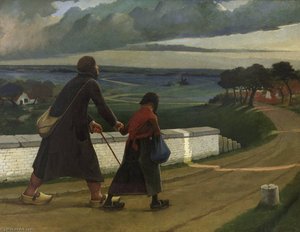
- Oasis
- The Drinker
- Landverhuisers
- Place Of Birth: Saint-jans-molenbeek, Belgium
Artist Biography
The Silent Visionary: The Life and Legacy of Eugène Laermans
In the quiet, shadowed corners of Belgian art history, few figures command as much profound respect and haunting intrigue as Eugène Jules Joseph Baron Laermans. Born in 1864 in Molenbeek-Saint-Jean, Brussels, his life was defined by a struggle against the encroaching darkness and silence of physical infirmity. At the tender age of eleven, a devastating bout of meningitis robbed him of his hearing and left him nearly mute. Yet, rather than allowing this tragedy to sever his connection to the world, Laermulus transformed his sensory deprivation into an unparalleled visual acuity. Deprived of sound, he turned his entire being toward the power of sight, developing an observational intensity that would eventually allow him to capture the very soul of the marginalized and the downtrodden.
His journey through the artistic landscape was one of remarkable stylistic metamorphosis. Enrolling at the Académie Royale des Beaux-Arts in 1887, he studied under the guidance of Jean-François Portaels, an experience that provided him with a rigorous academic foundation. During his early years, Laermans found himself drawn to the provocative and the decadent. Influenced by the evocative writings of Charles Baudelaire, he actively participated in the Decadent movement of 1890, even lending his brush to illustrate the controversial Les Fleurs du Mal. This period of his life was marked by an exploration of uncomfortable truths and a willingness to confront the darker, more complex facets of human nature, often utilizing an expressive and sometimes unsettling aesthetic.
From Decadence to Social Realism
As his career matured, Laermans underwent a profound shift that would ultimately define his historical significance. By 1893, he began to move away from the stylized decadence of his youth, gravitating instead toward a rugged, earthy realism reminiscent of the great Pieter Bruegel. This transition saw him abandon ornamental flourishes in favor of a more somber, monumental approach to his subjects. He became a chronicler of the human condition, focusing his gaze on the heavy-laden laborers and impoverished peasants of the Belgian countryside. His work during this era was not merely observational; it was an empathetic, often visceral, portrayal of the dignity found within hardship.
His mastery of composition and tone reached new heights in works such as his celebrated triptych, Landverhuisers (Emigrants), inspired by the novel La Nouvelle Carthage by Georges Eekhoud. In these pieces, Laermans utilized a muted palette and atmospheric depth to convey the weight of displacement and the struggle for survival. While some contemporary critics dismissed his depictions as "disturbing caricatures," it is precisely this raw, unvarnished honesty that has secured his place in the canon of social realism. He possessed a unique ability to imbue even the most desolate scenes with a sense of monumental gravity, turning the mundane struggles of the working class into epic narratives of endurance.
The Fading Light and Eternal Impression
The trajectory of Laermans' life took a final, tragic turn in 1924 when his eyesight began to fail. For an artist whose entire identity was forged through the lens of visual perception, this loss was catastrophic. He famously declared, "I am no longer Laermans," as he ceased to paint, retreating into a reclusive existence. Despite being elevated to the rank of Baron in 1927 by King Albert, his later years were marked by the profound isolation of total blindness. He passed away in 1940, leaving behind a body of work that serves as a testament to the resilience of the human spirit.
Today, the legacy of Eugène Laermans endures through paintings that continue to haunt and inspire. His ability to find beauty in the bleak and strength in the silent remains his greatest achievement. To look upon a Laermans canvas is to witness:
- A heightened sensory experience: Where the absence of sound creates a profound visual stillness.
- Social empathy: A deep, respectful connection to the lives of those often ignored by history.
- Technical evolution: A journey from the intricate decadence of the late 19th century to the powerful, stripped-back realism of the early 20th century.
His work remains a vital pillar of Belgian art, reminding us that even when the world grows dark and silent, the eyes of the soul can still perceive the profound truths of existence.
Related Articles

25 Must-See Masterpieces at Museum Boijmans Van Beuningen in Rotterdam
Explore 25 iconic works from Museum Boijmans Van Beuningen, from Rembrandt to Basquiat. Discover all masterpieces on OriginalUniqueArt.com.
Explore artworks organized by themes, styles, and characteristics.