Preview
 Send
Send Share
Share
 Details

 Download
 Similars
 X-Ray
X-Ray Diaporama
Norwood Green
 Impressionism
 1895
1895- 19th Century
 21.0 x 27.0 cm
 Ealing Central Library
 Read More
Hand Made Oil Reproduction
Hand-painted oil on canvas in your size and frame, made to order by our artists. ( Buy Print Buy Image)




P118B $10

P118H $10

P118W $10

P438Z $10

P508JH $12

P508YH $12

P805H $10

P805Z $10

P919BZ $10

P919G $10

P919XJ $10

P959ZH $10

P968JZ $12

W106C $8

W218G $10

W218JH $8

W218Y $10

W307PJ $10

W316G $10

W316PJ $8

W316Y $10

W398PJ $8

W4111J $10

W500HY $15

W500JH $15

W692G $12

W849H $8

W940BG $15

W953PJ $8




Pick from our preset sizes that match the artwork's original proportions.

You may enter your own dimensions to fit a specific frame or space. If your selected size does not match the original image's proportions, we will either crop the artwork or extend the painting with additional hand-painted elements. A digital mockup will be sent for your approval before production begins.
Please note that the on-screen preview does not reflect the actual cropping or extension. Only the mockup will accurately show the final composition.
While custom sizes are available, we recommend selecting a dimension from the predefined list to preserve the original proportions.
After order, OriginalUniqueArt.com team will email client for instructions and provide a mockup preview
Worldwide Delivery () in 3/4 weeks instead of standard 5 weeks. (20 August). No compromise on quality.

Free Worldwide Express Shipping

High-Quality Linen Canvas

Full Shipping Insurance

Customs Tax Refund Guarantee

True Color Matching Guarantee

60-Day Return Policy (Defects Only)

100% Money-Back Guarantee

Bulk Discount Offer
 Glass option is only available in size under 110 CM

Norwood Green
Reproduction Medium
Reproduction Size
-


Total Price
$ 300
Artwork Description
A Window into Victorian Serenity
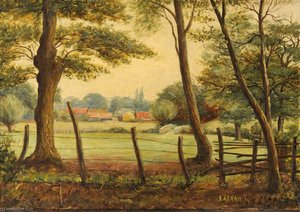
In the quietude of 1895, Ernest A. L. Ham captured a moment of profound stillness in his evocative work, Norwood Green. This charming piece serves as more than just a landscape; it is a nostalgic portal into the heart of an English small town, likely the Southall region that so deeply influenced the artist's soul. Through his meticulous brushwork, Ham invites the viewer to wander down a street lined with quaint houses, where the architecture of a bygone era stands in silent harmony with the natural world. The composition is anchored by the lush presence of roadside trees, their verdant canopies providing a sense of shelter and permanence to the scene. It is an idyllic vision of community and peace, rendered with a sensitivity that speaks to the artist's deep-rooted connection to the English countryside.
The narrative depth of the painting is found in its subtle human elements. Amidst the architectural charm, two solitary figures occupy the periphery, their presence adding a layer of lived experience to the landscape. Perhaps most captivating is the inclusion of a horse positioned centrally within the frame—a poignant symbol of a transitional era. This detail serves as a gentle reminder of a time when the rhythm of life was dictated by the pace of nature and animal labor, long before the mechanical roar of the modern age. The horse acts as a silent protagonist, embodying the slow, deliberate heartbeat of the late nineteenth century, and grounding the artwork in its historical reality.
Artistic Mastery and Decorative Elegance
Technically, Norwood Green exemplifies Ham’s ability to blend realism with an atmospheric, almost dreamlike quality. His technique utilizes a delicate balance of light and shadow to breathe life into the textures of stone, leaf, and earth. For the discerning collector or interior designer, this piece offers a sophisticated touch of historical warmth. The painting's palette, rich with organic tones, makes it an exquisite addition to a curated gallery wall or as a focal point in a room designed with classical or rustic elegance. It possesses that rare, transformative ability to anchor a space, providing a sense of continuity and timelessness.
To possess a reproduction of this masterpiece is to bring a piece of English heritage into the contemporary home. Whether placed in a sunlit study or a grand living area, Norwood Green evokes an emotional response of tranquility and reflection. It is an invitation to slow down, to breathe in the imagined scent of the roadside trees, and to find solace in the enduring beauty of a peaceful, pastoral life. For those who seek art that tells a story of peace, tradition, and the gentle passage of time, Ham’s vision remains an incomparable treasure.
Artist Biography
Ernest A. L. Ham: A Visionary of Rural England
Ernest Austin D’Lacey Ham, born in Wareham, Dorset on June 21st, 1874, was more than just a painter; he was a meticulous observer and preserver of the fading beauty of rural England. His life, intertwined with his family's maritime heritage – tracing back to France through the Hundred Years’ War – profoundly shaped his artistic perspective, instilling a deep appreciation for detail and a keen eye for capturing fleeting moments in time. Ham’s journey began not within the bustling studios of London’s art scene, but amidst the rolling hills and quiet villages of Dorset, an environment that would become the enduring subject of his work. His family's relocation to Southall in 1889 further cemented this connection to the English countryside, a landscape he would dedicate his life to portraying with remarkable accuracy and sensitivity.Early Life and Artistic Beginnings
Ham’s artistic inclinations were nurtured within a family that valued creativity. Several siblings pursued various art forms, suggesting an inherent predisposition towards visual expression. While details of his formal training remain somewhat sparse, it's evident he developed his skills through observation and practice, absorbing the techniques of the era. His early works demonstrated a fascination with architectural subjects – particularly the grand houses and churches that dotted the English landscape – alongside scenes of rural life. This dual interest would become a hallmark of his style, blending meticulous detail with an understanding of composition and light. The influence of academic art, prevalent during this period, is noticeable in his precise rendering and adherence to traditional techniques, yet Ham’s work quickly developed its own distinct character—a quiet realism imbued with a subtle sense of melancholy and nostalgia.The Norwood Road Series: Capturing the Essence of Rural Life
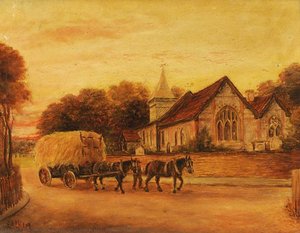
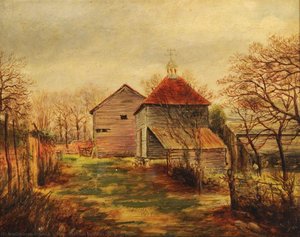
Ham's most celebrated period began around 1900 with his series of paintings depicting scenes from Norwood Green, a small village near Southall. These works—including “The Pond” (1896) and “Splash at Cranford Park” (1899)—are considered masterpieces of English landscape painting. He meticulously documented the daily routines of villagers, capturing their interactions with the land and each other. The paintings are characterized by a remarkable level of detail – from the textures of clothing to the reflections in the water—and an astute understanding of light and shadow. Notably, Ham wasn’t simply recording scenes; he was attempting to capture the *feeling* of these places, imbuing them with a sense of timelessness and quiet dignity. The use of muted colors and soft brushstrokes creates a serene atmosphere, inviting the viewer to step into the scene and experience it for themselves. The “Heston Church, New Heston Road” (1895) exemplifies this approach, presenting a remarkably detailed depiction of a modest village church, highlighting its architectural significance within the community.Beyond Norwood: Architectural Studies and Commissions
While the Norwood series solidified his reputation, Ham’s artistic interests extended beyond rural landscapes. He undertook numerous commissions to paint portraits and architectural studies, demonstrating versatility and technical skill. His work for Ham House, a magnificent country estate in Richmond, showcases his ability to render complex structures with precision and elegance. The meticulous detail evident in these architectural paintings—particularly “Heston Church” – reveals a deep understanding of perspective and the interplay of light and shadow. These commissions provided him with financial stability while allowing him to continue exploring his artistic passions.Legacy and Influence
Ernest A. L. Ham’s legacy lies in his ability to capture the quiet beauty of rural England, preserving a vanishing world through his paintings. His meticulous detail, coupled with an intuitive understanding of light and atmosphere, has earned him recognition as one of the most important English landscape painters of the late 19th and early 20th centuries. His work continues to be exhibited and appreciated for its evocative power and timeless appeal. Furthermore, Ham’s dedication to documenting local architecture contributed significantly to our understanding of vernacular design and the social fabric of rural communities. His paintings serve as a poignant reminder of a bygone era—a time when life moved at a slower pace and the beauty of the natural world was deeply valued. His influence can be seen in subsequent generations of landscape artists who sought to capture the essence of English countryside, solidifying his place as a pivotal figure in British art history.
ernest a. l. ham
1874 - 1958
Quick Facts
- Artistic Movement Or Style: Landscape Painting
- Artists Or Movements Influenced By This Artist: ['Ernest Hébert']
- Artists Who Influenced This Artist: ['Academic Realism']
- Date Of Birth: 1874
- Date Of Death: 1958
- Full Name: Ernest A. L. Ham
- Nationality: British
- Notable Artworks:
- The Pond, Norwood Green
- Splash at Cranford Park
- Heston Church
- Place Of Birth: Wareham, Dorset, UK
Related Articles

The Refined Aesthetic of Victorian Illustration: A Study in Narrative & Technique
Explore the captivating world of Victorian illustration! Discover Pre-Raphaelite influences, key artists like Rossetti & Stephens, and the era's rich narrative detail. A deep dive for art enthusiasts.

William Powell Frith: Narratives of Victorian Society & the Rise of Realist Painting
Explore the life & works of William Powell Frith, the 'greatest British painter of social scenes.' Discover his iconic Victorian genre paintings and learn about his lasting impact on realist art. Hand-painted reproductions available.

Dante Gabriel Rossetti's 25 Masterpieces: A Journey Through Victorian Art & Symbolism | OriginalUniqueArt
Explore 25 iconic artworks by Dante Gabriel Rossetti, a leading Pre-Raphaelite artist. Discover the stories behind masterpieces like 'Proserpine' & 'Beata Beatrix'. Find museum-quality art reproductions and elevate your home decor with OriginalUniqueArt.com.
Victorian Realism: Capturing the Soul and Intricate Detail of a Golden Era
Explore the exquisite world of Victorian Realism. Discover how 19th-century masters captured unparalleled detail and emotion through oil painting, and learn to curate these timeless masterpieces for your luxury interior collection.

John Gilbert: A Comprehensive Exploration of Technique, Context, and Enduring Legacy in Victorian Genre Painting
Explore the life & art of John Gilbert, a prolific Victorian painter renowned for his captivating genre scenes and Venetian-inspired style. Discover his legacy with OriginalUniqueArt.