Expressionism
Evening (Emil Nolde)
Emil Nolde (1867–1956) made Evening. It belongs to the Expressionism movement.

 Preview

 Hand Made Oil Painting
 Send
 Share
 Fact sheet


 Download
 Similars
 X-Ray
 Diaporama
 Q&A

 Stats
Evening, in brief
- Title
- Evening
- Artist
- Emil Nolde (1867–1956)
- Artist born in
- Nolde, Denmark
- Movement
- Expressionism
- Subject
- landscape painting, cloudscape artwork, water reflection, dreamlike scene, abstract nature, evening glow”
What does Evening depict?
A Symphony of Color: Experiencing Emil Nolde’s “Evening”
Emil Nolde's "Evening" is a captivating exploration of light and atmosphere, characteristic of his expressive landscape work. This piece doesn’t depict a literal evening scene, but rather an *emotional* response to one – a distillation of the feeling of twilight rendered in bold color and simplified forms. A dominant, luminous yellow cloud commands attention in the upper left quadrant, acting as a focal point that draws the eye down into the composition. Below, a gradient of blues transitions from deep indigo to lighter turquoise and verdant greens along the horizon line, suggesting water reflecting the celestial drama above.
Expressionism & The Power of Color
- Stylistic Roots: Nolde was a key figure in early 20th-century Expressionism, a movement that prioritized subjective experience and emotional impact over realistic representation. “Evening” exemplifies this approach through its non-naturalistic color palette and abstracted forms.
- Technique & Materials: The artwork appears to be executed in watercolor or gouache, evidenced by the fluidity of the washes and blending of colors. Nolde masterfully employs these techniques to create a sense of atmospheric depth despite the flattened perspective. Visible brushstrokes add texture and energy.
- Influences: While forging his own path, Nolde was influenced by artists like Vincent van Gogh and Paul Gauguin, particularly their use of intense color to convey emotion. He also drew inspiration from traditional folk art and primitive masks, evident in the bold outlines and simplified shapes.
Symbolism & Emotional Resonance
The symbolism within “Evening” is subtle yet potent. The large yellow cloud can be interpreted as a source of radiant energy or enlightenment – a beacon amidst the darkening sky. The winding body of water, reflecting the colors above, suggests a connection between the earthly and celestial realms. More broadly, Nolde’s landscapes often represent an attempt to connect with nature on a spiritual level.
The overall emotional impact is one of tranquility mixed with a hint of mystery. The stylized representation invites contemplation and allows viewers to project their own feelings onto the scene. Nolde's work frequently evokes a sense of longing or melancholy, reflecting his own complex relationship with the world around him.
Nolde’s Life & Legacy
Born in 1867 in Nordel, Germany, Emil Nolde dedicated himself to art after years working as a wood carver. Despite facing opposition from his family and later persecution under the Nazi regime (his work was deemed “degenerate”), he remained committed to his artistic vision. Nolde’s landscapes, seascapes, and portraits are celebrated for their raw emotional power and innovative use of color. His ability to capture the essence of a place or feeling – rather than simply its appearance – continues to resonate with audiences today.
High-resolution images of Evening
Emil Nolde, Evening. Public domain.
Questions on Evening, answered
What is "Evening" about?
The subjects of "Evening" are landscape painting, cloudscape artwork, water reflection, dreamlike scene, abstract nature, evening glow”, “stylized landscape”.
Is "Evening" free of copyright?
Regarding copyright, "Evening" is in the public domain - its copyright has expired.
Who is the artist behind "Evening"?
The artist behind "Evening" is Emil Nolde. The work is catalogued under Emil Nolde's name.
What art movement does "Evening" by Emil Nolde belong to?
"Evening" is a work of Expressionism. The movement indicates the artistic tradition the work is part of.
Where does "Evening" fall in Emil Nolde's career?
"Evening" belongs to the Mature Period of Emil Nolde's career. This classification relates the work to the artist's development.
What explains the copyright situation of "Evening" by Emil Nolde?
"Evening" by Emil Nolde is in the public domain - its copyright has expired. Copyright duration runs from the artist's death, which occurred in 1956.
Where does "Evening" sit within Emil Nolde's body of work?
"Evening" shares with Emil Nolde's other works its Expressionism style and the recorded themes: german romanticism influence, nature's ethereal beauty", "symbolic, spiritual themes", expressionist color theory, reflects coastal landscapes, nolde's personal visions.
Is "Evening" typical of what Emil Nolde usually created?
Emil Nolde's recurring themes include german romanticism influence, nature's ethereal beauty", "symbolic, spiritual themes", expressionist color theory, reflects coastal landscapes, nolde's personal visions; "Evening" focuses on landscape painting, cloudscape artwork, water reflection, dreamlike scene, abstract nature, evening glow”, “stylized landscape”.
About the artist, Emil Nolde
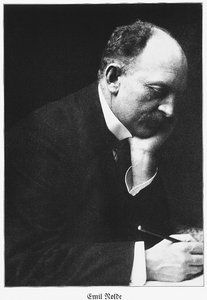
1867–1956, Denmark
Emil Nolde
The Life and Identity of Emile Nolde Born Hans Emil Hansen on 7 August 1867, the man who would become known as Emile Nolde grew up near the village of Nolde in the Duchy of Schleswig. His early years were shaped by the rural, agrarian life of his family. He eventually moved away from this path, choosing instead to work as a wood carver and furniture decorator. This tactile, physical labor preceded his shift toward painting and printmaking.
Also by Emil Nolde
 Sunset
 Sea with Red Sky
 Couple on the beach1903
 Masks1911
Essays around Evening
 Masterpieces of Emotion: The Top 25 Vincent van Gogh ArtworksImmerse yourself in the vibrant world of Vincent van Gogh. Explore 25 iconic Post-Impressionist masterpieces, from Starry Night to Sunflowe…
 Chasing Shadows: The Enchanting Beauty of Dim Light in Impressionist MasterpiecesDiscover the ethereal magic of Impressionist nightscapes. Explore how masters like Monet and Whistler captured the alchemy of moonlight, sh…
 Unveiling Inner Worlds: Exploring Psychological Depth in 20th & 21st Century ArtExplore the profound psychological themes within 20th & 21st-century art. Discover Expressionism, Surrealism & more – and learn how to coll…