
 Preview
 Send
Send Share
Share
 Details
 Guide
Guide

 Download
 Similars
 X-Ray
X-Ray Diaporama
 Stats
StatsAt Least One Egg (Avallon)


 Read More
Giclée / Art Print
Museum-quality giclée or canvas print with fast production and flexible finish options. ( Buy Hand Made Painting Switch to Digital Image)




































Pick from our preset sizes that match the artwork's original proportions.

You may enter your own dimensions to fit a specific frame or space. If your selected size does not match the original image's proportions, we will either crop the artwork or extend the image with a mirrored or solid-fill edge. A digital mockup will be sent for your approval before production begins.
Please note that the on-screen preview does not reflect the actual cropping or extension. Only the mockup will accurately show the final composition.
While custom sizes are available, we recommend selecting a dimension from the predefined list to preserve the original proportions.
Worldwide Delivery () in 2 weeks instead of standard 4/5 weeks. (25 September)

Free Worldwide Express Shipping

High-Quality Linen Canvas

Full Shipping Insurance

Customs Tax Refund Guarantee

True Color Matching Guarantee

100-Day Return Policy (Defects Only)

100% Money-Back Guarantee

Bulk Discount Offer
 Glass option is only available in size under 110 CM

At Least One Egg (Avallon)
Giclée / Art Print
Reproduction Size
-


Total Price
$ 81
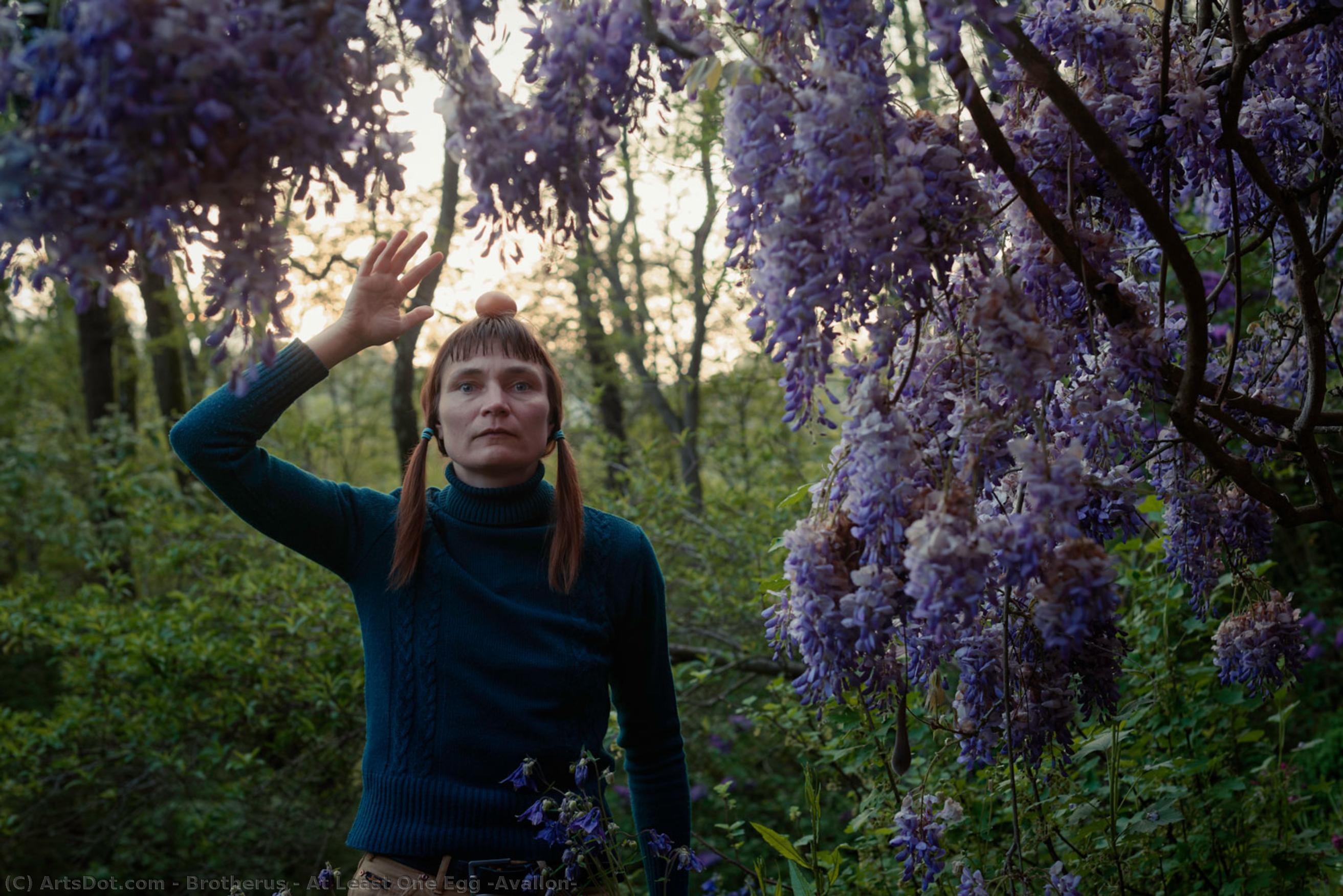
A Dreamlike Encounter: Elina Brotherus's "At Least One Egg (Avallon)"
Elina Brotherus’s photograph, “At Least One Egg (Avallon),” transports the viewer to a realm of serene beauty and subtle introspection. Captured in 2016, this evocative image showcases a woman enveloped by an ethereal cascade of purple wisteria blossoms within a dense forest setting. More than just a landscape portrait, it’s a study in human connection with nature, rendered with Brotherus' signature blend of realism and dreamlike quality.
Subject & Style: Nature's Embrace
The photograph centers on a woman positioned slightly off-center, her hand raised in what appears to be a gesture of welcome or communication. She is dressed in a dark blue cable-knit sweater, her hair styled in pigtails – details that ground the scene in a relatable reality while simultaneously contributing to its gentle, nostalgic feel. Brotherus’s style leans towards realism, meticulously capturing the textures and light of the forest environment. However, the diffused lighting, characteristic of early morning or late afternoon, imbues the image with an otherworldly quality. The overwhelming presence of wisteria—a flower often associated with love, longing, and resilience—creates a visually stunning backdrop that softens the edges of reality.
Technique & Composition: A Photographer's Precision
Brotherus is renowned for her commitment to unedited photography, prioritizing natural light and authentic representation. In "At Least One Egg (Avallon)," this approach shines through. The composition utilizes layering effectively – the woman and immediate wisteria form the foreground, dense foliage creates a midground, and darker shadows recede into the background, establishing depth and perspective. The prominent lines of tree branches and intricate patterns of the wisteria vines guide the viewer's eye throughout the scene. Notice how the photographer uses soft, diffused light to create a gentle glow around the blossoms and illuminate the woman’s face, enhancing the image's overall serene mood.
Symbolism & Emotional Impact: Fertility, Connection, and Serenity
Beyond its aesthetic appeal, "At Least One Egg (Avallon)" carries layers of symbolic meaning. The title itself hints at themes of fertility and potential, particularly poignant given Brotherus’s broader artistic exploration of infertility and involuntary childlessness in her series “Carpe Fucking Diem” and “Annunciation.” The raised hand can be interpreted as an invitation to connect with nature or a gesture of greeting directed towards the viewer. The abundance of wisteria, traditionally symbolizing love and devotion, further enriches the image’s emotional depth. Ultimately, the photograph evokes a sense of melancholic serenity—a quiet contemplation on life's cycles, human connection, and the enduring beauty of the natural world.
The Artist & Her Legacy
Elina Brotherus (born 1972) is a prominent Finnish photographer and video artist recognized for her autobiographical self-portraits and landscapes. A graduate of both analytical chemistry and photography, she brings a unique perspective to her work, blending scientific precision with artistic sensitivity. Her affiliation with the Helsinki School underscores her commitment to exploring themes of identity, memory, and the human condition through a distinctly Nordic lens. Brotherus’s dedication to unedited imagery and her willingness to confront personal challenges have established her as a significant voice in contemporary photography.
Artist Biography
Robert Montgomery: Sculpting Shadows and Speaking Truths
Born in Chapelhall, North Lanarkshire, Scotland, in 1972, Robert Montgomery’s artistic journey is one of deliberate disruption and profound reflection. Initially drawn to painting, he quickly evolved into a multifaceted artist working across sculpture, installation, and poetry – disciplines that increasingly converge within his singular vision. His work isn't merely about creating objects; it’s about engaging with space, language, and the often-uncomfortable truths of human experience. Influenced by a “melancholic post-Situationist” tradition, Montgomery frequently utilizes public spaces as canvases, challenging conventional perceptions and inviting viewers to reconsider their surroundings.
Montgomery's early career was marked by experimentation with minimalist sculptures, often accompanied by elaborate poetic titles. This initial phase laid the groundwork for his later, more ambitious projects. A pivotal moment arrived in 1995 when he secured a grant from the Scottish Arts Council alongside fellow artist John Ayscough – a grant initially threatened due to its unconventional nature. Andrew Nairne, then Visual Director at the council, championed their project, “Aerial ‘94,” ensuring its completion and launching Montgomery’s career with significant momentum. This early experience instilled in him a willingness to push boundaries and challenge established norms.
His signature style—a potent blend of text and visual elements—emerged through his practice of writing poems on public surfaces, mirroring the techniques of graffiti artists. This approach wasn’t simply about adding ephemeral messages; it was an assertion of voice within the urban landscape, a deliberate attempt to inject poetry into the everyday. This commitment to public engagement is deeply rooted in his belief that art should be accessible and provoke dialogue. The 1999 move to London solidified this ethos, providing him with access to a vibrant artistic community and further fueling his exploration of themes like power, love, and human kindness.
The Language of Light and Flame
Montgomery’s most recognizable work is undoubtedly his “fire poems.” These striking installations combine poetic messages with the dramatic spectacle of flames, transforming simple words into powerful visual statements. The technique itself—carefully crafted phrases projected onto a flame—demands precision and control, reflecting Montgomery's meticulous approach to all aspects of his art. The ephemeral nature of the flames adds another layer of complexity, emphasizing the transient beauty of language and the fleeting moments of connection it can create.
His installations frequently operate within industrial and urban environments, often without authorization. This deliberate act of intervention underscores a critical element of his practice: a challenge to established power structures and an assertion of artistic freedom. These pieces aren’t simply decorative; they are provocations—designed to disrupt the status quo and encourage viewers to question their assumptions about public space. The resulting encounters with authorities, such as the detention following a poem displayed on a London billboard for William Blake, highlight the inherent tension between art and authority.
A Poetic Palette: Materials and Techniques
Montgomery’s artistic toolkit is surprisingly diverse, encompassing a range of materials and techniques. He frequently employs recycled sunlight pieces—photographic images manipulated to capture the essence of light—as well as billboard pieces, woodcut panels, and watercolors. This eclectic approach reflects his desire to explore different modes of expression and to engage with various textures and surfaces. The use of watercolor, in particular, lends a delicate quality to some of his works, juxtaposing vulnerability with strength.
His work is deeply informed by the Situationist movement, a radical artistic and social theory that sought to challenge consumer culture and promote revolutionary change through art. Montgomery’s engagement with this tradition manifests in his use of public space as a site for critique and resistance, mirroring the Situationists' belief in the transformative potential of art.
Legacy and Influence
Robert Montgomery’s work has garnered significant critical acclaim and continues to resonate with audiences worldwide. His ability to seamlessly blend poetry, sculpture, and installation creates immersive experiences that are both intellectually stimulating and emotionally evocative. His influence extends beyond his own practice, inspiring a new generation of artists who are exploring the intersection of art, language, and public space.
Montgomery’s commitment to challenging conventional perceptions and engaging with complex social issues has cemented his place as a significant figure in contemporary art. His work serves as a powerful reminder that art can be a catalyst for change—a means of questioning, reflecting, and ultimately, transforming the world around us.

elina brotherus
1972 - , Finland
Quick Facts
- Artistic Movement Or Style: Site-specific installations, Fire poems, melancholic post- Situationist tradition
- Artists Or Movements Influenced By This Artist:
- Installation art
- Graffiti artists
- Artists Who Influenced This Artist:
- John Ayscough
- Situationists
- Date Of Birth: July 7, 1972
- Full Name: Robert Montgomery
- Nationality: Scottish
- Notable Artworks:
- Aerial '94
- Light and text installations
- Fire poem messages
- Place Of Birth: Chapelhall, Scotland
Related Articles
Pictorialism: A Search for Artistic Photography's Soul – Aesthetics, Techniques & Legacy
Explore the captivating world of Pictorialism – a pivotal movement that transformed photography into fine art. Discover key artists like Stieglitz & Käsebier, techniques, and collecting tips from experts.
The Lens of Truth: A Comprehensive History and Legacy of Documentary Photography
Explore the profound history of documentary photography. From early daguerreotypes to social reform movements, discover how the lens captures truth, preserves vanishing cultures, and shapes our global visual narrative through an expert art-historical lens.
Witnessing History Through Lens & Light: Documentary Photography's Enduring Legacy
Explore the powerful history of documentary photography – from its origins to contemporary masters like Gordon Parks & W. Eugene Smith. Discover how this art form shapes our understanding of society and witness pivotal moments in time.

Monochrome Visions: Exploring the Aesthetic & Historical Significance of Black & White Photography
Explore the rich history & artistic power of black and white photography. From early techniques to iconic masters like Ansel Adams, discover why monochrome continues to captivate art lovers today. Expert insights for collectors.

Beyond the Lens: Photography's Enduring Influence on Modern & Contemporary Art
Explore photography's pivotal role in shaping modern & contemporary art. Discover key movements, influential artists like Stieglitz, and expert collecting advice from OriginalUniqueArt.


