Menu
Switch to Print Switch to Digital Image Send
Details Add to favorites Download Similars Diaporama Stats

Hiawatha

Marvel at 'Hiawatha & Minnehaha' by Edmonia Lewis – a poignant marble sculpture capturing Native American legend and beauty, showcasing the artist’s neoclassical style.

Edmonia Lewis (1844-1907): Pioneering African American & Native American sculptor celebrated for neoclassical works exploring Black history, Indigenous culture & abolition.

Hand Made Oil Reproduction

Hand-painted oil on canvas in your size and frame, made to order by our artists. ( Switch to Print Switch to Digital Image)

Standard
custom
CM
INCH

Pick from our preset sizes that match the artwork's original proportions.

width
height

You may enter your own dimensions to fit a specific frame or space. If your selected size does not match the original image's proportions, we will either crop the artwork or extend the painting with additional hand-painted elements. A digital mockup will be sent for your approval before production begins.

Please note that the on-screen preview does not reflect the actual cropping or extension. Only the mockup will accurately show the final composition.
While custom sizes are available, we recommend selecting a dimension from the predefined list to preserve the original proportions.

Examples of what can be changed: Replace face with customer photo; Add pet (e.g., replace cat with dog); Include hidden message in background; Change background landscape or elements.
After order, OriginalUniqueArt.com team will email client for instructions and provide a mockup preview

Worldwide Delivery () in 3/4 weeks instead of standard 5 weeks. (17 September). No compromise on quality.

why_choose_icon
Free Worldwide Express Shipping
why_choose_icon
High-Quality Linen Canvas
why_choose_icon
Full Shipping Insurance
why_choose_icon
Customs Tax Refund Guarantee
why_choose_icon
True Color Matching Guarantee
why_choose_icon
100-Day Return Policy (Defects Only)
why_choose_icon
100% Money-Back Guarantee
why_choose_icon
Bulk Discount Offer

Total Price

$ 300

reproduction

Hiawatha

Reproduction Medium

Reproduction Size

-

Total Price

$ 300

Quick Facts

  • Artist: Edmonia Lewis
  • Influences: Longfellow's poem
  • Notable elements: Feather adornment
  • Movement: Neoclassical
  • Medium: Marble
  • Title: Hiawatha
  • Year: 1868

Art Quiz

There is only one correct answer for each question.

Question 1:
What is the primary subject matter of Edmonia Lewis’s sculpture ‘Hiawatha and Minnehaha’?
Question 2:
In what artistic style is ‘Hiawatha and Minnehaha’ created?
Question 3:
According to the description, what is a key element of the sculpture’s composition?
Question 4:
What year was ‘Hiawatha and Minnehaha’ created?
Question 5:
Edmonia Lewis is significant in art history because she was:

A Frozen Moment of Myth and Resilience

Edmonia Lewis’s “Hiawatha and Minnehaha,” sculpted in exquisite marble around 1868, is more than just a depiction of two figures from Henry Wadsworth Longfellow's celebrated poem; it’s a poignant meditation on identity, cultural heritage, and the enduring power of love amidst profound loss. The sculpture captures a fleeting, almost unbearably tender moment – a silent exchange between the Ojibwe warrior Hiawatha and his Dakota bride, Minnehaha – frozen in time within the cool embrace of a Roman studio. It’s a work that speaks volumes about Lewis's pioneering role as an African American and Native American artist navigating a world largely resistant to her presence and vision.

Neoclassical Elegance and Sculptural Innovation

Lewis, working primarily in Rome during the latter half of the 19th century, honed a neoclassical style deeply influenced by ancient Greek and Roman sculpture. Yet, she wasn’t simply replicating classical forms; instead, she imbued them with her own unique sensibility and a profound understanding of her dual heritage. The bust's composition is remarkably balanced, showcasing a masterful command of form and proportion. Note the subtly curving lines of Hiawatha’s face – the slightly furrowed brow suggesting contemplation, the gentle curve of his lips hinting at a restrained emotion. Minnehaha’s profile, serene and dignified, mirrors this elegance, her gaze directed towards him with an unspoken longing. The sculpture's scale is intimate, inviting close examination and fostering a sense of connection with these figures.

Echoes of Longfellow and Indigenous Lore

Lewis’s decision to depict Hiawatha and Minnehaha was deeply personal, fueled by her admiration for Longfellow’s poem. However, the sculpture transcends mere illustration; it draws upon a rich tapestry of Native American oral traditions surrounding the figure of Manabozho (Hiawatha). The story itself – a tale of peacemaking, betrayal, and ultimately, enduring love – resonates with themes of reconciliation and cultural exchange. The inclusion of details like the feather adorning Hiawatha’s head isn't merely decorative; it’s a symbolic reference to leadership and spiritual connection within Ojibwe culture. The drapery, rendered with meticulous detail, suggests both formality and vulnerability, reflecting the complexities of their relationship.

Symbolism of Loss and Hope

The sculpture’s emotional core lies in its portrayal of grief and remembrance. Minnehaha's posture—a quiet stillness, a subtle downward turn of her head—evokes a profound sadness, hinting at the tragic circumstances surrounding her death. The setting – a simple pedestal beneath a Roman sky – underscores the distance between these figures and their homeland, highlighting the displacement experienced by many Native Americans during this period. Yet, despite the palpable sorrow, there’s also an undercurrent of hope. Hiawatha's gaze is fixed on Minnehaha with unwavering devotion, suggesting that love can transcend even death. The sculpture becomes a testament to resilience—a celebration of cultural identity in the face of adversity.

A Legacy of Vision and Representation

“Hiawatha and Minnehaha” stands as a landmark achievement in American art history, marking a significant step forward for Edmonia Lewis. It’s a powerful example of her ability to blend classical technique with deeply personal themes, creating works that are both aesthetically beautiful and profoundly meaningful. Today, the sculpture continues to resonate with viewers, prompting reflection on issues of identity, cultural heritage, and the enduring power of human connection. Reproductions offer an accessible way to experience this remarkable work of art, bringing its poignant beauty into homes and galleries worldwide.


Artist Biography

A Pioneer Forged in Marble: The Life and Legacy of Edmonia Lewis

Born around July 4, 1844, in Greenbush, New York—a place that would later be renamed Rensselaer—Mary Edmonia Lewis emerged as a singular voice in the 19th-century art world. Known to many by her Ojibwe name, “Wildfire,” she was a sculptor who defied expectations and shattered barriers, becoming the first African American and Native American artist to achieve international recognition in the fine arts. Her story is one of resilience, artistic passion, and a determined spirit that refused to be confined by the societal constraints of her time. Lewis’s heritage was a rich tapestry woven from diverse threads: her father was Afro-Haitian, while her mother, Catherine Mike Lewis, traced her lineage to both the Mississauga Ojibwe people and African American roots. This blended ancestry profoundly shaped her artistic vision, imbuing her work with themes of identity, cultural heritage, and the struggles for freedom and equality. Orphaned at a young age, she was raised by her maternal aunts and half-brother Samuel, who recognized and nurtured her burgeoning talent, providing crucial support for her education and artistic aspirations. Early experiences selling Ojibwe crafts alongside her family near Niagara Falls instilled in her an appreciation for Indigenous artistry and a connection to her Native American identity—a connection that would resonate throughout her career.

From Abolitionist Activism to Roman Studios

Lewis’s formal education began at New-York Central College, a Baptist abolitionist school in McGrawville, followed by enrollment at Oberlin College in 1859. It was here that she formally adopted the name Mary Edmonia Lewis and embarked on her artistic studies. However, her time at Oberlin was marred by racial prejudice and a deeply unjust accusation of poisoning classmates—an incident that led to a trial, acquittal, but lasting trauma and ultimately prompted her departure in 1863. Despite these hardships, Oberlin exposed her to the fervent abolitionist movement and forged connections with individuals who would later champion her work. Moving to Boston around 1863, Lewis began crafting portrait medallions of prominent abolitionists like William Lloyd Garrison and Charles Sumner, establishing herself as an artist committed to social justice. This early success paved the way for a pivotal move in 1865: she relocated to Rome, Italy, where she would spend the majority of her career. Rome offered a haven—a vibrant artistic community and a degree of freedom from the pervasive racism she had experienced in America. It was here that Lewis truly flourished, honing her neoclassical style and creating some of her most iconic sculptures.

Sculpting Identity: Themes and Techniques

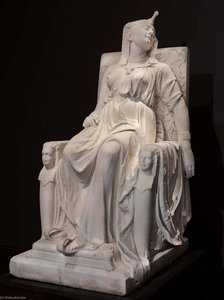
Edmonia Lewis’s work is characterized by its elegant neoclassical forms infused with powerful thematic content. She fearlessly tackled subjects rarely explored by sculptors of her time—particularly those relating to Black people and Indigenous peoples of the Americas. Her sculptures are not merely aesthetic objects; they are poignant statements about race, identity, and the human condition. The Death of Cleopatra, perhaps her most celebrated work, presents a dramatic and unconventional depiction of the Egyptian queen’s final moments, emphasizing agency and dignity rather than despair. Hiawatha and Minnehaha, a sculpture inspired by Longfellow's poem, portrays Native American figures with sensitivity and respect, challenging prevailing stereotypes. Other notable works include busts of historical figures like Abraham Lincoln and Ulysses S. Grant, as well as sculptures exploring biblical narratives. Lewis’s dedication to her craft was remarkable; she insisted on personally executing the entire sculpting process from start to finish—a rare practice for sculptors of that era, who typically relied on assistants for the laborious task of carving marble. This commitment underscored her artistic independence and ensured the authenticity of her vision.

A Lasting Impression: Legacy and Historical Significance

Edmonia Lewis’s achievements were groundbreaking. She was not only a pioneering sculptor but also a symbol of resilience and determination in the face of adversity. Her success challenged societal norms and prejudices, opening doors for future generations of artists from marginalized communities. Though her work fell into relative obscurity for many years after her death in 1907, it has experienced a remarkable resurgence in recent decades, thanks to renewed scholarly interest and a growing appreciation for her unique contribution to art history. In 2002, Molefi Kete Asante included Lewis on his list of “100 Greatest African Americans,” cementing her place as an important figure in American cultural heritage. Today, her sculptures are held in prestigious museum collections around the world, inspiring contemporary artists and scholars alike. Edmonia Lewis’s story is a testament to the power of art to transcend boundaries, challenge conventions, and illuminate the complexities of the human experience—a legacy that continues to resonate with audiences today.
  • Notable Works: The Death of Cleopatra, Hiawatha and Minnehaha, Forever Free, Old Arrowhead.
  • Influences: Neoclassical sculpture, abolitionist movement, Native American storytelling traditions.
Edmonia Lewis

Edmonia Lewis

1844 - 1907 , United States of America

Quick Facts

  • Artistic Movement Or Style: Neoclassical sculpture
  • Date Of Birth: July 4, 1844
  • Date Of Death: 1907
  • Full Name: Mary Edmonia Lewis
  • Nationality: American
  • Notable Artworks:
    • The Death of Cleopatra
    • Hiawatha and Minnehaha
    • Forever Free
    • Hagar
    • Columbus
  • Place Of Birth: Greenbush, USA
Explore artworks organized by themes, styles, and characteristics.