

 Preview
 Send
Send Share
Share
 Details
 Guide
Guide

 Download
 Similars
 X-Ray
X-Ray Diaporama
 Stats
StatsFlute Player
 Oil On Panel
- Taos Society of Artists
 1931
1931 31.0 x 41.0 cm
 Private collection
 Read More
Giclée / Art Print
Museum-quality giclée or canvas print with fast production and flexible finish options. ( Buy Hand Made Painting Switch to Digital Image)




P118B $10

P118H $10

P118W $10

P438Z $10

P508JH $12

P508YH $12

P805H $10

P805Z $10

P919BZ $10

P919G $10

P919XJ $10

P959ZH $10

P968JZ $12

W106C $8

W218G $10

W218JH $8

W218Y $10

W307PJ $10

W316G $10

W316PJ $8

W316Y $10

W398PJ $8

W4111J $10

W500HY $15

W500JH $15

W692G $12

W849H $8

W940BG $15

W953PJ $8




Pick from our preset sizes that match the artwork's original proportions.

You may enter your own dimensions to fit a specific frame or space. If your selected size does not match the original image's proportions, we will either crop the artwork or extend the image with a mirrored or solid-fill edge. A digital mockup will be sent for your approval before production begins.
Please note that the on-screen preview does not reflect the actual cropping or extension. Only the mockup will accurately show the final composition.
While custom sizes are available, we recommend selecting a dimension from the predefined list to preserve the original proportions.
Worldwide Delivery () in 2 weeks instead of standard 4/5 weeks. (26 September)

Free Worldwide Express Shipping

High-Quality Linen Canvas

Full Shipping Insurance

Customs Tax Refund Guarantee

True Color Matching Guarantee

100-Day Return Policy (Defects Only)

100% Money-Back Guarantee

Bulk Discount Offer
 Glass option is only available in size under 110 CM

Flute Player
Giclée / Art Print
Reproduction Size
-


Total Price
$ 81
The Serene Contemplation: Eanger Irving Couse’s “Flute Player”
Eager Irving Couse's "Flute Player," painted in 1931, isn’t merely a portrait; it’s a portal into the heart of Native American culture and spirituality. This oil-on-panel masterpiece, currently residing in a private collection in Akron, Ohio, captures a moment of profound stillness – a man deeply immersed in his music beneath the warm glow of what appears to be a desert sunset. Couse, a pivotal figure in the Taos Society of Artists, dedicated much of his career to respectfully portraying the lives and traditions of the Pueblo people, and “Flute Player” stands as a testament to that commitment.
The painting immediately draws the eye with its harmonious blend of realism and romanticism. Couse’s signature style—characterized by a high finish and an intense focus on capturing the quiet dignity of Native American life—is evident in every brushstroke. He masterfully employs strong sidelight, reminiscent of the dramatic lighting found in Western landscapes, to sculpt the subject's form and imbue him with a sense of both strength and vulnerability. The meticulous detail in the rendering of his traditional attire – the intricately woven headdress adorned with feathers, the beaded necklace, and the flowing garment – speaks volumes about the artistry and cultural significance embedded within each element.
A Symphony of Symbolism
Beyond its aesthetic beauty, “Flute Player” is rich in symbolic meaning. The flute itself—a central instrument in Native American ceremonies and storytelling—represents connection to the spirit world, a conduit for communication with ancestors and deities. The man’s posture, seated on the ground and completely absorbed in his music, suggests a meditative state, a deliberate disconnection from the everyday concerns of life. The carefully placed bowls, both near the bottom left corner and further back on the right side, aren't simply decorative; they subtly evoke themes of sustenance, community, and domesticity – elements deeply intertwined with Native American culture.
The choice of a solitary figure playing in what appears to be an open space is particularly significant. It speaks to the individual’s relationship with nature, with spirituality, and with the timeless rhythms of life. The absence of other figures reinforces this sense of introspection and communion with something larger than oneself.
The Artist's Vision: Couse and the Taos Society
Eanger Irving Couse’s work is inextricably linked to his involvement with the Taos Society of Artists, a group that played a crucial role in shaping the artistic landscape of the American Southwest. Founded in 1912, the society sought to capture the essence of Southwestern life and culture through authentic representation. Couse's deep respect for the Native Americans he depicted is palpable in “Flute Player,” reflecting his desire to portray their lives with dignity and understanding – a rare approach for an artist of his time.
His artistic training in Europe, particularly under Adolphe Bouguereau and Tony Robert-Fleury, provided him with the technical skills to translate his vision onto canvas. However, it was his immersion in the culture of Taos that truly informed his work, allowing him to capture not just a likeness but also the spirit and soul of its subjects.
A Legacy of Quiet Reverence
“Flute Player” is more than just a beautiful painting; it’s a window into a vanished world. It's a poignant reminder of the importance of cultural preservation, artistic integrity, and the power of art to connect us to our shared human heritage. Couse’s ability to capture both the physical details and the emotional essence of Native American life is truly remarkable, solidifying “Flute Player” as a timeless masterpiece that continues to resonate with viewers today.
Size: 31 x 41 cm
Date: 1931
Artist Biography
A Bridge Between Worlds: The Life and Art of Eanger Irving Couse
Eanger Irving Couse, born in 1866 amidst the burgeoning industrial landscape of Saginaw, Michigan, was an artist destined to become a pivotal figure in American art. His story isn’t simply one of artistic development; it's a compelling narrative of cultural connection, bridging the rigorous traditions of European academic painting with a profound and respectful portrayal of Native American life and the captivating landscapes of the Southwest. From his earliest years, Couse displayed an innate curiosity about the Chippewa tribes inhabiting the lands near his childhood home—an attraction that blossomed into a lifelong dedication to depicting their existence with sensitivity and dignity. This wasn’t mere observation; it was the seed of a deep empathy that would fundamentally shape his artistic journey. He left traditional schooling at sixteen, driven by an unwavering commitment to art, initially studying at the Art Institute of Chicago and then the National Academy of Design in New York City before embarking on a decade-long sojourn in Paris.From Parisian Salons to the Allure of Taos
Paris proved transformative. Studying under William-Adolphe Bouguereau at the École des Beaux-Arts and Académie Julian instilled within Couse a mastery of classical techniques—precise draftsmanship, nuanced modeling, and a refined sense of composition. He honed his skills capturing the light and atmosphere of the Normandy coast, yet even amidst these European influences, the pull towards the American West remained strong. A visit to his father-in-law’s ranch in Oregon sparked an interest in Native American subjects, culminating in *The Captive*, exhibited at the Paris Salon in 1892. This significant early work, depicting a scene from the Whitman Massacre and modeled by his wife Virginia and a local Klikitat Indian, demonstrated both his technical prowess and burgeoning thematic concerns. Returning to the United States, Couse balanced studio work in New York with increasingly frequent trips westward, eventually leading him to Taos, New Mexico, in 1902. This marked a turning point; he was captivated by the unique light, landscape, and culture of the region, establishing a summer residence that would evolve into his permanent home. He wasn’t merely visiting; he was immersing himself, seeking to understand and represent a way of life far removed from the bustling cities of the East Coast.The Soul of Taos: A Defining Artistic Vision
Taos became more than just a location for Couse—it was an immersion into a culture. He dedicated himself to studying and painting the lives of the Taos Indians, not as exoticized figures but as individuals possessing inherent dignity and grace. Unlike some contemporaries who focused on dramatic narratives or romanticized portrayals, Couse sought to capture quiet moments of daily life—scenes of contemplation, craftsmanship, and familial connection. His style evolved into a distinctive blend of academic precision and an evocative use of light and color, creating paintings that were both technically accomplished and emotionally resonant. He favored warm, earthy tones, often depicting his subjects bathed in the soft glow of firelight or the golden hues of the setting sun. He frequently employed two primary models, Ben Lujan and Jerry Mirable, allowing him to portray a sense of continuity and intimacy within his work. This dedication led to his becoming a founding member and first president of the Taos Society of Artists in 1915, solidifying Taos’s reputation as an important artistic center. His paintings weren't simply representations; they were interpretations imbued with respect and understanding—a testament to his commitment to portraying Native American life authentically.Recognition, Legacy, and Enduring Influence
Couse’s talent didn’t go unnoticed. He received numerous awards throughout his career, including the Altman Prize from the National Academy of Design, the Isidor Prize from the Salmagundi Club, and the Lippincott Prize from the Pennsylvania Academy of Fine Arts. Notably, he secured commissions from the Santa Fe Railway between 1914 and 1936 to create paintings used in their advertising campaigns—a testament to his ability to capture the allure of the Southwest for a wider audience. *Elk-foot of the Taos Tribe* is widely considered his masterwork, eventually purchased for the United States national art collection, cementing his place within the canon of American art. Beyond these accolades, Couse’s lasting legacy lies in his contribution to shaping perceptions of Native American life and establishing a unique artistic identity for the Taos Society. He offered a perspective that diverged from more stereotypical representations prevalent at the time, emphasizing peaceful coexistence and the inherent beauty of Pueblo culture. His work stands as a powerful reminder of the importance of cultural sensitivity and respectful representation in art. The preservation of his home and studio—now the Eanger Irving Couse House and Studio–Joseph Henry Sharp Studios, listed on the National Register of Historic Places—ensures that future generations can connect with his artistic vision and appreciate his profound impact on American art history.Key Characteristics of His Work
- Academic Precision: Couse’s foundation in European academic training is evident in the meticulous detail and realistic rendering of his figures and landscapes.
- Evocative Use of Light: He masterfully employed light and shadow to create atmosphere and emotional depth, often depicting scenes bathed in warm, golden tones.
- Respectful Representation: Couse’s portrayals of Native Americans were characterized by dignity and sensitivity, avoiding stereotypical or romanticized depictions.
- Focus on Daily Life: He preferred to capture quiet moments of everyday existence rather than dramatic narratives, offering a glimpse into the routines and traditions of Pueblo culture.
- Limited Palette: Couse favored a warm, earthy palette that reflected the colors of the Southwestern landscape and created a sense of harmony and tranquility.
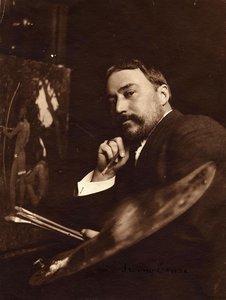
Eanger Irving Couse
1866 - 1936 , United States of America
Quick Facts
- Artistic Movement Or Style: Impressionism
- Artists Or Movements Influenced By This Artist: ['Taos Society of Artists']
- Artists Who Influenced This Artist:
- Bouguereau
- Sharp
- Date Of Birth: September 3, 1866
- Date Of Death: 1936
- Full Name: Eanger Irving Couse
- Nationality: American
- Notable Artworks:
- Trees With White
- The Chief
- Elk-foot of the Taos Tribe
- Place Of Birth: Saginaw, USA
Related Articles

James Otto Lewis: Navigating American Modernism Through Regional Identity & Stylistic Innovation
Explore the captivating portraits of James Otto Lewis, a pivotal figure bridging 19th-century realism & American Modernism. Discover his groundbreaking work documenting Native American culture and regional identity.

Grant Wood & American Regionalism: Identity, Myth & the Rural Landscape
Explore the world of Grant Wood & American Regionalism with OriginalUniqueArt. Discover the symbolism behind 'American Gothic', recurring themes, and the movement's lasting impact on art history. High-quality reproductions available.
Henry Farny: Romantic Visions of the American West & Indigenous Life
Explore the evocative paintings of Henry Farny, renowned for his romantic realism & depictions of Native American life in the 19th-century West. Discover his legacy and key artworks at OriginalUniqueArt.

American Realism's Defining Works: 10 Masterpieces for Your Home
Explore 10 defining American Realism masterpieces – Hopper, Homer & more. Discover the stories behind these iconic paintings and bring timeless art to your home with OriginalUniqueArt's museum-quality reproductions. Explore the full collection online.
Eanger Irving Couse: Bridging Tradition & Modernity in American Southwest Art
Explore the life & art of Eanger Irving Couse, a pivotal figure in Southwestern Impressionism and founder of the Taos Society of Artists. Discover his captivating paintings & legacy.


