Mexican Muralism
untitled (9666) (Diego Rivera)
Diego Rivera (1886–1957) made untitled (9666). It belongs to the Mexican Muralism movement.

 Preview

 Hand Made Oil Painting
 Send
 Share
 Fact sheet


 Download
 Similars
 X-Ray
 Diaporama
 Q&A

 Stats
untitled (9666), in brief
- Title
- untitled (9666)
- Artist
- Diego Rivera (1886–1957)
- Artist born in
- Guanajuato, Mexico
- Movement
- Mexican Muralism
- Subject
- mexican woman portrait, kitchen scene painting, traditional cooking art, rivera style imagery, domestic life artwork, warm color palette”,
What does untitled (9666) depict?
A Moment of Domesticity: Diego Rivera’s Intimate Portrait
This captivating work by Diego Rivera, tentatively titled “untitled (9666),” offers a rare glimpse into the quiet intimacy of everyday life. Unlike his monumental public murals for which he is celebrated, this painting presents a more personal and subdued scene – a woman absorbed in the preparation of food within a warmly lit domestic space. The subject, rendered with Rivera’s characteristic attention to form and detail, kneels near a table laden with culinary essentials: bowls, a spoon, and two cakes suggesting a celebratory occasion or simply the comforting ritual of home baking. Her long hair cascades over her shoulders, framing a face that conveys both concentration and serenity, while a delicate necklace adds a touch of personal adornment.Style & Technique: A Bridge Between Realism and Muralist Boldness
While smaller in scale than his famed murals, “untitled (9666)” still bears the hallmarks of Rivera’s distinctive style. The painting demonstrates a masterful command of realism, particularly evident in the depiction of textures – the fabric of the woman's dress, the smooth surfaces of the bowls, and the inviting appearance of the cakes. However, it is not merely representational; there’s a solidity to the figures and objects that hints at the influence of his muralist training. Rivera often simplified forms and emphasized their structural integrity, a technique visible here in the grounded presence of the woman and the carefully arranged composition. The use of light and shadow creates depth and volume, drawing the viewer into this intimate scene. It’s a fascinating example of how Rivera could translate his grand public vision into a more personal and introspective mode.Historical Context & Symbolism
Created sometime during Rivera's prolific career (1886-1957), this painting reflects the artist’s deep engagement with Mexican identity and culture. Though not overtly political like many of his murals, “untitled (9666)” subtly celebrates the dignity of labor and the importance of domestic life – themes that resonated strongly within post-revolutionary Mexico. The woman's focused activity can be interpreted as a symbol of nurturing and sustenance, both literally and metaphorically. Rivera’s work frequently aimed to elevate the lives of ordinary people, and this painting continues that tradition by portraying a seemingly simple act – preparing food – with grace and reverence. The cakes themselves might symbolize celebration or abundance, hinting at a moment of joy within the home.Emotional Impact & Interior Design Considerations
“untitled (9666)” evokes a sense of warmth, tranquility, and quiet contentment. It’s a painting that invites contemplation and offers a respite from the frenetic pace of modern life. The muted color palette and soft lighting create a soothing atmosphere, making it an ideal addition to interiors seeking a touch of understated elegance. This artwork would be particularly well-suited for dining rooms, kitchens, or bedrooms, where its themes of nourishment and domesticity can resonate most strongly. A high-quality reproduction of this piece could serve as a focal point in a room, adding depth and character to any space while honoring the legacy of one of Mexico’s greatest artists.High-resolution images of untitled (9666)
Protected by copyright: the image is shown for reference only.
Other sizes, crops and citation →Diego Rivera, untitled (9666).
Questions on untitled (9666), answered
What is "untitled (9666)" about?
The themes present in "untitled (9666)" by Diego Rivera include mexican woman portrait, kitchen scene painting, traditional cooking art, rivera style imagery, domestic life artwork, warm color palette”,, cultural mexican art”. Together they summarize the artwork's subject matter.
Is "untitled (9666)" free of copyright?
Regarding copyright, "untitled (9666)" is still protected by copyright.
Which artist is "untitled (9666)" attributed to?
"untitled (9666)" was created by Diego Rivera. The information on this page describes Diego Rivera's original work.
What art movement does "untitled (9666)" by Diego Rivera belong to?
"untitled (9666)" is a work of Mexican Muralism. The movement indicates the artistic tradition the work is part of.
What stage of Diego Rivera's development does "untitled (9666)" represent?
Within Diego Rivera's career, "untitled (9666)" falls in the Early Modern. The phase helps compare it with the artist's other works.
Why is the copyright status of "untitled (9666)" what it is?
"untitled (9666)" by Diego Rivera is still protected by copyright. Copyright terms are measured from the artist's death, and Diego Rivera died in 1957.
How does "untitled (9666)" fit into Diego Rivera's themes and style?
"untitled (9666)" belongs to Diego Rivera's Mexican Muralism work, whose recorded themes include mexican muralism influence, domestic life portrayal", traditional gender roles, social realism themes, rivera's cultural focus, regional identity art, narrative storytelling, political commentary subtle.
Where does "untitled (9666)" stand among Diego Rivera's recurring subjects?
Among Diego Rivera's recorded themes - mexican muralism influence, domestic life portrayal", traditional gender roles, social realism themes, rivera's cultural focus, regional identity art, narrative storytelling, political commentary subtle - "untitled (9666)" brings its own focus on mexican woman portrait, kitchen scene painting, traditional cooking art, rivera style imagery, domestic life artwork, warm color palette”,, cultural mexican art”.
About the artist, Diego Rivera

1886–1957, Mexico
Diego Rivera
Early Life, Family and Artistic Training Diego Rivera emerged from a family of modest means in Guanajuato, Mexico, born on December 8, 1886. His early environment was marked by a significant loss when his twin brother, Carlos, died at the age of two. Despite this, his talent manifested almost immediately. By the age of three, Rivera was already drawing, a drive that his parents, María del Pilar Barrientos and Diego Rivera Acosta, recognized and supported.
Also by Diego Rivera
 Man at the Crossroads/Man, Controller of the Univers1934
 Detroit Industry, North Wall
 Dream of a Sunday Afternoon in Alameda Park1948
 Land and Freedom
Essays around untitled (9666)
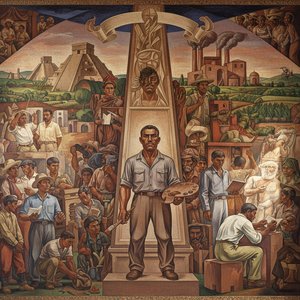 Diego Rivera: A Revolutionary Vision of Mexican Identity Through MuralismExplore the revolutionary murals of Diego Rivera and his profound impact on Mexican art & identity. Discover his techniques, iconic works l…
 Pain and Passion: The 25 Most Iconic Masterpieces by Frida KahloExplore 25 iconic Frida Kahlo masterpieces and their stories. Discover museum-quality art at OriginalUniqueArt.com.
 25 Masterpieces by Joan Miró: A Journey Through Surrealist MagicStep into the surreal world of Joan Miró. Explore 25 iconic masterpieces, from biomorphic shapes to vibrant colors. Discover the stories be…