Preview
 Send
Send Share
Share
 Details
 Guide
Guide

 Download
 Similars
 X-Ray
X-Ray Diaporama
 Stats
StatsUntitled


 Read More
The artwork displayed on this page is protected by copyright law, which means we cannot legally create or sell an identical reproduction. This protection is enforced under international agreements such as the Berne Convention and by national laws, including those outlined by the U.S. Copyright Law - Title 17.
This method fully complies with copyright regulations because it does not involve copying or duplicating the protected artwork. Instead, it is a creative reinterpretation - a new painting that is influenced by the original but not identical to it.
Giclée / Art Print
Museum-quality giclée or canvas print with fast production and flexible finish options. ( Buy Hand Made Painting Switch to Digital Image)




P118B $10

P118H $10

P118W $10

P438Z $10

P508JH $12

P508YH $12

P805H $10

P805Z $10

P919BZ $10

P919G $10

P919XJ $10

P959ZH $10

P968JZ $12

W106C $8

W218G $10

W218JH $8

W218Y $10

W307PJ $10

W316G $10

W316PJ $8

W316Y $10

W398PJ $8

W4111J $10

W500HY $15

W500JH $15

W692G $12

W849H $8

W940BG $15

W953PJ $8




Pick from our preset sizes that match the artwork's original proportions.

Type the width and the height you need, to fit your frame or your wall. A print can only be cut, never made bigger than the picture, so a size with a different shape loses a part of the image. We send you a digital mockup to approve before we print anything. The picture shown on this page does not show the real cut — only the mockup does.
Worldwide Delivery () in 2 weeks instead of standard 4/5 weeks. (25 October)

Free Worldwide Express Shipping

High-Quality Linen Canvas

Full Shipping Insurance

Customs Tax Refund Guarantee

True Color Matching Guarantee

100-Day Return Policy (Defects Only)

100% Money-Back Guarantee

Bulk Discount Offer
 Glass option is only available in size under 110 CM

Untitled
Giclée / Art Print
Reproduction Size
-


Total Price
$ 81
A Fragmented Echo of Mesopotamia
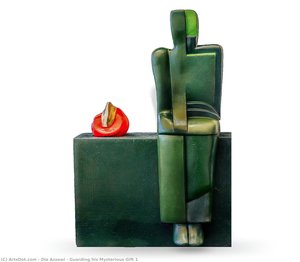
Dia al-Azzawi’s “Untitled” isn't merely a painting; it’s a deliberate distillation of ancient Mesopotamian spirit—a visual meditation on history, myth, and the enduring power of geometric abstraction. Born in Baghdad in 1939, al-Azzawi’s artistic journey began amidst the shifting sands of Iraqi identity, profoundly shaped by encounters with the monumental ruins of Sumerian and Akkadian civilizations. This early immersion instilled within him a deep appreciation for symbolic representation and narrative complexity—elements that would become central to his distinctive oeuvre. The artwork itself presents a striking juxtaposition of form and color. Two elongated figures dominate the canvas, rendered in a flattened perspective that eschews traditional spatial illusion. Bold hues – yellows, greens, blues, reds, purples, and blacks – are applied with unrestrained confidence, creating a vibrant mosaic effect reminiscent of ancient mosaics and temple murals. Geometric shapes—rectangles, triangles, and irregular polygons—construct the bodies and clothing of these figures, mirroring the precise architectural designs characteristic of Mesopotamian temples. These forms aren’t merely decorative; they're deliberately fragmented and rearranged, reflecting a broader artistic impulse toward deconstructing established conventions.- Style: Abstract Expressionism with Influences from Cubism
- Technique: Layered brushstrokes or washes create texture, suggesting controlled application of paint despite the overall impression of dynamism.
- Medium: Likely oil or acrylic on canvas.
- Consider commissioning a high-quality reproduction for your home or office – bringing the spirit of Mesopotamia into a contemporary space.
Questions & Answers
What subjects appear in "Untitled" by Dia al-Azzawi?
The themes present in "Untitled" by Dia al-Azzawi include ancient mesopotamia, geometric shapes, cultural symbolism, dynamic composition, color palette, fragmented forms, historical narrative. Together they summarize the artwork's subject matter.
Toward which tone does "Untitled" lean?
The dominant hue of "Untitled" by Dia al-Azzawi is green to violet spectrum. The hue is the underlying tone of the palette.
What was Dia al-Azzawi's age when "Untitled" was created?
When "Untitled" was created in 1988, Dia al-Azzawi - born in 1939 - was 49 years old.
Artist Biography
A Life Forged in Mesopotamian Echoes
Dia al-Azzawi, born in Baghdad in 1939, is more than just a painter; he’s a visual poet of the Arab world, an artist whose life and work are inextricably linked to the turbulent history and enduring cultural heritage of Iraq. His formative years unfolded amidst a period of profound political and social change, a backdrop that would deeply inform his artistic vision. From early childhood experiences steeped in Iraqi folklore and the majestic remnants of Mesopotamia’s ancient civilizations, al-Azzawi developed an acute sensitivity to the power of symbolism and narrative. This foundation led him to the Institute of Fine Arts in Baghdad, where he received formal training, mastering technical skills while simultaneously absorbing the currents of art history – a knowledge base he would later brilliantly synthesize with his own unique aesthetic language. Even then, it was clear that al-Azzawi wasn’t simply aiming to replicate existing styles; he sought to excavate and revitalize the visual culture of his ancestors.The Birth of a Distinctive Vision
Al-Azzawi's artistic journey began with explorations in abstract expressionism, but this phase proved merely a stepping stone towards something far more distinctive. He quickly gravitated toward an innovative style that boldly integrated Arabic calligraphy into his compositions. This wasn’t mere ornamentation; it was a deliberate act of reclamation, a powerful assertion of Arab identity within the global art landscape. Al-Azzawi became a central figure in the *Hurufiyya* movement, a collective endeavor to liberate Arabic letters from their traditional linguistic function and explore their inherent aesthetic potential as abstract forms. His canvases began to pulse with the energy of ancient scripts, transformed into dynamic shapes and patterns that resonated with both historical weight and contemporary relevance. The palette he employed was often vibrant and emotionally charged, reflecting not only his personal intensity but also a deep engagement with the political realities surrounding him. He didn’t shy away from confronting difficult themes; instead, he channeled them into works of profound beauty and unsettling power.Forging New Paths: The New Vision Group
In 1963, recognizing the need for a more progressive artistic voice in Iraq, al-Azzawi co-founded the New Vision group (Jama’at al-Ru’ya al-Jadida). This collective of Iraqi artists aimed to break free from conventional norms and modernize Arab art. It was a bold undertaking, challenging established institutions and advocating for experimentation. Al-Azzawi's leadership within the group proved instrumental in fostering a vibrant artistic community and inspiring a new generation of creatives. The New Vision group wasn’t simply about stylistic innovation; it was about redefining what it meant to be an Arab artist in a rapidly changing world, forging a path toward greater cultural autonomy and self-expression. Through exhibitions, publications, and collaborative projects, they sought to elevate the profile of modern Iraqi art both domestically and internationally.Themes of Heritage, Conflict, and Exile
Throughout his prolific career, Dia al-Azzawi has consistently addressed themes of heritage, identity, conflict, and exile – subjects deeply resonant with the experiences of the Arab world. His work serves as a poignant reflection of the political turmoil and social upheaval that have marked Iraq’s history and continue to shape its present. He masterfully navigates diverse media—painting, sculpture, printmaking, and digital art—demonstrating an unwavering commitment to artistic innovation. Notable works like “Amin Hasanain Al-Ibrahimy,” a moving tribute to the renowned Iraqi poet, and the harrowing “Nasheed Al Jassad (Bodily Anthem) Tel el Zaatar” series, commemorating the victims of the Tel al-Zaatar refugee camp massacre in Lebanon, stand as powerful testaments to his artistic conscience. His collaborative spirit is also evident in projects like the Nabu Museum in Lebanon, a testament to his dedication to preserving and promoting Arab art and culture for future generations.A Legacy Etched in Calligraphy and Courage
Today, Dia al-Azzawi is rightfully regarded as one of the most important and influential artists of the modern Arab world. His pioneering use of Arabic calligraphy, coupled with his unflinching exploration of complex socio-political themes, has left an indelible mark on subsequent generations of artists. Though he now resides in London, he remains a vital voice in contemporary art, continuing to advocate for Arab artistic expression on a global stage. His work is exhibited internationally and held in numerous prestigious collections, solidifying his place as a significant figure not only within the context of Middle Eastern art but also within the broader narrative of global art history. Dia al-Azzawi’s legacy isn't just about aesthetic innovation; it’s about courage—the courage to confront difficult truths, to reclaim cultural identity, and to use art as a powerful tool for social change.
Dia al-Azzawi
1939 - , Iraq
Quick Facts
- Full Name: Dia al-Azzawi
- Nationality: Iraqi
- Date Of Birth: 1939
- Place Of Birth: Baghdad, Iraq
- Notable Artworks:
- Amin Hasanain Al-Ibrahimy
- Nasheed Al Jassad
- Pleasure to the Eye
- We Are Not Seen But Corpses
- Artistic Movement Or Style: Hurufiyya, Abstract Expressionism
- Artists Or Movements Influenced By This Artist: ['Modern Arab artists']
Related Articles

Geometric Abstraction's 10 Defining Masterpieces | Art for Your Home - OriginalUniqueArt
Explore 10 defining masterpieces of Geometric Abstraction! Discover Kandinsky, Mondrian & Malevich’s iconic works. Find museum-quality art reproductions and curated decor ideas to elevate your home at OriginalUniqueArt.com.
Fernand Léger's Masterpieces: 25 Iconic Paintings & The Machine Age Aesthetic | OriginalUniqueArt
Explore 25 iconic Fernand Léger paintings that defined the Machine Age & Cubism. Discover the stories behind his bold colors, geometric forms & avant-garde style. Find museum-quality art reproductions on OriginalUniqueArt.com.

Kandinsky's Masterpieces: 25 Paintings That Define Abstract Art | OriginalUniqueArt
Journey through Wassily Kandinsky's 25 most iconic abstract paintings. Explore his revolutionary use of color, form & spiritual expressionism. Find museum-quality Kandinsky reproductions and elevate your home decor with OriginalUniqueArt.com. Discover all masterpieces on OriginalUniqueArt.com!

Beyond Form & Color: Geometric Abstraction's Evolution in 20th/21st Century Art
Explore the evolution of geometric abstraction from Cubism to contemporary art. Discover key artists like Malevich & Mondrian, investment insights, and expert collecting advice at OriginalUniqueArt.

Neo-Abstract Art: The High-Impact Evolution of Modern Visual Energy and Geometric Sophistication
Discover the power of Neo-Abstract art. Explore how bold geometric forms and high-impact visual energy are redefining modern design. Learn to curate sophisticated, high-energy spaces with the latest trends in contemporary abstraction and structural color.