Academic Art · 1871
Edwin Forrest (David Johnson, 1871)
David Johnson (1827–1908) made Edwin Forrest. It dates from 1871. It belongs to the Academic Art movement. It is made in oil on canvas. It is kept at National Gallery of Art in Washington, USA. It measures 75 × 65 cm.
- 1871
- Oil On Canvas
- 75 × 65 cm
- National Gallery of Art, Washington

 Preview

 Hand Made Oil Painting
 Send
 Share
 Fact sheet


 Download
 Similars
 X-Ray
 Diaporama
 Q&A

 Stats
Edwin Forrest, in brief
- Title
- Edwin Forrest
- Artist
- David Johnson (1827–1908)
- Artist born in
- New York City, United States
- Date
- 1871
- Medium
- Oil On Canvas
- Dimensions
- 75 × 65 cm
- Where to see it
- National Gallery of Art, Washington, USA
- Movement
- Academic Art
- Period
- 19th Century
- Subject
- man, portrait, face, hair, shirt, vest
What does Edwin Forrest depict?
Portrait of Edwin Forrest by David Johnson
In this formal portrait, David Johnson captures Edwin Forrest in a moment of quiet gravitas. Painted in 1871, the work presents the subject in a bust-length view, positioned slightly off-center to the right. Forrest, a nineteenth-century American Shakespearean actor, meets the viewer's gaze with a serious and steady expression. There is a certain weight to his presence, a dignity that reflects the stature he held on the stage during his career.
Johnson, an artist known for his ability to weave light through the landscapes of the American Northeast, turns his attention here from the natural world to the human form. The portrait focuses on the character etched into the subject's features. The lighting is soft and diffused, illuminating the face while allowing the background to recede into shadow. This technique ensures that the viewer's attention remains fixed on the man himself, emphasizing the psychological depth of a performer accustomed to commanding an audience.
Composition and Visual Elements
This bust-length portrait presents the subject in a poised, slightly off-center position to the right. He meets the viewer's gaze directly, maintaining a serious expression that commands immediate attention. The arrangement relies on a sense of proximity, with the subject's body partially obscuring the background to create a palpable sense of depth and presence.
The color palette is restrained, dominated by muted earth tones and deep, dark hues. Browns, blacks, and creams establish a somber atmosphere, while touches of white provide necessary contrast. This tonal arrangement is supported by a soft, diffused light that illuminates the face, drawing the eye toward the intricate details of the features. By leaving the background darker and less defined, the artist ensures the viewer's focus remains fixed upon the subject's countenance.
Technique and Artistic Materials
Executed in oil on canvas, this portrait reflects a style that leans toward realism while maintaining the structured discipline of academic painting. The artist employs a controlled application of pigment to define the subject, utilizing subtle shading and deliberate variations in color intensity to create a palpable sense of depth. This approach allows the figure to emerge from the darker, less defined background, focusing the viewer's attention entirely on the character of the sitter.
The tactile quality of the work is achieved through a thoughtful handling of texture. Visible brushwork is used to suggest the coarse, uneven roughness of the hair, providing a sharp contrast to the smoother, more seamless rendering of the shirt. These technical choices emphasize the physical presence of the subject, grounding the portrait in a tangible, material reality.
Which museum holds Edwin Forrest?
National Gallery of Art
Washington, USA
Origins and History of the National Gallery of Art The National Gallery of Art was privately established in 1937 for the American people. Its foundation followed a joint resolution of the United States Congress. The institution was conceived by Andrew W.


High-resolution images of Edwin Forrest
David Johnson, Edwin Forrest (1871), National Gallery of Art. Public domain.
Questions on Edwin Forrest, answered
Where can I see the original "Edwin Forrest" by David Johnson?
"Edwin Forrest" by David Johnson is on display at the National Gallery of Art, Washington, USA. The museum listing refers to the original work, not to reproductions.
What is the creation date of "Edwin Forrest" by David Johnson?
The creation of "Edwin Forrest" by David Johnson is dated 1871.
What medium is "Edwin Forrest" by David Johnson executed in?
The medium of "Edwin Forrest" by David Johnson is oil on canvas. Reproductions aim to render the appearance of this technique.
What size is "Edwin Forrest" by David Johnson in real life?
The recorded dimensions of "Edwin Forrest" by David Johnson are 75 x 65 cm. Reproductions can be ordered in other sizes while keeping the same proportions.
What does "Edwin Forrest" by David Johnson depict?
"Edwin Forrest" by David Johnson depicts: man, portrait, face, hair, shirt, vest, collar, brown.
Can the image of "Edwin Forrest" by David Johnson be freely reproduced?
The copyright answer for "Edwin Forrest" by David Johnson: the work is in the public domain - its copyright has expired. This determines whether reproductions of the image may be freely made.
Who is the artist behind "Edwin Forrest"?
"Edwin Forrest" is attributed to David Johnson.
Which artistic current is "Edwin Forrest" by David Johnson part of?
"Edwin Forrest" by David Johnson belongs to the Academic Art movement. This movement provides the stylistic context of the work.
What stage of David Johnson's development does "Edwin Forrest" represent?
Within David Johnson's career, "Edwin Forrest" falls in the Mature Period. The phase helps compare it with the artist's other works.
About the artist, David Johnson

1827–1908, United States
David Johnson
David Johnson: Weaver of Northeastern Light David Johnson, born in New York City in 1827, wasn’t a name etched into the public consciousness during his lifetime, yet his contributions to American landscape painting are profoundly significant. He belonged to the second generation of the Hudson River School, a movement that sought to capture the sublime beauty and spirit of America's natural world – a legacy he inherited and subtly reshaped over a remarkably productive career spanning nearly five decades. Unlike some of his more flamboyant contemporaries, Johnson’s approach was characterized by quiet observation, meticulous detail, and an almost meditative quality, earning him recognition as a master of Luminism, a style emphasizing subtle tonal variations and atmospheric effects to evoke mood and atmosphere rather than dramatic spectacle. Johnson's early artistic journey began with limited formal training.
Also by David Johnson
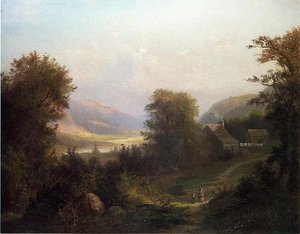 Hudson River Scene1863
 On the Waywayanda, Orange County, New York1877
 Near Noroton, Connecticut1875
 A View on Lake George1876
Essays around Edwin Forrest
 American artworks of the 1820s1820s American art by George Catlin, Gilbert Stuart, and Rembrandt Peale. View these iconic masterpieces and more on OriginalUniqueArt.com.
 American artworks of the 1810s1810s American art by Gilbert Stuart, John Trumbull, and Rembrandt Peale. Find museum-quality reproductions on OriginalUniqueArt.com.
 The Art of the Gaze: A Collector's Guide to Mastering Portrait Composition and Emotional DepthMaster the nuances of portrait composition with our expert guide for collectors. Discover how light, gaze, and texture create emotional dep…