

 Preview
 Send
Send Share
Share
 Details

 Download
 Similars
 X-Ray
X-Ray Diaporama
 Stats
StatsPastoral Scene
 Oil
Oil- WallArt
- Realism
 1860
1860- 19th Century
 56.0 x 71.0 cm
 Read More
Hand Made Oil Reproduction
Hand-painted oil on canvas in your size and frame, made to order by our artists. ( Switch to Print Switch to Digital Image)




P118B $10

P118H $10

P118W $10

P438Z $10

P508JH $12

P508YH $12

P805H $10

P805Z $10

P919BZ $10

P919G $10

P919XJ $10

P959ZH $10

P968JZ $12

W106C $8

W218G $10

W218JH $8

W218Y $10

W307PJ $10

W316G $10

W316PJ $8

W316Y $10

W398PJ $8

W4111J $10

W500HY $15

W500JH $15

W692G $12

W849H $8

W940BG $15

W953PJ $8




Pick from our preset sizes that match the artwork's original proportions.

You may enter your own dimensions to fit a specific frame or space. If your selected size does not match the original image's proportions, we will either crop the artwork or extend the painting with additional hand-painted elements. A digital mockup will be sent for your approval before production begins.
Please note that the on-screen preview does not reflect the actual cropping or extension. Only the mockup will accurately show the final composition.
While custom sizes are available, we recommend selecting a dimension from the predefined list to preserve the original proportions.
After order, OriginalUniqueArt.com team will email client for instructions and provide a mockup preview
Worldwide Delivery () in 3/4 weeks instead of standard 5 weeks. (11 September). No compromise on quality.

Free Worldwide Express Shipping

High-Quality Linen Canvas

Full Shipping Insurance

Customs Tax Refund Guarantee

True Color Matching Guarantee

100-Day Return Policy (Defects Only)

100% Money-Back Guarantee

Bulk Discount Offer
 Glass option is only available in size under 110 CM

Pastoral Scene
Reproduction Medium
Reproduction Size
-


Total Price
$ 300
A Serene Encounter with Rural Realism
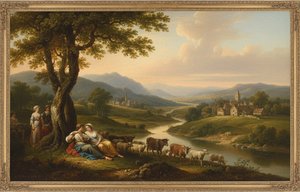
In the quietude of the mid-19th century, few artists captured the soul of the French countryside with as much tenderness and precision as Constant Troyon. His masterpiece, Pastoral Scene, painted in 1860, serves as a breathtaking window into a bygone era of agricultural tranquility. At first glance, the viewer is drawn into a harmonious landscape where the boundaries between humanity and nature seem to dissolve. The composition centers on a gentle gathering of life: two prominent cows, one draped in patches of brown and white and the other in stark black and white, anchor the foreground with their heavy, peaceful presence. Nearby, a woman and a child sit nestled against the earth, their relaxed postures suggesting a profound connection to the land they inhabit. This is not merely a depiction of labor, but a celebration of existence within the rhythmic cycles of rural life.
The technical mastery displayed in this work reflects Troyon’s unique lineage, rooted in the meticulous precision of porcelain decoration. Every brushstroke contributes to a rich, tactile experience; the artist employs bold, expressive movements to create depth and texture, particularly in the coats of the cattle and the soft, undulating grasses. The color palette is a sophisticated arrangement of earthy tones—deep ochres, mossy greens, and warm umbers—which are illuminated by a soft, diffused light that bathes the entire scene in a nostalgic glow. This use of light does more than illuminate the subjects; it creates an atmosphere of intimacy, as if the viewer has stumbled upon a private, sacred moment of repose in a sun-drenched meadow.
The Legacy of the Barbizon Spirit
To understand the emotional weight of Pastoral Scene, one must look to the historical context of the Barbizon School. Troyon, a leading figure of this movement, sought to move away from the idealized, theatrical landscapes of the past in favor of an authentic, unadorned Realism. In this painting, the inclusion of secondary figures—the distant cow and the scattered sheep—adds layers of narrative complexity, suggesting a vast, living ecosystem that extends far beyond the frame. There is a profound sense of stability and calm in the balanced composition, where every element, from the seated figures to the grazing livestock, finds its rightful place in a larger, harmonious whole.
For the discerning collector or interior designer, this painting offers much more than mere decoration; it provides an emotional anchor for a room. The artwork possesses a timeless quality that can breathe life into a modern space, offering a sense of peace and groundedness that is increasingly rare in our fast-paced world. Whether displayed in a sunlit study or a grand living area, a high-quality oil reproduction of this piece invites contemplation and serves as a constant reminder of the beauty found in simplicity. Owning such a work is an opportunity to preserve a fragment of 19th-century French heritage, bringing the enduring charm of Troyon’s pastoral vision into the contemporary home.
Artist Biography
Early Life and Training
- Born: Seville, France (1810)
- Died: 1865
- Constant Troyon's early years were shaped by his family’s connection to the porcelain manufactory in Sèvres. His father and mother both worked there, fostering an environment where artistic skill was valued.
- He began as a decorator at the manufactory, meticulously honing his skills in porcelain ornamentation from a young age. This training instilled in him a keen eye for detail and precision that would later influence his painting style.
- By 21, Troyon embarked on countrywide travels, dedicating himself to landscape painting whenever finances allowed. These journeys provided invaluable experience and exposure to diverse environments.
- When funds were low, he returned to porcelain decoration, demonstrating a pragmatic approach to supporting his artistic ambitions.
- He received mentorship from Camille Roqueplan, who introduced him to other prominent Barbizon artists like Rousseau and Jules Dupré. While initially influenced by their style, Troyon would eventually develop his own distinct voice.
Artistic Development and Dutch Influence
- A pivotal moment in Troyon's artistic development occurred during a trip to the Netherlands in 1846.
- Inspired by Paulus Potter’s "Young Bull" and masterpieces by Cuyp and Rembrandt, he transitioned to animal painting, discovering his true calling.
- This experience marked a significant shift in his style, moving away from purely landscapes towards depictions of animals within their natural settings.
- The Dutch masters' emphasis on realism and capturing the essence of animals deeply resonated with Troyon, shaping his artistic vision.
Artistic Style and Legacy
- Troyon’s works were characterized by authenticity, showcasing animals in their natural, dynamic states. He strived to capture not just their physical appearance but also their character and behavior.
- Art critic Albert Wolff noted Troyon's transformative style, praising his ability to breathe life into animals and create compelling landscapes.
- Despite achieving considerable success, Troyon remained somewhat skeptical of his own accomplishments, reflecting a humble and introspective nature.
- He received numerous accolades throughout his career, including the Legion of Honour and five Paris Salon medals, demonstrating widespread recognition for his talent.
- Napoleon III was among his clientele, further solidifying his reputation as a leading artist of the time.
- Sadly, success took a toll on Troyon's mental health, and he passed away in 1865 after periods of unrest.
Notable Works and Lasting Impact
- Most of his renowned works date from 1850 to 1864, with earlier pieces considered less significant as they predate his Dutch-inspired style.
- His legacy includes the Troyon Prize for animal paintings at the École des Beaux Arts, established by his mother to honor his memory and encourage future artists.
- Major works can be found in prestigious galleries worldwide, including the Wallace Gallery (Glasgow), Louvre, and the Metropolitan Museum of Art.
- "Vallée de la Toucque, Normandy," exemplifies his genius, showcasing his ability to capture both the beauty of the landscape and the vitality of its animal inhabitants.
- He influenced subsequent artists, such as Émile van Marcke, demonstrating the enduring impact of his artistic vision.
Connection to the Barbizon School
- Troyon was a significant member of the Barbizon School, a group of French landscape painters who favored painting outdoors and depicting realistic scenes from nature.
- The Barbizon School emphasized direct observation and sought to capture the essence of rural life and landscapes, rejecting the idealized depictions prevalent in academic art.
- While Troyon initially followed the style of other Barbizon artists, his unique talent for animal painting distinguished him within the group.

Constant Troyon
1810 - 1865 , France
Quick Facts
- Artistic Movement Or Style: Barbizon School, Naturalism
- Artists Or Movements Influenced By This Artist: ['Émile van Marcke']
- Artists Who Influenced This Artist:
- Paulus Potter
- Aelbert Cuyp
- Rembrandt
- Date Of Birth: August 28, 1810
- Date Of Death: February 21, 1865
- Full Name: Constant Troyon
- Nationality: French
- Notable Artworks:
- Vallée de la Toucque, Normandy
- Watering Cattle
- Cattle in Stormy Weather
- Oxen at Work
- Returning to the Farm
- Place Of Birth: Sèvres, France
Related Articles

Idyllic Visions: Exploring the Pastoral Scene in Art History – From Arcadia to Modern Interpretations
Explore the captivating history of pastoral art from classical Arcadia to modern masterpieces. Discover key artists like Millet & Cole at OriginalUniqueArt. Find serene landscape paintings for your home.

Romantic Landscapes: 10 Masterpieces for Your Home | OriginalUniqueArt
Journey through 10 Romantic landscape masterpieces by Friedrich, Turner & Cole. Explore emotional art, sublime nature scenes & iconic 19th-century paintings. Find museum-quality reproductions for your home at OriginalUniqueArt.com – discover the full collection online!

John Constable's Masterpieces: Explore 25 Iconic Landscapes for Your Home
Journey through John Constable's 25 most celebrated landscapes. Explore Romanticism, Dedham Vale & his masterful use of light in iconic paintings like 'Hay Wain'. Find museum-quality art reproductions and elevate your home decor on OriginalUniqueArt.com.
Idyllic Visions: Exploring the Pastoral Tradition in Western Art – Themes, Techniques & Enduring Appeal
Explore the rich history of pastoral art from classical Arcadia to contemporary interpretations. Discover key artists, themes & collecting tips at OriginalUniqueArt.

Evocations of Place: A Historical Journey Through Landscape Art
Explore the rich history of landscape art with OriginalUniqueArt. Discover renowned artists, movements like Impressionism & Romanticism, and expert guidance for collecting timeless pieces. Find your perfect serene escape today!


