Preview
 Send
Send Share
Share
 Details
 Guide
Guide

 Download
 Similars
 X-Ray
X-Ray Diaporama
 Stats
StatsPP-104


 Read More
The artwork displayed on this page is protected by copyright law, which means we cannot legally create or sell an identical reproduction. This protection is enforced under international agreements such as the Berne Convention and by national laws, including those outlined by the U.S. Copyright Law - Title 17.
As a respectful and legal alternative, we offer custom, hand-painted artworks inspired by the original. Our skilled and professional artists carefully study the original's style, mood, and artistic essence to create a new, unique piece that evokes the same feeling - while remaining an original creation in its own right.
This method fully complies with copyright regulations because it does not involve copying or duplicating the protected artwork. Instead, it is a creative reinterpretation - a new painting that is influenced by the original but not identical to it.
Hand Made Oil Reproduction
Hand-painted oil on canvas in your size and frame, made to order by our artists. ( Switch to Print Switch to Digital Image)




































Pick from our preset sizes that match the artwork's original proportions.

Type the width and the height you need, to fit your frame or your wall. This is hand-painted, so for a size with a different shape the artist can paint a bit more around the picture, or cut a bit — you choose. We send you a digital mockup to approve before the painting starts. The picture shown on this page does not show the real result — only the mockup does.
After order, OriginalUniqueArt.com team will email client for instructions and provide a mockup preview
Worldwide Delivery () in 3/4 weeks instead of standard 5 weeks. (24 October). No compromise on quality.

Free Worldwide Express Shipping

High-Quality Linen Canvas

Full Shipping Insurance

Customs Tax Refund Guarantee

True Color Matching Guarantee

100-Day Return Policy (Defects Only)

100% Money-Back Guarantee

Bulk Discount Offer
 Glass option is only available in size under 110 CM

PP-104
Reproduction Medium
Reproduction Size
-


Total Price
$ 300
The Raw Power of Abstraction: Exploring Clyfford Still’s PP-104
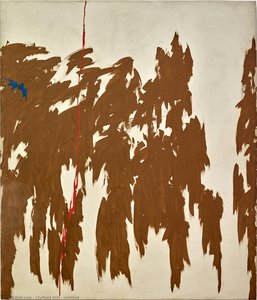
In the pantheon of American Abstract Expressionism, few names command as much visceral respect as Clyfford Still. His work, particularly the evocative piece PP-104 from 1952, serves as a profound testament to the artist's ability to transcend mere pigment and canvas, reaching instead into the very soul of human emotion. This particular work, captured in a striking interplay of color and form, exemplifies the rugged, unyielding spirit that defined Still’s contribution to modern art. Unlike the controlled gestures of his contemporaries, Still’s approach feels elemental, as if the painting were not so much composed as it were unearthed from the earth itself.
The visual impact of PP-104 is immediate and arresting. At first glance, the viewer is met with a bold, saturated red background that pulses with an almost rhythmic intensity. This field of color is interrupted by jagged, black outlines and irregular shapes that seem to tear through the surface of the work. While some might perceive it as a drawing due to its sharp, defined edges, there is an undeniable weight to the application of color. The contrast between the fiery red and the deep, obsidian blacks creates a tension that is both beautiful and unsettling, inviting the eye to wander through a landscape of pure, unadulterated feeling.
Technique and the Language of Texture
To understand PP-104, one must look closely at the artist's unique technical vocabulary. Still was a master of texture, utilizing heavy, impasto-like applications to create a surface that possesses its own topography. In this piece, the intricate lines and patterns are not merely decorative; they are the scars and ridges of an intense creative struggle. The way the black outlines interact with the red expanse suggests a sense of organic growth or geological upheaval. Each brushstroke feels deliberate yet wild, contributing to a larger tapestry of movement that defies traditional composition.
< p>For the discerning collector or interior designer, this piece offers a unique opportunity to introduce a focal point of immense character into a space. The starkness of the black and red palette allows it to integrate seamlessly into both minimalist modern environments and more eclectic, sophisticated settings. It is a work that demands attention without overwhelming the room, acting as an anchor of profound artistic gravity. A high-quality reproduction of PP-104 preserves these delicate textures and intense color relationships, allowing the raw energy of Still’s vision to breathe within a contemporary home or gallery.A Legacy of Artistic Integrity
Historically, Clyfford Still stands as a pioneer who moved beyond the figurative much earlier than many of his peers. His work was never about representing the world we see, but rather about expressing the internal world we feel. PP-104 is a window into that internal landscape—a place of high drama and existential depth. By stripping away the distractions of recognizable objects, Still forces us to confront the raw essence of color and form. This piece remains a vital touchstone for anyone seeking to understand the heights of mid-century abstraction and the enduring power of an artist who refused to compromise his vision.
Questions & Answers
Where is the portrait format of "PP-104" recommended to be displayed?
The portrait format of "PP-104" by Clyfford Still is recommended for a living room. Format and space together guide the placement of a reproduction.
Where can I find a guide to "PP-104"?
The Guide page of "PP-104" by Clyfford Still offers a printable two-sheet factsheet: the artwork with its identity table, a decade band placing it in the artist's lifetime, other works by the artist, the measured color palette, and ready-to-copy citations in four styles.
What is the overall mood of "PP-104" by Clyfford Still?
The overall mood of "PP-104" by Clyfford Still is bold. The mood describes the general atmosphere of the work.
Artist Biography
A Pioneer of Abstract Expressionism: The Life and Art of Clyfford Still
Clyfford Still, born in 1904 amidst the vast landscapes of Grandin, North Dakota, stands as a pivotal figure in the evolution of American art. His journey, marked by an unwavering commitment to artistic integrity and a relentless exploration of form and color, positioned him among the leading lights of Abstract Expressionism. Though often overshadowed by contemporaries like Jackson Pollock and Mark Rothko, Still’s contribution was foundational; he ventured into non-figurative painting earlier than many of his peers, forging a path toward a new visual language that would profoundly influence modern art. His early life, spent moving between North Dakota, Washington, and Alberta, Canada, instilled in him a deep connection to the natural world – a resonance that would echo throughout his artistic career. A brief period of study at the Art Students League in New York City in 1925 offered initial exposure to the art world, but it was his subsequent experiences teaching and painting on the West Coast that truly shaped his unique vision. He wasn’t simply seeking to depict nature; he aimed to capture its raw essence, its underlying forces of creation and destruction.From Representation to Revelation: The Development of a Unique Style
The transformation from representational work to the radical abstraction for which Still is celebrated occurred between 1938 and 1942, a period of intense experimentation and self-discovery. This shift wasn’t merely stylistic; it was profoundly philosophical. He sought to strip away all recognizable imagery, believing that true artistic expression lay in confronting the fundamental elements of painting itself – color, form, and surface. Early works like PH-616 (1929) offer a glimpse into this transitional period, showcasing his initial exploration of rural life rendered with a muted palette and evocative symbolism. These paintings weren’t simply depictions; they were imbued with a sense of longing, a quiet contemplation of the human condition within the vastness of the American landscape. As he moved further toward abstraction, these representational elements gradually dissolved into jagged planes of color, fractured surfaces, and imposing vertical forms. These weren't merely abstract shapes; they were imbued with raw emotion, existential angst, and the sublime power of nature. He worked primarily with oil paint applied with palette knives, building up layers of texture that created a dynamic interplay between light and shadow. This technique allowed him to create surfaces that seemed to pulse with energy, inviting viewers into an immersive experience—a confrontation with the very act of painting itself.The Language of Color and Form: Key Characteristics of Still’s Work
Still's mature paintings are characterized by their monumental scale and dramatic color juxtapositions. He favored large canvases, believing that only through such expansiveness could he convey the full emotional weight of his vision. His compositions typically feature irregular, fractured planes of color – often dark and brooding hues punctuated by flashes of brighter tones. These forms aren’t simply arranged on the canvas; they seem to emerge from it, creating a sense of depth and spatial ambiguity. The vertical element is particularly significant in Still's work, representing what he termed “the vertical necessity of life” – a defiant assertion of human spirit against overwhelming forces. 1957-D No. 1, with its predominantly black and yellow palette accented by white and red, exemplifies this characteristic use of color and form to evoke powerful emotional responses. He deliberately avoided titles that might suggest specific interpretations, preferring a numerical system (e.g., “1957-D No. 1”) that emphasized the painting’s purely visual qualities. This was part of his broader effort to resist categorization and maintain control over how his work was perceived. He wanted viewers to experience the paintings directly, without preconceived notions or external narratives.Legacy and Influence: A Lasting Impact on Modern Art
Clyfford Still's influence extends far beyond his own body of work. He is considered a key progenitor of Color Field painting, a movement that emphasized the expressive potential of color as an independent element in art. His uncompromising artistic vision and rejection of conventional norms paved the way for subsequent generations of abstract painters. While he often distanced himself from the New York art world, his impact on its development was undeniable. He taught at various institutions, including Washington State University and the California School of Fine Arts, inspiring countless students to explore their own creative potential. In 1959, a comprehensive retrospective of his work at the Albright-Knox Art Gallery in Buffalo, New York, solidified his reputation as a major force in American art. Perhaps one of his most significant legacies is The Clyfford Still Museum in Denver, Colorado, which houses an extraordinary collection of over 3,125 works – representing 93 percent of his lifetime output and complete archives. This museum provides unparalleled access to the breadth and depth of his artistic vision, ensuring that his contributions will continue to be studied and appreciated for generations to come. His work continues to resonate with viewers today, offering a powerful meditation on the human condition and the enduring mysteries of existence.Further Exploration
- Explore more about Clyfford Still’s artworks at OriginalUniqueArt.com.
- Discover the Color Field art movement.
- Learn about artists like Mark Rothko and their influence on the art world.

Clyfford Still
1904 - 1980 , United States of America
Quick Facts
- Full Name: Clyfford Still
- Nationality: American
- Date Of Birth: 1904
- Date Of Death: 1980
- Place Of Birth: Grand Island, United States of America
- Notable Artworks:
- PH-616
- 1957-D No. 1
- 1950 W
- January 1951
- Artistic Movement Or Style: Abstract Expressionism
- Artists Or Movements Influenced By This Artist: ['Color Field painting']
Related Articles

Dark Masterpieces: 10 Iconic Paintings Dominated by Black Tones |
Explore 10 iconic paintings dominated by black tones, from Rembrandt’s chiaroscuro to Goya's dark expressions. Discover the stories behind these masterpieces & find museum-quality art reproductions for your home at .
Mark Rothko's Masterpieces: 25 Paintings That Define Abstract Expressionism | OriginalUniqueArt
Explore 25 iconic Mark Rothko paintings that define Abstract Expressionism. Discover the stories, colors & emotions behind these masterpieces. Find museum-quality art reproductions and curated decor ideas at OriginalUniqueArt.com.

Geometric Abstraction's 10 Defining Masterpieces | Art for Your Home - OriginalUniqueArt
Explore 10 defining masterpieces of Geometric Abstraction! Discover Kandinsky, Mondrian & Malevich’s iconic works. Find museum-quality art reproductions and curated decor ideas to elevate your home at OriginalUniqueArt.com.

Abstract Expressionism's 10 Defining Masterpieces |
Explore 10 defining Abstract Expressionism masterpieces by Pollock, Rothko & de Kooning. Discover the stories behind these iconic paintings and find museum-quality art reproductions to elevate your home decor on .

Kandinsky's Masterpieces: 25 Paintings That Define Abstract Art | OriginalUniqueArt
Journey through Wassily Kandinsky's 25 most iconic abstract paintings. Explore his revolutionary use of color, form & spiritual expressionism. Find museum-quality Kandinsky reproductions and elevate your home decor with OriginalUniqueArt.com. Discover all masterpieces on OriginalUniqueArt.com!


![PH-233 [formerly Self-Portrait]](/media/artworks/images-thumb/ee/8d/ee8d64fde49d8167a8ef180934d1231c.jpg)