Preview
 Send
Send Share
Share
 Details
 Guide
Guide

 Download
 Similars
 X-Ray
X-Ray Diaporama
 Stats
StatsUntitled (D2X63K)
 Oil On Canvas
- WallArt
- Neoclassical Style
 1789
1789- Early Modern
 92.0 x 69.0 cm
 Metropolitan Museum of Art
 Read More
Giclée / Art Print
Museum-quality giclée or canvas print with fast production and flexible finish options. ( Buy Hand Made Painting Switch to Digital Image)




P118B $10

P118H $10

P118W $10

P438Z $10

P508JH $12

P508YH $12

P805H $10

P805Z $10

P919BZ $10

P919G $10

P919XJ $10

P959ZH $10

P968JZ $12

W106C $8

W218G $10

W218JH $8

W218Y $10

W307PJ $10

W316G $10

W316PJ $8

W316Y $10

W398PJ $8

W4111J $10

W500HY $15

W500JH $15

W692G $12

W849H $8

W940BG $15

W953PJ $8




Pick from our preset sizes that match the artwork's original proportions.

Type the width and the height you need, to fit your frame or your wall. A print can only be cut, never made bigger than the picture, so a size with a different shape loses a part of the image. We send you a digital mockup to approve before we print anything. The picture shown on this page does not show the real cut — only the mockup does.
Worldwide Delivery () in 2 weeks instead of standard 4/5 weeks. (23 October)

Free Worldwide Express Shipping

High-Quality Linen Canvas

Full Shipping Insurance

Customs Tax Refund Guarantee

True Color Matching Guarantee

100-Day Return Policy (Defects Only)

100% Money-Back Guarantee

Bulk Discount Offer
 Glass option is only available in size under 110 CM

Untitled (D2X63K)
Giclée / Art Print
Reproduction Size
-


Total Price
$ 81
A Portrait of Dignity Amidst Revolution
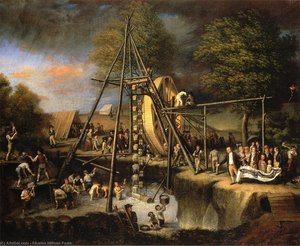
In the quiet gravity of Charles Willson Peale’s 1789 masterpiece, Untitled (D2X63K), we encounter more than just a painted figure; we witness the very soul of a nascent nation. Painted during the transformative years following George Washington’s inauguration, this work serves as a profound window into the Enlightenment-era American spirit. The central subject, a man seated with composed intellect in a formal chair, radiates an aura of stability and purpose. His hands, clasped in thoughtful repose, suggest a mind deeply engaged with the weight of a new republic's responsibilities. Through Peale’s lens, we see the embodiment of virtue and strength, capturing a moment when the dust of revolution was settling into the foundations of a lasting identity.Neoclassical Mastery and the Play of Light
Peale’s technical execution in this piece reflects the height of Neoclassical elegance, a style that sought to revive the balance and clarity of classical antiquity. Drawing inspiration from masters such as Benjamin West and Jacques-Louis David, Peale employs a deliberate and disciplined approach to form. The composition is anchored by precise lines and a harmonious arrangement of figures, creating a sense of eternal stillness. Most striking, however, is his sophisticated use of chiaroscuro. By orchestrating dramatic contrasts between deep shadows and soft, focused light, Peale sculpts the subject's features and clothing, imbuing the portrait with a three-dimensional grandeur. This interplay of light does not merely illuminate the scene; it breathes life into the textures of the fabric and the solemnity of the man’s expression, inviting the viewer to linger on every subtle nuance of the brushwork.A Narrative of Collective Responsibility
Beyond the singular focus on the seated gentleman, the painting weaves a complex narrative through its secondary figures and symbolic elements. The presence of two additional individuals, positioned subtly within the periphery, suggests that the building of a nation is never a solitary endeavor but a collective pursuit of progress. A book resting near the subject further reinforces the theme of intellectual enlightenment and the importance of law and knowledge in a stable society. For the discerning collector or interior designer, this artwork offers much more than aesthetic beauty; it provides a profound emotional resonance. It is a piece that commands attention in any space, offering a sophisticated dialogue between historical gravity and timeless grace, making it an exquisite choice for those looking to infuse their surroundings with a sense of heritage, intellect, and enduring dignity.Questions & Answers
Who created "Untitled (D2X63K)"?
The artist behind "Untitled (D2X63K)" is Charles Willson Peale. The work is catalogued under Charles Willson Peale's name.
Can I examine "Untitled (D2X63K)" in more detail?
"Untitled (D2X63K)" can be examined layer by layer on the artwork's X-Ray page, a viewer inspired by a conservator's light bench with eleven optical readings of the image.
How strong is the contrast in "Untitled (D2X63K)" by Charles Willson Peale?
The light-dark contrast of "Untitled (D2X63K)" is recorded as statement. Contrast describes how strongly light and dark areas differ.
Artist Biography
Charles Willson Peale: A Life of Art, Science, and Patriotism
- Born: April 15, 1741, Chester, Queen Anne's County, Maryland
- Died: February 22, 1827, Philadelphia, Pennsylvania
Early Life and Artistic Training
- Peale’s early life was marked by financial hardship following his father’s death. He apprenticed as a saddler before discovering his passion for art.
- He received initial training from John Hesselius and briefly studied with John Singleton Copley, demonstrating an early aptitude for portraiture.
- A crucial period in his development was his time studying under Benjamin West in London (1767-1770). This exposure to European artistic trends significantly influenced his style.
Artistic Career and Major Works
- Portraiture: Peale is best known for his portraits of prominent figures from the American Revolution, including numerous depictions of George Washington (nearly sixty in total). These portraits are valuable historical documents as well as artistic achievements.
- Style: His style evolved over time, initially influenced by West’s Neoclassical approach but later incorporating elements of realism and a desire to capture likeness accurately.
- Notable Works:
- George Washington (1772): Marked the beginning of his long association with Washington.
- The Staircase Group (c. 1795): A striking example of trompe l'oeil, depicting his sons Raphael and Titian as if they were part of the architectural setting.
Scientific Pursuits and Peale’s American Museum
- Peale was a passionate naturalist and scientist, organizing expeditions to study natural history.
- He founded Peale's American Museum in Philadelphia (1784), one of the first museums in the United States. It housed botanical, biological, and archaeological specimens.
- The museum played a significant role in popularizing science and education in America. He was particularly known for his displays of mastodon bones, acquired through an expedition in 1801.
- He taught himself taxidermy to preserve specimens for the museum, demonstrating his diverse skills.
Legacy and Historical Significance
- Peale’s work bridges the gap between art and science, reflecting the Enlightenment ideals of his time.
- His portraits provide invaluable visual records of key figures in American history.
- The founding of Peale's American Museum was a pioneering effort that helped establish the museum as an important institution for education and scientific exploration.
- He influenced subsequent generations of artists and scientists, contributing significantly to the development of American culture.
- His family legacy continued through his sons, including James Peale and Rubens Peale, who also became accomplished artists and contributed to the museum's collection.

Charles Willson Peale
1741 - 1827 , United Kingdom
Quick Facts
- Full Name: Charles Willson Peale
- Nationality: American
- Date Of Birth: 1741
- Date Of Death: 1827
- Place Of Birth: Chester, United Kingdom
- Notable Artworks:
- Staircase Group
- George Washington portraits
- Artistic Movement Or Style: Neoclassical painting
- Artists Who Influenced This Artist:
- John Hesselius
- John Singleton Copley
- Benjamin West
Related Articles
18th Century Masters: 10 Artworks That Define an Era | OriginalUniqueArt
Journey through 18th century art! Explore 10 iconic paintings – from Rococo elegance to Neoclassical grandeur. Discover Fragonard, David & more. Find museum-quality reproductions and elevate your home decor on OriginalUniqueArt.com.

Charles Willson Peale: Portraiture, Enlightenment Ideals & Shaping American Identity
Explore the life & art of Charles Willson Peale – Revolutionary portraitist, scientist, and founder of America’s first museum. Discover his iconic paintings of Washington & the Enlightenment ideals that shaped a nation.

Grant Wood & American Regionalism: Identity, Myth & the Rural Landscape
Explore the world of Grant Wood & American Regionalism with OriginalUniqueArt. Discover the symbolism behind 'American Gothic', recurring themes, and the movement's lasting impact on art history. High-quality reproductions available.
Titian Ramsay Peale II: A Legacy of Botanical Precision & Artistic Innovation
Explore the life & art of Titian Ramsay Peale II, a master of botanical precision and wildlife painting. Discover his legacy bridging art & natural history at OriginalUniqueArt.

Benjamin West: Transatlantic Ambition & Shaping American Art
Explore the life & legacy of Benjamin West, pioneering American artist and Royal Academy president. Discover his Neoclassical masterpieces, transatlantic influence, and lasting impact on art history. Learn more at OriginalUniqueArt.