Preview
 Send
Send Share
Share
 Details
 Guide
Guide

 Download
 Similars
 X-Ray
X-Ray Diaporama
 Stats
StatsRachel Weeping


 Read More
Giclée / Art Print
Museum-quality giclée or canvas print with fast production and flexible finish options. ( Buy Hand Made Painting Switch to Digital Image)




P118B $10

P118H $10

P118W $10

P438Z $10

P508JH $12

P508YH $12

P805H $10

P805Z $10

P919BZ $10

P919G $10

P919XJ $10

P959ZH $10

P968JZ $12

W106C $8

W218G $10

W218JH $8

W218Y $10

W307PJ $10

W316G $10

W316PJ $8

W316Y $10

W398PJ $8

W4111J $10

W500HY $15

W500JH $15

W692G $12

W849H $8

W940BG $15

W953PJ $8




Pick from our preset sizes that match the artwork's original proportions.

Type the width and the height you need, to fit your frame or your wall. A print can only be cut, never made bigger than the picture, so a size with a different shape loses a part of the image. We send you a digital mockup to approve before we print anything. The picture shown on this page does not show the real cut — only the mockup does.
Worldwide Delivery () in 2 weeks instead of standard 4/5 weeks. (28 October)

Free Worldwide Express Shipping

High-Quality Linen Canvas

Full Shipping Insurance

Customs Tax Refund Guarantee

True Color Matching Guarantee

100-Day Return Policy (Defects Only)

100% Money-Back Guarantee

Bulk Discount Offer
 Glass option is only available in size under 110 CM

Rachel Weeping
Giclée / Art Print
Reproduction Size
-


Total Price
$ 81
The Haunting Beauty of Loss
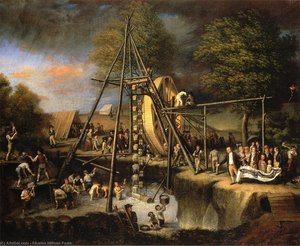
Charles Willson Peale’s “Rachel Weeping,” painted in 1772, isn't merely a portrait; it’s a visceral embodiment of sorrow, a poignant meditation on loss and the enduring bonds of family. The painting depicts Rachel Peale, Charles’s wife, mourning the death of their child – a tragedy that struck deeply within the heart of this prominent American artist and his family. Yet, despite its subject matter, “Rachel Weeping” transcends mere grief to become a powerful statement about resilience, faith, and the enduring nature of love.
Peale’s decision to immortalize this moment of profound sorrow was revolutionary for its time. Rather than shy away from depicting the raw emotion of bereavement, he embraced it with unflinching honesty. The composition immediately draws the viewer in – a woman enveloped in shadow, cradling her lifeless infant, a scene both heartbreaking and strangely dignified. It’s a stark departure from the idealized depictions of motherhood prevalent in earlier art, offering instead an intimate glimpse into the depths of human suffering.
Neoclassical Elegance Meets Emotional Intensity
Stylistically, “Rachel Weeping” masterfully blends elements of Neoclassicism with Romanticism. Peale’s training under Benjamin West, a leading figure in the British Neoclassical movement, is evident in the painting's carefully rendered details – the delicate folds of Rachel’s garments, the precise modeling of her face, and the restrained palette dominated by muted browns, grays, and creams. However, beneath this formal elegance lies an undeniable surge of emotional intensity. The use of chiaroscuro—the dramatic contrast between light and shadow—heightens the sense of drama and underscores the painting’s central theme of grief. Notice how the light gently illuminates Rachel's face, highlighting her sorrowful expression while leaving much of the background shrouded in darkness.
Peale’s technique is remarkably skillful. He employs a loose brushstroke to create a sense of movement and immediacy, capturing the raw emotion of the scene with remarkable sensitivity. The positioning of the child – nestled close to Rachel's chest, its head resting on her shoulder – speaks volumes about the profound connection between mother and child, further amplifying the painting’s emotional impact.
Symbolism and a Testament to Family
The symbolism within “Rachel Weeping” is layered and deeply resonant. The inclusion of other figures in the background—a man standing behind Rachel and another positioned further back on the right—suggests a wider family circle, emphasizing the communal nature of grief. The presence of medical bottles hints at the era’s limited understanding of illness and death, adding a layer of historical context to the scene. Most powerfully, Rachel's posture – her head bowed in sorrow, her hands clasped protectively around the child—evokes the iconography of the Madonna and Child, transforming her grief into a sacred act of mourning.
Peale’s decision to paint this image after the loss of his own children underscores the profound personal connection he felt to the subject matter. “Rachel Weeping” is not simply a portrait; it's a deeply felt expression of love, loss, and the enduring strength of the human spirit. It remains a hauntingly beautiful testament to the complexities of family life and the universal experience of grief.
A Legacy of Emotional Depth
“Rachel Weeping” holds a significant place in American art history as one of the earliest examples of a portrait confronting difficult emotions with such directness. Its emotional honesty and technical skill continue to resonate with viewers today, prompting reflection on themes of loss, family, and the enduring power of human connection. Reproductions of this iconic painting offer a powerful opportunity to experience Peale’s masterful artistry and contemplate the profound beauty that can be found even in moments of deepest sorrow.
Questions & Answers
In what year was "Rachel Weeping" by Charles Willson Peale created?
The creation of "Rachel Weeping" by Charles Willson Peale is dated 1772.
How many people view "Rachel Weeping"?
Statistics about "Rachel Weeping" by Charles Willson Peale are on the artwork's Stats page: monthly visits of the artwork, visits of the artist's works, and country and language breakdowns of recent visitors.
Can I preview "Rachel Weeping" by Charles Willson Peale before ordering?
The Preview page of "Rachel Weeping" lets you preview the artwork before ordering.
Artist Biography
Charles Willson Peale: A Life of Art, Science, and Patriotism
- Born: April 15, 1741, Chester, Queen Anne's County, Maryland
- Died: February 22, 1827, Philadelphia, Pennsylvania
Early Life and Artistic Training
- Peale’s early life was marked by financial hardship following his father’s death. He apprenticed as a saddler before discovering his passion for art.
- He received initial training from John Hesselius and briefly studied with John Singleton Copley, demonstrating an early aptitude for portraiture.
- A crucial period in his development was his time studying under Benjamin West in London (1767-1770). This exposure to European artistic trends significantly influenced his style.
Artistic Career and Major Works
- Portraiture: Peale is best known for his portraits of prominent figures from the American Revolution, including numerous depictions of George Washington (nearly sixty in total). These portraits are valuable historical documents as well as artistic achievements.
- Style: His style evolved over time, initially influenced by West’s Neoclassical approach but later incorporating elements of realism and a desire to capture likeness accurately.
- Notable Works:
- George Washington (1772): Marked the beginning of his long association with Washington.
- The Staircase Group (c. 1795): A striking example of trompe l'oeil, depicting his sons Raphael and Titian as if they were part of the architectural setting.
Scientific Pursuits and Peale’s American Museum
- Peale was a passionate naturalist and scientist, organizing expeditions to study natural history.
- He founded Peale's American Museum in Philadelphia (1784), one of the first museums in the United States. It housed botanical, biological, and archaeological specimens.
- The museum played a significant role in popularizing science and education in America. He was particularly known for his displays of mastodon bones, acquired through an expedition in 1801.
- He taught himself taxidermy to preserve specimens for the museum, demonstrating his diverse skills.
Legacy and Historical Significance
- Peale’s work bridges the gap between art and science, reflecting the Enlightenment ideals of his time.
- His portraits provide invaluable visual records of key figures in American history.
- The founding of Peale's American Museum was a pioneering effort that helped establish the museum as an important institution for education and scientific exploration.
- He influenced subsequent generations of artists and scientists, contributing significantly to the development of American culture.
- His family legacy continued through his sons, including James Peale and Rubens Peale, who also became accomplished artists and contributed to the museum's collection.

Charles Willson Peale
1741 - 1827 , United Kingdom
Quick Facts
- Full Name: Charles Willson Peale
- Nationality: American
- Date Of Birth: 1741
- Date Of Death: 1827
- Place Of Birth: Chester, United Kingdom
- Notable Artworks:
- Staircase Group
- George Washington portraits
- Artistic Movement Or Style: Neoclassical painting
- Artists Who Influenced This Artist:
- John Hesselius
- John Singleton Copley
- Benjamin West
Related Articles

Titian Ramsay Peale II: A Legacy of Botanical Precision & Artistic Innovation
Explore the life & art of Titian Ramsay Peale II, a master of botanical precision and wildlife painting. Discover his legacy bridging art & natural history at OriginalUniqueArt.

Echoes of Loss: Exploring Representations of Grief Across Art History
Explore the profound history of grief in art, from Renaissance masterpieces to Baroque drama. Discover how artists captured loss, mourning & faith through powerful imagery. Expert insights at OriginalUniqueArt.

Echoes of Absence: Loss & Grief in Visual Art Through the Ages
Explore the profound history of grief in art, from Renaissance masterpieces to contemporary expressions. Discover how artists have captured loss, mourning, and mortality through powerful imagery & symbolism. OriginalUniqueArt offers expert insights.

Charles Willson Peale: Portraiture, Enlightenment Ideals & Shaping American Identity
Explore the life & art of Charles Willson Peale – Revolutionary portraitist, scientist, and founder of America’s first museum. Discover his iconic paintings of Washington & the Enlightenment ideals that shaped a nation.
The Visceral Language of Loss: Exploring Grief's Depiction in Art History
Explore the profound history of grief in art with OriginalUniqueArt. Discover Renaissance & Baroque masterpieces depicting loss, mourning, and faith. Expert insights & handmade reproductions available.