Preview
 Send
Send Share
Share
 Details

 Download
 Similars
 X-Ray
X-Ray Diaporama
 Stats
StatsGeneral Henry Knox
 Oil
Oil- WallArt
- Neoclassical Style
 1778
1778- Early Modern
 7.0 x 5.0 cm
 Metropolitan Museum of Art
 Read More
Giclée / Art Print
Museum-quality giclée or canvas print with fast production and flexible finish options. ( Buy Hand Made Painting Switch to Digital Image)




P118B $10

P118H $10

P118W $10

P438Z $10

P508JH $12

P508YH $12

P805H $10

P805Z $10

P919BZ $10

P919G $10

P919XJ $10

P959ZH $10

P968JZ $12

W106C $8

W218G $10

W218JH $8

W218Y $10

W307PJ $10

W316G $10

W316PJ $8

W316Y $10

W398PJ $8

W4111J $10

W500HY $15

W500JH $15

W692G $12

W849H $8

W940BG $15

W953PJ $8




Pick from our preset sizes that match the artwork's original proportions.

You may enter your own dimensions to fit a specific frame or space. If your selected size does not match the original image's proportions, we will either crop the artwork or extend the image with a mirrored or solid-fill edge. A digital mockup will be sent for your approval before production begins.
Please note that the on-screen preview does not reflect the actual cropping or extension. Only the mockup will accurately show the final composition.
While custom sizes are available, we recommend selecting a dimension from the predefined list to preserve the original proportions.
Worldwide Delivery () in 2 weeks instead of standard 4/5 weeks. (12 September)

Free Worldwide Express Shipping

High-Quality Linen Canvas

Full Shipping Insurance

Customs Tax Refund Guarantee

True Color Matching Guarantee

100-Day Return Policy (Defects Only)

100% Money-Back Guarantee

Bulk Discount Offer
 Glass option is only available in size under 110 CM

General Henry Knox
Giclée / Art Print
Reproduction Size
-


Total Price
$ 81
A Portrait of Resilience: The Spirit of Valley Forge
In the frozen, desperate winter of 1778, amidst the biting winds and profound uncertainty of Valley Forge, Charles Willson Peale captured more than just a likeness; he immortalized an era of burgeoning American identity. His portrait of General Henry Knox serves as a poignant window into the crucible of the Revolutionary War. The painting transcends the boundaries of traditional military portraiture, offering a soulful glimpse into the character of a man who would become one of George Washington’s most trusted advisors. Through Peale's lens, we do not merely see a soldier, but a leader forged in the fires of hardship, embodying the unwavering determination that defined the Continental Army during its darkest hour.
The subject, Henry Knox, was far from a typical career officer; a Boston bookseller turned artillery expert, his ascent to prominence is a testament to merit and intellect. Peale meticulously renders Knox’s countenance, utilizing a masterful approach to chiaroscuro that sculpts the General's features with dramatic light and shadow. This technique imbues the portrait with an emotional resonance, suggesting a quiet contemplation and a heavy sense of responsibility. The subtle tonal variations across the face reveal a man of deep thought, capturing a rare moment of stillness amidst the turbulent anxieties of wartime existence.
Neoclassical Elegance and Symbolic Authority
Adhering to the neoclassical ideals prevalent during the Enlightenment, Peale’s style emphasizes reason, order, and a refined realism. Eschewing flamboyant embellishment, the artist relies on smooth brushwork and precise anatomical accuracy to convey dignity. Every element of the composition is steeped in symbolic meaning, designed to communicate Knox's prestige and his vital role in the struggle for independence. The iconic red coat, accented with meticulous gold trim, serves as a visual shorthand for military rank and the gravity of his command.
Even the attire, including the authoritative hat, functions as a symbol of the dignity associated with leadership. For the discerning collector or interior designer, this piece offers a profound sense of historical weight and classical sophistication. The monochrome palette, while lending a timeless and classic appearance, allows the viewer to focus on the structural integrity of the composition and the psychological depth of the sitter. It is an artwork that does not merely decorate a space but commands it, inviting conversation about heritage, sacrifice, and the enduring strength of the human spirit.
An Essential Addition to any Curated Collection
For those seeking to infuse their environments with a sense of historical significance and artistic mastery, this reproduction of Peale’s masterpiece is an incomparable choice. Whether placed in a stately library, a professional study, or a sophisticated living space, the portrait brings with it the gravity of American history. It serves as a constant reminder of the resilience required to build a nation, making it an inspiring centerpiece for any collection focused on fine art, Americana, or classical portraiture.
Artist Biography
Charles Willson Peale: A Life of Art, Science, and Patriotism
- Born: April 15, 1741, Chester, Queen Anne's County, Maryland
- Died: February 22, 1827, Philadelphia, Pennsylvania
Early Life and Artistic Training
- Peale’s early life was marked by financial hardship following his father’s death. He apprenticed as a saddler before discovering his passion for art.
- He received initial training from John Hesselius and briefly studied with John Singleton Copley, demonstrating an early aptitude for portraiture.
- A crucial period in his development was his time studying under Benjamin West in London (1767-1770). This exposure to European artistic trends significantly influenced his style.
Artistic Career and Major Works
- Portraiture: Peale is best known for his portraits of prominent figures from the American Revolution, including numerous depictions of George Washington (nearly sixty in total). These portraits are valuable historical documents as well as artistic achievements.
- Style: His style evolved over time, initially influenced by West’s Neoclassical approach but later incorporating elements of realism and a desire to capture likeness accurately.
- Notable Works:
- George Washington (1772): Marked the beginning of his long association with Washington.
- The Staircase Group (c. 1795): A striking example of trompe l'oeil, depicting his sons Raphael and Titian as if they were part of the architectural setting.
Scientific Pursuits and Peale’s American Museum
- Peale was a passionate naturalist and scientist, organizing expeditions to study natural history.
- He founded Peale's American Museum in Philadelphia (1784), one of the first museums in the United States. It housed botanical, biological, and archaeological specimens.
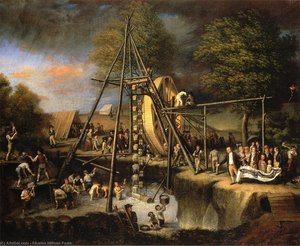
- The museum played a significant role in popularizing science and education in America. He was particularly known for his displays of mastodon bones, acquired through an expedition in 1801.
- He taught himself taxidermy to preserve specimens for the museum, demonstrating his diverse skills.
Legacy and Historical Significance
- Peale’s work bridges the gap between art and science, reflecting the Enlightenment ideals of his time.
- His portraits provide invaluable visual records of key figures in American history.
- The founding of Peale's American Museum was a pioneering effort that helped establish the museum as an important institution for education and scientific exploration.
- He influenced subsequent generations of artists and scientists, contributing significantly to the development of American culture.
- His family legacy continued through his sons, including James Peale and Rubens Peale, who also became accomplished artists and contributed to the museum's collection.

Charles Willson Peale
1741 - 1827 , United Kingdom
Quick Facts
- Artistic Movement Or Style: Neoclassical painting
- Artists Who Influenced This Artist:
- John Hesselius
- John Singleton Copley
- Benjamin West
- Date Of Birth: April 15, 1741
- Date Of Death: February 22, 1827
- Full Name: Charles Willson Peale
- Nationality: American
- Notable Artworks:
- Staircase Group
- George Washington portraits
- Place Of Birth: Chester, United Kingdom
Related Articles
Henri Matisse's Masterpieces: Explore 25 Iconic Paintings & Art Decor Ideas
Journey through Henri Matisse's 25 most iconic paintings! Explore Fauvism, vibrant colors & the stories behind masterpieces like 'The Dance'. Find museum-quality art reproductions and curated decor ideas to elevate your space. Discover all masterpieces on OriginalUniqueArt.com.
Robert Henri & the Spirit of American Realism: A Legacy of Urban Life and Artistic Independence
Explore the life & legacy of Robert Henri, a pivotal figure in American Realism. Discover his captivating portraits, influence on the Ashcan School, and enduring impact on art history. Learn more at OriginalUniqueArt.
Titian Ramsay Peale II: A Legacy of Botanical Precision & Artistic Innovation
Explore the life & art of Titian Ramsay Peale II, a master of botanical precision and wildlife painting. Discover his legacy bridging art & natural history at OriginalUniqueArt.

Grant Wood & American Regionalism: Identity, Myth & the Rural Landscape
Explore the world of Grant Wood & American Regionalism with OriginalUniqueArt. Discover the symbolism behind 'American Gothic', recurring themes, and the movement's lasting impact on art history. High-quality reproductions available.

Charles Willson Peale: Portraiture, Enlightenment Ideals & Shaping American Identity
Explore the life & art of Charles Willson Peale – Revolutionary portraitist, scientist, and founder of America’s first museum. Discover his iconic paintings of Washington & the Enlightenment ideals that shaped a nation.