Preview
 Send
Send Share
Share
 Details
 Guide
Guide

 Download
 Similars
 X-Ray
X-Ray Diaporama
 Stats
StatsChimney and Water Tower
 Oil On Canvas
- WallArt
- Precisionism
 1931
1931 76.0 x 61.0 cm
 Amon Carter Museum of American Art
 Read More
Giclée / Art Print
Museum-quality giclée or canvas print with fast production and flexible finish options. ( Buy Hand Made Painting Switch to Digital Image)




P118B $10

P118H $10

P118W $10

P438Z $10

P508JH $12

P508YH $12

P805H $10

P805Z $10

P919BZ $10

P919G $10

P919XJ $10

P959ZH $10

P968JZ $12

W106C $8

W218G $10

W218JH $8

W218Y $10

W307PJ $10

W316G $10

W316PJ $8

W316Y $10

W398PJ $8

W4111J $10

W500HY $15

W500JH $15

W692G $12

W849H $8

W940BG $15

W953PJ $8




Pick from our preset sizes that match the artwork's original proportions.

You may enter your own dimensions to fit a specific frame or space. If your selected size does not match the original image's proportions, we will either crop the artwork or extend the image with a mirrored or solid-fill edge. A digital mockup will be sent for your approval before production begins.
Please note that the on-screen preview does not reflect the actual cropping or extension. Only the mockup will accurately show the final composition.
While custom sizes are available, we recommend selecting a dimension from the predefined list to preserve the original proportions.
Worldwide Delivery () in 2 weeks instead of standard 4/5 weeks. (11 October)

Free Worldwide Express Shipping

High-Quality Linen Canvas

Full Shipping Insurance

Customs Tax Refund Guarantee

True Color Matching Guarantee

100-Day Return Policy (Defects Only)

100% Money-Back Guarantee

Bulk Discount Offer
 Glass option is only available in size under 110 CM

Chimney and Water Tower
Giclée / Art Print
Reproduction Size
-


Total Price
$ 81
A Concrete Landscape: Deconstructing Industrial American Identity
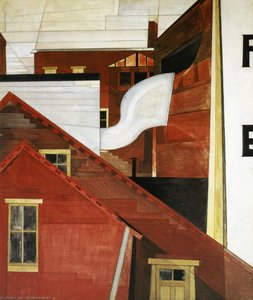
Charles Demuth's 1931 painting, “Chimney and Water Tower,” isn’t merely a depiction of an industrial scene; it’s a carefully constructed meditation on the evolving relationship between humanity and its manufactured environment. Captured in stark black and white, the image presents a deceptively simple composition: a towering water tower, capped with a vibrant red dome, stands sentinel beside a substantial brick factory building, all framed by a prominent chimney reaching skyward. Yet, within this seemingly straightforward arrangement lies a complex exploration of American identity during a period of rapid industrialization and burgeoning modernism.
Demuth, a key figure in the Precisionist movement, rejected the subjective emotionalism of Impressionism and Expressionism in favor of an objective, almost photographic approach. He sought to capture the essence of his subjects with meticulous detail and geometric clarity – a deliberate reaction against the perceived excesses of previous artistic styles. Here, that precision is evident in the sharply defined lines, the carefully rendered textures of brick and metal, and the precise placement of every element within the frame. The painting isn’t about romanticizing industry; it's about dissecting it, analyzing its forms, and presenting them with a cool, analytical gaze.
Precisionism and the American Landscape
Born in Lancaster, Pennsylvania, Demuth’s early life was deeply intertwined with the industrial landscape of his hometown. His father ran a textile mill, and this proximity to manufacturing profoundly influenced his artistic vision. Precisionism emerged as a direct response to this environment – a desire to find beauty and significance within the often-overlooked structures of American industry. Demuth wasn’t interested in portraying factories as symbols of progress or prosperity; instead, he sought to reveal their inherent geometry and power, elevating them to the status of monumental forms.
The choice of a water tower and chimney is particularly significant. The water tower, a relatively new technology at the time, represented both technological advancement and a crucial element in urban infrastructure – supplying clean water for domestic use and firefighting. The chimney, a symbol of industrial output and often associated with pollution, provided a counterpoint, highlighting the complex relationship between progress and its environmental consequences. Demuth’s decision to render these elements in monochrome further emphasizes their stark materiality, stripping away any romantic or decorative associations.
Symbolism and Emotional Resonance
Despite its seemingly detached aesthetic, “Chimney and Water Tower” resonates with a subtle emotional depth. The scale of the water tower dominates the composition, suggesting both strength and vulnerability. The red dome, a vibrant splash of color against the predominantly grayscale palette, draws the eye and injects a sense of energy into the scene – perhaps representing the vitality of industry or even a defiant assertion of modernity. The lone figure near the water tower hints at human presence within this industrial landscape, inviting us to contemplate our role in shaping and being shaped by the world around us.
The painting’s historical context is crucial to understanding its significance. Created during the Great Depression, a period of economic hardship and social upheaval, “Chimney and Water Tower” can be interpreted as a reflection on America's industrial past and future. It’s a quiet but powerful statement about the enduring presence of industry in the American landscape – a landscape that was simultaneously celebrated for its productivity and lamented for its environmental impact.
A Reproduction Worth Admiring
OriginalUniqueArt offers meticulously crafted hand-painted reproductions of Charles Demuth's “Chimney and Water Tower,” capturing the artist’s precise detailing and evocative atmosphere. Each reproduction is created using archival-quality materials, ensuring that it will retain its beauty and vibrancy for generations to come. Whether you are an art collector, interior designer, or simply someone who appreciates fine art, a OriginalUniqueArt reproduction of “Chimney and Water Tower” is a stunning addition to any space – a testament to the enduring power of Precisionist art and a poignant reflection on the American industrial landscape.
Questions & Answers
Who is the artist behind "Chimney and Water Tower"?
"Chimney and Water Tower" was created by Charles Demuth. The information on this page describes Charles Demuth's original work.
When was "Chimney and Water Tower" made?
The creation of "Chimney and Water Tower" by Charles Demuth is dated 1931.
At what age did Charles Demuth make "Chimney and Water Tower"?
Charles Demuth made "Chimney and Water Tower" at the age of 48. The artist was born in 1883 and the work is dated 1931.
Why is the copyright status of "Chimney and Water Tower" what it is?
"Chimney and Water Tower" by Charles Demuth is in the public domain - its copyright has expired. Copyright terms are measured from the artist's death, and Charles Demuth died in 1935.
What size is "Chimney and Water Tower" by Charles Demuth in real life?
"Chimney and Water Tower" measures 76 x 61 cm in its original form. Original dimensions are a useful reference when choosing a reproduction size.
Is "Chimney and Water Tower" one of Charles Demuth's most popular works?
"Chimney and Water Tower" by Charles Demuth has a recognized popularity level. This classification reflects how widely the work is recognized.
How light is "Chimney and Water Tower" overall?
Overall, "Chimney and Water Tower" is recorded as balanced. Perceived brightness describes how light or dark the work appears.
Artist Biography
early life and education
charles henry buckius demuth, an american watercolorist, was born on november 8, 1883, in lancaster, pennsylvania. he developed a unique style of painting known as precisionism, which would later become a significant contribution to the american art scene. demuth's early education took place at franklin & marshall academy, followed by studies at drexel university and the prestigious pennsylvania academy of fine arts in philadelphia. it was during his time at pafa that he met william carlos williams, with whom he formed a lasting friendship.career and influences
demuth's artistic career began to take shape after his studies in the united states. he later attended académie colarossi and académie julian in paris, where he became an integral part of the avant-garde art scene. the city's acceptance of his homosexuality also had a profound impact on his work. upon returning to america, demuth retained aspects of cubism in many of his works, reflecting the influence of his time in paris. his fondness for lancaster is evident in the subject matter of numerous works, showcasing industrial features like bridges, smoke stacks, and skyscrapers.notable works and precisionism
demuth's most famous painting, the figure five in gold, was inspired by william carlos williams's poem "the great figure." this work is a prime example of demuth's unique style, which he termed "precisionism." other notable works include his "poster portraits," dedicated to artists and writers like georgia o'keeffe, arthur dove, and eugene o'neill. key characteristics of precisionism:- quasi-cubist, sharply defined manner
- urban and rural landscapes with industrial features
- highly structured scenes lacking figures
- depiction of an industrial setting with sharp linearity
legacy and museum quality replicas at OriginalUniqueArt
demuth's contributions to the precisionist art movement have left a lasting impact on american modernism. at OriginalUniqueArt.com, you can find museum-quality replicas of his works, including the figure five in gold and other notable pieces. explore the world of precisionism with OriginalUniqueArt's extensive collection: /en/art/show/art-d3cl2x-en/
Charles Demuth
1883 - 1935 , United States of America
Quick Facts
- Full Name: Charles Henry Buckius Demuth
- Nationality: American
- Date Of Birth: 1883
- Date Of Death: 1935
- Place Of Birth: Lancaster, United States of America
- Notable Artworks:
- The Figure Five in Gold
- Tree Forms 1916
- Poster Portraits
- Artistic Movement Or Style: Precisionism
- Artists Who Influenced This Artist:
- William Carlos Williams
- Cubism
- Artists Or Movements Influenced By This Artist: ['Marsden Hartley']
Related Articles

Precisionism: A Study of Industrial Aesthetics & Modern American Art
Explore Precisionism, a pivotal American art movement celebrating the Machine Age. Discover key artists like Sheeler & O'Keeffe, its European roots, and lasting influence on modern aesthetics. Expert analysis for collectors.

Precisionism: The Sharp, Industrial Edge of Modern Art and the Machine Age Aesthetic
Dive into the sharp, industrial world of Precisionism. Discover how this bold American movement used geometric precision and machine-age aesthetics to redefine modern art through skyscrapers, factories, and sleek, structural beauty.

Evocations of Place: A Historical Journey Through Landscape Art
Explore the rich history of landscape art with OriginalUniqueArt. Discover renowned artists, movements like Impressionism & Romanticism, and expert guidance for collecting timeless pieces. Find your perfect serene escape today!

Precision of Vision: Charles Demuth & the Modernist Reframing of American Industry
Explore the groundbreaking art of Charles Demuth & the Precisionism movement. Discover iconic paintings like 'The Figure Five in Gold,' his unique style, and lasting impact on American Modernism. Learn more at OriginalUniqueArt.

Grant Wood & American Regionalism: Identity, Myth & the Rural Landscape
Explore the world of Grant Wood & American Regionalism with OriginalUniqueArt. Discover the symbolism behind 'American Gothic', recurring themes, and the movement's lasting impact on art history. High-quality reproductions available.