The Rise of Precisionism: Context & Origins
The Industrial Revolution, sometimes divided into the First Industrial Revolution and Second Industrial Revolution, was a transitional period of the global economy toward more widespread, efficient and stable manufacturing processes, succeeding the S...
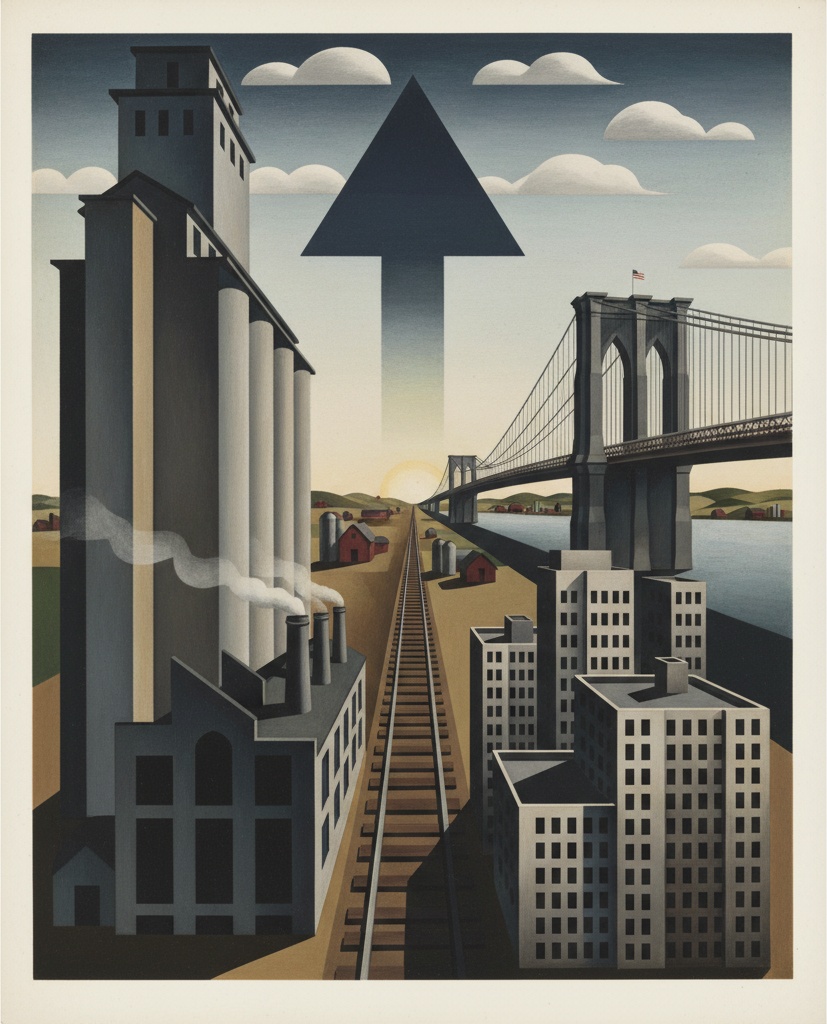
The early decades of the twentieth century witnessed a seismic shift in the global landscape, driven by unprecedented industrial growth and technological innovation. This era, often romanticized as the Machine Age, profoundly impacted not only societal structures but also artistic expression. Emerging from this transformative period was Precisionism, an American art movement that sought to capture the sleekness, power, and dynamism of a rapidly modernizing world. Unlike its European counterparts—particularly Futurism—which often glorified speed and chaos, Precisionism developed a distinctly American sensibility, rooted in a fascination with the built environment and the inherent geometry of industrial forms. The backdrop was one of burgeoning cities, expanding railway networks, and colossal factories – symbols of progress that simultaneously inspired awe and apprehension. It wasn’t merely about depicting these structures; it was about distilling their essence, reducing them to their fundamental shapes and planes, a visual language reflecting the perceived order and efficiency of the machine.
The movement arose in response to the abstract tendencies gaining prominence in Europe, particularly Cubism. While acknowledging the innovations of artists like Picasso and Braque, American painters sought a more grounded approach—one that connected with their immediate surroundings. The First World War played an indirect role, fostering a sense of national identity and a desire to define a uniquely American aesthetic, separate from European traditions. This wasn’t a rejection of all foreign influence, but rather a selective assimilation, filtered through the lens of American experience.
European Influences & The American Response
 Wikipedia: Precisionism
Precisionism was a modernist art movement that emerged in the United States after World War I. Influenced by Cubism, Purism, and Futurism, Precisionist artists reduced subjects to their essential geometric shapes, eliminated detail, and often used pl...
The seeds of Precisionism were undeniably sown in Europe. Cubism, with its fragmented perspectives and geometric forms, provided a crucial foundation for the movement’s visual vocabulary. Purism, championed by artists like Amédée Ozenfant and Le Corbusier, emphasized clarity, precision, and the beauty of industrial objects—themes that resonated deeply with American painters. Futurism, though embraced less directly, contributed to the fascination with machinery and speed. However, Precisionists diverged significantly from their European predecessors in their subject matter and overall tone.
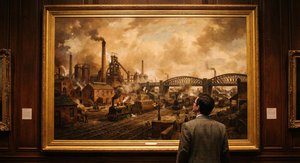
Where Futurist paintings often depicted dynamic motion and a sense of overwhelming energy, Precisionist works tended towards stillness and clarity. The focus shifted from celebrating the *process* of industrialization to portraying the *results*—the monumental structures themselves. Adolph von Menzel’s German Eisenwalzwerk (Moderne Cyklopen), completed in 1875, though predating Precisionism, served as a powerful precursor, capturing the bustling energy and scale of a factory with remarkable realism. This work demonstrated the potential for depicting industrial scenes with both accuracy and artistic merit, influencing early American artists. The European emphasis on abstraction was tempered by a desire to represent recognizable forms—skyscrapers, bridges, locomotives—albeit rendered in a highly stylized manner. It was a uniquely American synthesis of European innovation and local observation.
Key Characteristics: Geometry, Light, & Subject Matter
Precisionism is readily identifiable through its distinctive visual language. A hallmark of the style is the reduction of subjects to their essential geometric shapes—cylinders, cones, cubes—creating a sense of order and clarity. Artists meticulously rendered details with sharp precision, eliminating superfluous ornamentation and focusing on the underlying structure of objects. Planes of light played a crucial role in defining form and creating a sense of crisp focus, often emphasizing the sleekness and sheen of machine surfaces.
The subject matter was overwhelmingly focused on the new American landscape: skyscrapers piercing the skyline, bridges spanning vast distances, factories churning out goods, and railway networks connecting the nation. These were not merely depictions of industrial progress; they were symbols of a changing society—a society increasingly defined by technology and urbanization. Artists often employed a limited color palette, favoring muted tones and subtle gradations to convey a sense of solidity and permanence. The absence of human figures in many Precisionist paintings is noteworthy, suggesting both the scale of these structures and a certain detachment from the human experience.
Prominent Artists & Their Iconic Works
Several artists stand out as key figures in the development of Precisionism. Charles Sheeler, perhaps the most iconic representative of the movement, masterfully captured the geometric forms of industrial architecture in works like American Landscape. His paintings often featured railway scenes and factories, rendered with meticulous detail and a sense of quiet grandeur. Georgia O'Keeffe, while known for her floral paintings, also produced a series of striking cityscapes that embody Precisionist principles—her depictions of New York skyscrapers are particularly noteworthy.
Charles Demuth’s work often blended Cubist influences with a distinctly American sensibility. His painting Incense of a New Church, for example, depicts a factory smokestack rising like a cathedral spire, suggesting a spiritual dimension to industrial life. Louis Lozowick explored the darker side of industrialization in his stark and claustrophobic cityscapes, while Niles Spencer captured the dynamism of urban scenes with a unique sense of energy. These artists, though diverse in their individual styles, shared a common fascination with the built environment and a desire to capture its essence through geometric abstraction.
Precisionism and the Machine Age: A Complex Relationship
The relationship between Precisionism and the Machine Age was complex and multifaceted. While the movement celebrated the power and efficiency of technology, it wasn’t simply an uncritical endorsement of industrial progress. A subtle undercurrent of anxiety often permeated these paintings—a sense of alienation and detachment from the human experience. The absence of people in many works suggests a certain indifference to the social consequences of industrialization.
The economic realities of the Great Depression further complicated this relationship. As unemployment soared and factories stood idle, the celebratory tone of earlier Precisionist paintings began to fade. Some artists, like Clarence Holbrook Carter, explored the darker side of industrial life in their work, depicting scenes of poverty and despair. The movement’s focus on geometric abstraction could be interpreted as a way of distancing themselves from the harsh realities of the Depression era—a retreat into form as a means of coping with social upheaval.
Legacy & Influence on Subsequent Art Movements
Precisionism, though relatively short-lived, exerted a significant influence on subsequent art movements. Its emphasis on geometric abstraction paved the way for later styles like Cubist Realism and hard-edge painting. The movement’s focus on American subject matter helped to establish a distinct national identity in art, separate from European traditions.
The sleekness and dynamism of Precisionist paintings also influenced graphic design and advertising during the 1930s and 40s. Its legacy can be seen in the work of artists who followed, including those associated with Pop Art and Photorealism. Today, Precisionism continues to captivate audiences with its unique blend of realism, abstraction, and social commentary—a testament to its enduring power and relevance. At OriginalUniqueArt.com, we offer a curated selection of high-quality reproductions of Precisionist masterpieces, allowing you to experience the beauty and complexity of this pivotal American art movement firsthand.