Oil Edition
 Everything about Rocks







































 For artworks or reproductions larger than 105 cm (approximately 41 inches) on any side, the frame will be shipped as a kit, disassembled. This method ensures safe delivery and prevents damage during transport.


Rocks – An Exploration of Welsh Landscape and Surrealist Influence
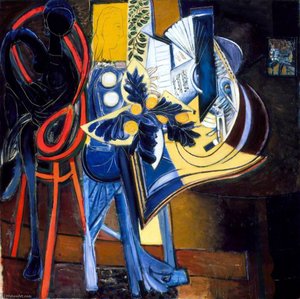
Ceri Richards’s “Rocks,” painted in 1942 during the tumultuous years of World War II, stands as a testament to both the enduring beauty of the Gower Peninsula landscape and the burgeoning influence of surrealist artistic principles. Executed in oil on canvas, this monumental piece—measuring 62 x 74 cm—captures not merely a visual representation but an emotional resonance that speaks to themes of resilience, contemplation, and the transformative power of nature.
- Subject Matter: The painting depicts a dramatic rock formation dominating a coastal scene. Jagged cliffs rise from the turbulent sea, creating a dynamic interplay between solidity and movement—a visual metaphor for confronting challenges with unwavering determination.
- Style & Technique: Richards’s approach aligns closely with Surrealist aesthetics, prioritizing dreamlike imagery and subconscious exploration over realistic depiction. Thick impasto brushstrokes imbue the canvas with textural richness, conveying both the ruggedness of the rock surface and an underlying sense of emotional intensity. The muted palette—dominated by browns, greys, and ochres—further enhances the painting’s contemplative mood.
The historical context surrounding “Rocks” is crucial to understanding its significance. Created amidst the anxieties of wartime Britain, Richards sought solace in observing the natural world – a practice deeply rooted in Welsh artistic tradition. The Gower Peninsula, with its dramatic cliffs and windswept beaches, served as an inspiration for artists throughout the century, embodying both vulnerability and strength.
- Symbolism: Beyond its immediate visual appeal, “Rocks” operates on a symbolic level. The towering rock formation represents steadfastness and permanence—a grounding force amidst uncertainty. Simultaneously, the turbulent sea symbolizes forces beyond human control, prompting reflection on acceptance and adaptability.
More than just a depiction of scenery, Richards’s masterpiece invites viewers into a realm of psychological introspection. The painting's subdued colors and textured surface encourage contemplation—a deliberate strategy reflecting the artist’s fascination with music and its ability to evoke profound emotional responses. “Rocks” remains an enduring symbol of Welsh artistic heritage and a captivating example of Surrealist technique applied to landscape painting.
- Further Research: For deeper insights into Richards's life and work, explore resources such as Wikipedia and Art UK.
Additionally, you can delve into the artistic legacy of Dylan Thomas, whose poetry profoundly influenced Richards’s oeuvre. Examining works like “The force that through the green fuse drives the flower” and “Twelve Lithographs for Dylan Thomas” reveals a shared commitment to capturing the essence of Welsh identity and exploring themes of beauty, loss, and transcendence.
Questions & Answers
Is this Rocks painted by hand or printed?
Painted by hand: a trained painter copies Rocks in oil on linen canvas.
What size should I choose for Rocks?
The original measures 62 x 74 cm. Sizes run from 29.2 x 34.2 cm ($200) to 212.0 x 248.5 cm ($1915); the table on this page lists the main steps and their prices.
How long does delivery take?
Delivery takes 4 to 5 weeks, with free worldwide express shipping; an urgent production option is offered on this page. You can return it within 100 days for a full refund, with no condition.
Where is the original Rocks?
The original is in the collection of the Arts Council Collection, London.
What medium did Ceri Richards use for Rocks?
Acrylic On Canvas.
More about this painting
 Preview

 Send
 Share
 Details
 Fact sheet


 Download
 Similars
 X-Ray
 Diaporama
 Q&A

 Stats