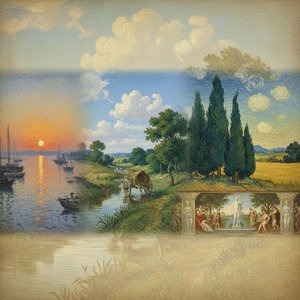
The Dawn of Landscape: Ancient Roots and Early Representations
Landscape painting, also known as landscape art, is the depiction in painting of natural scenery such as mountains, valleys, rivers, trees, and forests, especially where the main subject is a wide view—with its elements arranged into a coherent compo...
Though we often associate landscape painting with a specific period – perhaps the idyllic scenes of the 19th century – its roots stretch far back into antiquity. Early representations weren’t conceived as independent genres, but rather as elements *within* larger narratives. Consider the frescoes unearthed from Minoan sites on Crete, dating back to around 1500 BCE; these depict a vibrant natural world, albeit one subservient to human activity and mythology. Similarly, ancient Egyptian art frequently incorporated detailed depictions of the Nile River valley, not for its own sake, but as the lifeblood sustaining their civilization. These early glimpses reveal an inherent human fascination with our surroundings, a desire to document and interpret the environment – even if it wasn’t yet considered “art” in the modern sense.
The classical world saw further development, particularly within Roman wall paintings discovered at Pompeii and Herculaneum. These offered more expansive views, attempting to create illusions of depth and space. However, a truly independent tradition of landscape painting wouldn’t emerge until much later, requiring a sophisticated understanding of perspective and composition – skills honed through centuries of representing the human form and architectural structures. The seeds were sown, but the full flowering of landscape as a distinct artistic pursuit awaited the Renaissance.
Renaissance Visions & The Rise of Idealized Nature
The Italian Renaissance marked a pivotal shift. While still often serving as backdrops for religious or mythological scenes, landscapes began to gain prominence in their own right. Artists like Giovanni Bellini incorporated increasingly detailed and atmospheric backgrounds into his works, demonstrating a growing appreciation for the beauty of the natural world. Giorgione’s enigmatic paintings, such as *The Tempest*, hinted at a deeper symbolic meaning within the landscape itself – a sense of mystery and emotional resonance that transcended mere depiction.
However, Renaissance landscapes were rarely faithful reproductions of reality. They were often idealized, constructed according to principles of harmony and balance, reflecting a humanist worldview that sought order and perfection in all things. The Northern European tradition offered a different approach. Artists like Joachim Patinir and Albrecht Altdorfer created dramatic, almost fantastical landscapes, populated with biblical figures but driven by an intense focus on the grandeur and power of nature. Pieter Bruegel the Elder stands as a towering figure, his detailed scenes of peasant life unfolding within meticulously rendered landscapes – works that captured both the beauty and harshness of rural existence.
Impressionism's Embrace: Capturing Fleeting Moments in Light and Color
Impressionism was a 19th-century art movement characterized by visible brush strokes, open composition, emphasis on accurate depiction of light in its changing qualities (often accentuating the effects of the passage of time), ordinary subject matter...
The 19th century witnessed a revolution in landscape painting with the advent of Impressionism. Rejecting the academic conventions of precise detail and historical narrative, artists like Claude Monet, Pierre-Auguste Renoir, and Alfred Sisley ventured *en plein air* – outdoors – to capture the fleeting effects of light and atmosphere. This wasn’t about recreating a scene perfectly; it was about conveying the *sensation* of being there, the momentary impression of color and movement.
Monet's groundbreaking work, *Impression, soleil levant*, from which the movement derived its name, exemplifies this approach. Visible brushstrokes, open compositions, and a focus on capturing the changing qualities of light became hallmarks of Impressionism. Artists sought to depict not what they *knew* about a landscape, but what they *saw* – the interplay of sunlight on water, the shifting shadows in a field, the vibrant hues of a summer garden. This radical departure from tradition initially met with harsh criticism, but ultimately paved the way for new ways of seeing and representing the world.
Tonalism and Beyond: Evoking Mood and Atmosphere in American Landscapes
 Untitled (landscape with two cows), (painting)
Admire 'Untitled (landscape with two cows)' by Edward Mitchell Bannister. This serene 1898 tonalist landscape captures nature's beauty. Hand-painted reproductions available.
Across the Atlantic, a distinctively American landscape painting style emerged in the late 19th century known as Tonalism. Artists like Edward Mitchell Bannister sought to evoke mood and atmosphere through subtle harmonies of color and tone. Unlike the bright, vibrant palettes of the Impressionists, Tonalist painters favored muted colors – grays, blues, and browns – creating a sense of tranquility and introspection.
Untitled (landscape with two cows), painted by Bannister in 1898, exemplifies this aesthetic. The painting isn’t about dramatic spectacle; it's about capturing the quiet beauty of a rural scene, the soft light filtering through the trees, the peaceful presence of the animals. Theodore Robinson, another key figure, similarly focused on serene depictions of nature, as seen in his *Study of Rocks*, showcasing the delicate interplay of light and shadow. These artists weren’t simply documenting landscapes; they were conveying a feeling – a sense of peace, solitude, and connection to the natural world.
Modern Interpretations: From Abstraction to Environmental Consciousness
The 20th and 21st centuries have seen an explosion of diverse approaches to landscape painting. From the abstract explorations of color and form to works that address environmental concerns, artists continue to push the boundaries of the genre. Karl Hagemeister, a key figure in German Impressionism, utilized oil pastels to create evocative landscapes imbued with poetic emotion. Later artists explored more conceptual themes.
Today, landscape painting remains a vital and relevant art form. It reflects our evolving relationship with nature – from romantic appreciation to urgent calls for conservation. The enduring appeal of the genre lies in its ability to connect us to something larger than ourselves, to evoke emotions, and to offer a glimpse into the beauty and fragility of the world around us.
Collecting the Essence of Eden: Bringing Landscape Art into Your Home
Whether you’re drawn to the vibrant energy of Impressionism, the tranquil mood of Tonalism, or the bold experimentation of modern art, landscape painting offers a wealth of options for enriching your living space. At OriginalUniqueArt.com, we offer high-quality reproductions of masterpieces from across history, allowing you to bring the beauty of nature into your home. Our handmade oil paintings are crafted by skilled artists using professional materials, ensuring lasting quality and authenticity.
Explore our extensive collection today and discover the perfect artwork to evoke a sense of serenity, inspiration, or simply a deeper connection to the natural world. From custom reproductions tailored to your specific preferences to expert art consultation services, we’re dedicated to helping you find the piece that speaks to your soul. Let us help you transform your space into an oasis of beauty and tranquility.