Preview
 Send
Send Share
Share
 Details

 Download
 Similars
 X-Ray
X-Ray Diaporama
Rosalie Reisener


 Read More
Giclée / Art Print
Museum-quality giclée or canvas print with fast production and flexible finish options. ( Buy Hand Made Painting Buy Image)




P118B $10

P118H $10

P118W $10

P438Z $10

P508JH $12

P508YH $12

P805H $10

P805Z $10

P919BZ $10

P919G $10

P919XJ $10

P959ZH $10

P968JZ $12

W106C $8

W218G $10

W218JH $8

W218Y $10

W307PJ $10

W316G $10

W316PJ $8

W316Y $10

W398PJ $8

W4111J $10

W500HY $15

W500JH $15

W692G $12

W849H $8

W940BG $15

W953PJ $8




Pick from our preset sizes that match the artwork's original proportions.

You may enter your own dimensions to fit a specific frame or space. If your selected size does not match the original image's proportions, we will either crop the artwork or extend the image with a mirrored or solid-fill edge. A digital mockup will be sent for your approval before production begins.
Please note that the on-screen preview does not reflect the actual cropping or extension. Only the mockup will accurately show the final composition.
While custom sizes are available, we recommend selecting a dimension from the predefined list to preserve the original proportions.
Worldwide Delivery () in 2 weeks instead of standard 4/5 weeks. (22 August)

Free Worldwide Express Shipping

High-Quality Linen Canvas

Full Shipping Insurance

Customs Tax Refund Guarantee

True Color Matching Guarantee

60-Day Return Policy (Defects Only)

100% Money-Back Guarantee

Bulk Discount Offer
 Glass option is only available in size under 110 CM

Rosalie Reisener
Giclée / Art Print
Reproduction Size
-


Total Price
$ 81
Collectible Description
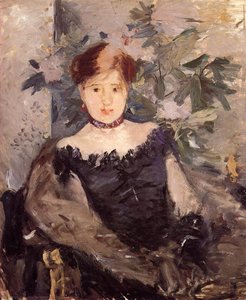
Rosalie Reisener: A Moment of Quiet Elegance by Berthe Morisot
Berthe Morisot’s “Rosalie Reisener,” painted in 1866, is more than just a portrait; it's a delicate distillation of Impressionist ideals – a fleeting capture of light, atmosphere, and the quiet intimacy of domestic life. This watercolor masterpiece, currently residing within the hallowed halls of the Musée d’Orsay in Paris, offers a rare glimpse into Morisot’s artistic process and her profound understanding of the female form. The painting depicts a young woman seated comfortably in a chair, her hands gently folded in her lap, an expression of serene contemplation upon her face. It's a scene seemingly unremarkable at first glance, yet within its soft hues and subtle details lies a powerful statement about the burgeoning artistic movement of the time and Morisot’s unique contribution to it.
- Subject Matter: The subject, Rosalie Reisener, represents a shift in artistic focus. Unlike grand historical or mythological scenes prevalent at the time, Morisot chose to depict an ordinary woman – a detail that reflects the Impressionists' interest in capturing everyday life and the beauty found within the mundane.
- Technique: Morisot’s mastery of watercolor is immediately apparent. She employs loose, broken brushstrokes, layering washes of color to create a luminous effect. The delicate handling of light and shadow gives the painting an ethereal quality, characteristic of the Impressionist style. Notice how she avoids sharp outlines, instead allowing forms to blend softly into one another, contributing to the overall sense of atmosphere.
- Color Palette: The muted palette – dominated by soft blues, pinks, and browns – evokes a feeling of warmth and tranquility. These colors are not used in a purely representational manner; rather, Morisot manipulates them to create an emotional response in the viewer, emphasizing the intimacy of the scene.
Historical Context: The Rise of Impressionism
“Rosalie Reisener” was created during a pivotal moment in art history – the rise of Impressionism. Emerging in mid-19th century France, this movement challenged the established academic traditions and sought to capture the subjective experience of seeing. Artists like Morisot rejected the meticulous detail and idealized forms favored by the Salon, instead embracing loose brushwork, vibrant colors, and an emphasis on capturing fleeting moments of light and atmosphere. The Impressionists were fascinated by the effects of natural light and its impact on color, and “Rosalie Reisener” exemplifies this fascination perfectly. Morisot’s work aligns with the broader movement's desire to portray modern life, moving away from historical or mythological subjects towards scenes of contemporary society.
The painting’s location within the Musée d’Orsay is significant. The museum itself was originally a Beaux-Arts railway station and now houses one of the world’s finest collections of Impressionist art, providing an ideal setting to appreciate Morisot's contribution to this revolutionary movement. Its proximity to works by Edouard Manet further underscores the interconnectedness of these pioneering artists.
Symbolism and Emotional Impact
Beyond its technical brilliance, “Rosalie Reisener” possesses a subtle symbolic depth. The woman’s relaxed posture and contemplative gaze suggest a sense of peace and contentment. The simple setting – a chair, a hat – speaks to the values of domesticity and quiet reflection that were increasingly important in 19th-century French society. Morisot's focus on portraying female subjects was also noteworthy; she challenged traditional artistic representations of women, presenting them as intelligent, independent individuals rather than passive objects of male gaze.
The painting’s emotional impact is one of quiet beauty and serenity. It invites the viewer to pause, to contemplate the scene, and to appreciate the subtle nuances of light and color. It's a testament to Morisot's ability to capture not just an image, but also a feeling – a moment of stillness in a rapidly changing world.
Provenance and Significance
"Rosalie Reisener" is a cornerstone of Berthe Morisot’s oeuvre and a vital piece within the Impressionist canon. Its creation in 1866 marks an important stage in her artistic development, solidifying her position as one of the movement's most innovative and influential figures. The painting’s presence at the Musée d’Orsay ensures its continued appreciation by art lovers worldwide.
Artist Biography
A Life Immersed in Light and Intimacy
Berthe Morisot, born in Bourges, France, in 1841, emerged as a pivotal figure within the Impressionist movement, yet her story extends far beyond simply being a “female Impressionist.” To define her solely by gender diminishes the profound originality of her artistic vision and her unwavering commitment to capturing the fleeting moments of modern life. Descended from a bourgeois family with artistic lineage – she was related to the celebrated Rococo painter Jean-Honoré Fragonard – Morisot received an education uncommon for women of her era, one that nurtured her innate talent and fostered a lifelong dedication to painting. Early lessons with Geoffroy-Alphonse Chocarne and Joseph Guichard provided foundational skills, but it was exposure to the masterpieces within the Louvre, copying works by the Old Masters, that truly ignited her artistic sensibility. This period of rigorous training laid the groundwork for her later explorations of light, color, and form. The influence of Jean-Baptiste-Camille Corot proved particularly significant; his emphasis on *plein air* painting – working outdoors directly from nature – became a cornerstone of Morisot’s approach, allowing her to capture the ephemeral qualities of light and atmosphere with remarkable sensitivity.Navigating the Impressionist Circle
Morisot's artistic journey intertwined closely with that of Édouard Manet, whom she met in 1864. Their relationship was one of mutual respect and intellectual exchange, with Manet serving as a mentor and friend. He painted her numerous times, immortalizing her presence within his own evolving style. However, Morisot wasn’t merely a subject; she actively participated in the burgeoning Impressionist movement, becoming a founding member alongside Monet, Degas, Renoir, and Pissarro. In 1874, she boldly exhibited with this group of “rejected” artists, defying the conservative standards of the official Salon. This first Impressionist exhibition marked a turning point in art history, challenging traditional academic conventions and paving the way for new modes of artistic expression. Morisot participated in nearly all subsequent Impressionist exhibitions, consistently showcasing her unique perspective and solidifying her position within the avant-garde. Her work, often depicting intimate scenes of domestic life – women reading, mothers with children, leisurely moments in gardens – offered a distinctly feminine gaze, challenging prevailing societal norms and expanding the scope of acceptable subject matter for female artists.A Distinctive Artistic Voice
What sets Morisot apart is not simply *what* she painted, but *how* she painted it. Her brushwork is characterized by its delicate fluidity, a lightness of touch that conveys an impression of spontaneity and immediacy. She masterfully employed broken color – applying small strokes of pure pigment side-by-side to create a shimmering effect of light and atmosphere. Unlike some of her Impressionist colleagues who focused on grand landscapes or bustling cityscapes, Morisot often chose intimate interior scenes and portraits, exploring the nuances of human relationships and the quiet beauty of everyday life. Her palette is typically soft and harmonious, favoring pastel shades and subtle gradations of color. This isn’t to say her work lacks strength; rather, it possesses a refined elegance and emotional depth that resonates with viewers even today. Critics like Gustave Geffroy recognized this unique quality, hailing her as one of “les trois grandes dames” of Impressionism – alongside Marie Bracquemond and Mary Cassatt – acknowledging her significant contribution to the movement.Legacy and Lasting Influence
Berthe Morisot’s life was tragically cut short in 1895, but her artistic legacy endures. Married to Eugène Manet, brother of Édouard, she navigated a world that often underestimated female artists, yet she persevered with unwavering determination. She exhibited under her full maiden name – a subtle act of independence and self-assertion – and consistently challenged conventional expectations. Her work continues to captivate audiences with its delicate beauty, emotional honesty, and innovative technique. Morisot’s influence extends beyond the realm of Impressionism; she paved the way for future generations of female artists, demonstrating that women could achieve artistic excellence and contribute meaningfully to the evolution of art history. Today, her paintings are held in prestigious collections around the world, serving as a testament to her enduring talent and her pivotal role in shaping modern art. Woman in the Green Dress, The Cradle, and Summer’s Day remain iconic examples of her mastery, inviting viewers into a world of light, intimacy, and quiet contemplation.
Berthe Morisot
1841 - 1895 , France
Quick Facts
- Artistic Movement Or Style: Impressionism
- Artists Or Movements Influenced By This Artist: ['Impressionism']
- Artists Who Influenced This Artist:
- Corot
- Manet
- Date Of Birth: January 14, 1841
- Date Of Death: March 2, 1895
- Full Name: Berthe Morisot
- Nationality: French
- Notable Artworks:
- Woman in the green dress
- The Cradle
- La Lecture
- Place Of Birth: Bourges, France
Related Articles

Watercolor Wonders: 10 Masterpieces That Redefined Art History | OriginalUniqueArt
Journey through 10 legendary watercolor masterpieces by Sargent, Turner & Homer! Explore iconic landscapes, portraits & floral art that redefined history. Find museum-quality reproductions and curated decor ideas at OriginalUniqueArt.com.

Ephemeral Visions: Exploring the Artistic Legacy & Contemporary Practice of Watercolor Painting
Explore the captivating world of watercolor painting! Discover its rich history, essential techniques, influential artists & collecting tips. A comprehensive guide for art enthusiasts from OriginalUniqueArt.

Ephemeral Visions: Exploring the History & Emotional Resonance of Watercolor Painting
Explore the captivating history of watercolor painting, from ancient techniques to modern masters like Kandinsky & Blake. Discover essential artists, collecting tips & the emotional power of this luminous medium. Expert insights for art enthusiasts.

Ephemeral Visions: Exploring the Artistic Legacy & Nuances of Watercolor Painting
Explore the captivating world of watercolor painting! Discover its rich history, essential techniques, influential artists & collecting tips from art experts. A comprehensive guide for enthusiasts.

The Enduring Appeal of Watercolor: History, Techniques & Contemporary Practice
Explore the captivating world of watercolor painting! Discover its rich history, essential techniques, influential artists, and collecting tips. A comprehensive guide for art enthusiasts.