Preview
 Send
Send Share
Share
 Details
 Guide
Guide

 Download
 Similars
 X-Ray
X-Ray Diaporama
 Stats
StatsTriptych (detail)


 Read More
Hand Made Oil Reproduction
Hand-painted oil on canvas in your size and frame, made to order by our artists. ( Switch to Print Switch to Digital Image)




P118B $10

P118H $10

P118W $10

P438Z $10

P508JH $12

P508YH $12

P805H $10

P805Z $10

P919BZ $10

P919G $10

P919XJ $10

P959ZH $10

P968JZ $12

W106C $8

W218G $10

W218JH $8

W218Y $10

W307PJ $10

W316G $10

W316PJ $8

W316Y $10

W398PJ $8

W4111J $10

W500HY $15

W500JH $15

W692G $12

W849H $8

W940BG $15

W953PJ $8




Pick from our preset sizes that match the artwork's original proportions.

You may enter your own dimensions to fit a specific frame or space. If your selected size does not match the original image's proportions, we will either crop the artwork or extend the painting with additional hand-painted elements. A digital mockup will be sent for your approval before production begins.
Please note that the on-screen preview does not reflect the actual cropping or extension. Only the mockup will accurately show the final composition.
While custom sizes are available, we recommend selecting a dimension from the predefined list to preserve the original proportions.
After order, OriginalUniqueArt.com team will email client for instructions and provide a mockup preview
Worldwide Delivery () in 3/4 weeks instead of standard 5 weeks. (4 October). No compromise on quality.

Free Worldwide Express Shipping

High-Quality Linen Canvas

Full Shipping Insurance

Customs Tax Refund Guarantee

True Color Matching Guarantee

100-Day Return Policy (Defects Only)

100% Money-Back Guarantee

Bulk Discount Offer
 Glass option is only available in size under 110 CM

Triptych (detail)
Reproduction Medium
Reproduction Size
-


Total Price
$ 300
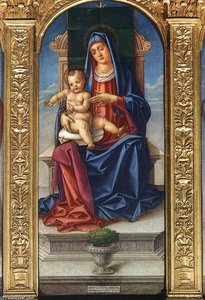
Bartolomeo Vivarini’s “Triptych (detail)” – A Venetian Vision of Faith
Bartolomeo Vivarini's "Triptych (detail)," painted around 1460, offers a captivating glimpse into the heart of Venetian Renaissance art. More than just a devotional image, it’s a meticulously crafted tableau brimming with symbolic depth and technical mastery—a testament to the artist’s skill and his deep engagement with the spiritual world. This particular detail, often studied for its intricate composition and luminous colors, reveals a sophisticated understanding of perspective, light, and human emotion, all hallmarks of Vivarini's distinctive style.
Vivarini, working primarily in Venice during the late 15th century, was deeply influenced by his predecessors, particularly Antonello da Messina, whom he learned oil painting from. However, he quickly developed a unique Venetian aesthetic—characterized by bold outlines, vibrant colors, and a dramatic use of light and shadow. Unlike some of his contemporaries who favored the cool palette of the north, Vivarini embraced warmer tones, reflecting the sun-drenched atmosphere of Venice. This “Triptych (detail)” exemplifies this approach, showcasing a rich tapestry of reds, blues, and golds that immediately draw the viewer in.
A Scene of Devotion: Narrative and Symbolism
The central image depicts a serene moment within a religious setting—a woman, likely representing the Virgin Mary, cradling the infant Jesus. The composition is carefully balanced, drawing our attention to the tender embrace between mother and child. To the left of the Virgin kneels a diminutive figure, identified as a nun from the Dominican order, her posture conveying deep reverence and devotion. This detail suggests a private commission—a personal expression of faith intended for contemplation within a sacred space.
Beyond the immediate figures, the scene is layered with symbolism. The architectural backdrop, reminiscent of Venetian buildings, anchors the image in its urban context while simultaneously elevating it to a realm of spiritual significance. The use of gold – particularly prominent in the Virgin’s robe and the celestial background – signifies divinity and holiness. The presence of an angel, soaring above, reinforces this sense of grace and divine intervention. Even seemingly minor details, such as the cup visible in the scene, hint at ritual and ceremony, further enriching the narrative.
Technique and Artistic Innovation
Vivarini’s mastery is evident in his meticulous attention to detail and his innovative use of technique. The figures are rendered with a remarkable degree of realism—their faces expressive, their drapery flowing realistically. He employs a technique known as “stiacciato,” creating subtle variations in the surface of the paint to suggest depth and texture. This creates an illusion of three-dimensionality, bringing the scene to life.
Notably, Vivarini was one of the first Venetian painters to experiment with oil painting—a medium that allowed for richer colors, greater luminosity, and more subtle gradations of tone than traditional tempera. The use of oil paint in this triptych contributes significantly to its vibrant appearance and atmospheric quality. The artist’s hard outlines, a characteristic feature of his style, provide clarity and definition, while the warm color palette evokes a sense of warmth and intimacy.
A Legacy of Venetian Art
“Triptych (detail)” by Bartolomeo Vivarini stands as a significant example of Venetian Renaissance art—a synthesis of religious devotion, artistic innovation, and technical skill. It reflects the vibrant cultural landscape of Venice during the 15th century, where faith, commerce, and artistic expression converged to create a unique and enduring legacy. Reproductions of this work offer a beautiful opportunity to experience the artistry and spiritual depth of Vivarini’s vision, bringing a touch of Venetian elegance and profound contemplation into any space.
Questions & Answers
What color harmony does "Triptych (detail)" by Bartolomeo Vivarini display?
"Triptych (detail)" by Bartolomeo Vivarini displays a unified palette color harmony.
Can I order an oil reproduction of "Triptych (detail)"?
You can order a hand-painted reproduction of "Triptych (detail)" by Bartolomeo Vivarini directly on this page: a hand-painted oil reproduction on linen canvas, made to order.
Which artist is "Triptych (detail)" attributed to?
"Triptych (detail)" was created by Bartolomeo Vivarini. The information on this page describes Bartolomeo Vivarini's original work.
How old was Bartolomeo Vivarini when creating "Triptych (detail)" in 1460?
When "Triptych (detail)" was created in 1460, Bartolomeo Vivarini - born in 1440 - was 20 years old.
When was "Triptych (detail)" created, and to which movement does it belong?
"Triptych (detail)" by Bartolomeo Vivarini is dated 1460 and belongs to Venetian Renaissance.
What is the creation date of "Triptych (detail)" by Bartolomeo Vivarini?
The creation of "Triptych (detail)" by Bartolomeo Vivarini is dated 1460.
Where does "Triptych (detail)" sit within Bartolomeo Vivarini's body of work?
Within Bartolomeo Vivarini's output, "Triptych (detail)" sits in the Venetian Renaissance style, alongside the themes of venetian renaissance, devotional focus, religious iconography, medieval roots, patronage, civic importance venice, vivarini’s style, detailed realism.
Artist Biography
A Legacy of Venetian Light and Devotion
In the vibrant, shimmering atmosphere of the Quattrocento, Bartolomeo Vivarini emerged as a pivotal figure in the evolution of Venetian painting. Born in the storied glassmaking hub of Murano, Italy, he was part of an influential dynasty of artists that helped shape the visual identity of the Republic of Venice. As a member of the Vivarini family, his life and work were deeply intertwined with the artistic pulse of his homeland, bridging the transition from the ornate, gilded traditions of the late Gothic period to the burgeoning humanism of the early Renaissance.
The artistry of Vivarini is characterized by a profound sense of spiritual depth and technical precision. While he was a master of tempera, often utilizing gold leaf to imbue his compositions with a celestial luxury, he was also an innovator in the use of new mediums. It is noted that he learned the art of oil painting from Antonello da Messina, and he is credited with producing what is believed to be the first oil painting in Venice around 1473. This mastery allowed him to manipulate light and texture in ways that brought a new level of intimacy and serenity to his religious subjects.
Mastery of Form and Symbolism
Vivarini’s work often presents a striking balance between hard, defined outlines and a rich, emotive color palette. His figures frequently possess a dignified and devout expression, capturing the solemnity required for the altarpieces that adorned Venetian basilicas. This ability to convey human emotion through structured forms made him a sought-after painter for significant religious commissions. A notable example of his skill is found in his Madonna and Child, where he uses light entering through windows and deep red drapery to create a sense of sacred space.
Beyond the figures themselves, Vivarini’s paintings are often layered with symbolic meaning:
- The use of gold: His frequent application of gold leaf serves not only as decoration but as a medium to represent divine light.
- Natural motifs: In a charming nod to his name—as vivarino translates to goldfinch in Italian—he occasionally included the small bird as a subtle signature within his works.
- Architectural depth: His compositions, such as the Conversano Polyptych, demonstrate a sophisticated understanding of perspective and the integration of sacred figures into complex, multi-paneled structures.
Historical Significance and Artistic Influence
The historical importance of Bartolomeo Vivarini lies in his role as a bridge between eras. He stood at the crossroads of the Byzantine-influenced traditions of his predecessors and the revolutionary Renaissance styles brought by artists like Fra Angelico and Giovanni Bellini. By blending these diverse influences, he helped establish a unique Venetian visual language—one that prioritized luminous color and emotional resonance.
His influence extended through his family lineage, notably impacting the work of his nephew, Alvise Vivarini, who would become a leading artist in Venice before the rise of Bellini. Through his meticulous detail and his pioneering adoption of oil techniques, Bartolomeo Vivarini left an indelible mark on the history of Italian art, ensuring that the spiritual and aesthetic grandeur of Murano and Venice would be preserved for generations to come.

Bartolomeo Vivarini
1440 - 1499 , Italy
Quick Facts
- Artistic Movement Or Style: Venetian Renaissance
- Artists Or Movements Influenced By This Artist: ['Alvise Vivarini']
- Artists Who Influenced This Artist:
- Antonello da Messina
- Fra Angelico
- Full Name: Bartolomeo Vivarini
- Nationality: Italian
- Notable Artworks:
- Madonna and Child
- Conversano Polyptych
- Triptych (detail)
- Place Of Birth: Murano, Italy
- Date Of Birth: 1440
- Date Of Death: 1499
Related Articles

Jacopo Tintoretto's Masterpieces: 25 Paintings That Define Venetian Drama | OriginalUniqueArt
Explore 25 breathtaking masterpieces by Jacopo Tintoretto, the Venetian master of drama and light. Discover the stories behind iconic Renaissance paintings & find museum-quality art reproductions to elevate your home decor on OriginalUniqueArt.com.

Jacopo Palma il Giovane: A Venetian Master's Poetic Evolution
Explore the captivating world of Jacopo Palma il Giovane, a pivotal Venetian Renaissance master. Discover his unique style, influenced by Titian & Tintoretto, and learn about key works perfect for discerning collectors.

Divine Grace: An Art Historian's Journey Through Iconic Masterpieces of the Virgin Mary
Explore the profound beauty of Marian iconography through an art historian's lens. Discover iconic masterpieces by Raphael and Renaissance masters, celebrating the divine grace and timeless elegance of the Virgin Mary in classical fine art.
Divine Grace: A Journey Through the Most Iconic Depictions of the Virgin Mary in Art History
Embark on a profound journey through art history with our exploration of the most iconic depictions of the Virgin Mary. Discover the divine grace, symbolism, and masterful techniques found in Renaissance masterpieces and sacred iconography.

Venetian Renaissance: The Mastery of Color, Light, and the Art of Colorito
Explore the luminous mastery of the Venetian Renaissance. Discover how masters like Titian and Giorgione revolutionized art through colorito, light, and atmosphere. An expert guide to the golden age of Italian painting for collectors and enthusiasts.