Preview
 Send
Send Share
Share
 Details
 Guide
Guide

 Download
 Similars
 X-Ray
X-Ray Diaporama
 Stats
StatsMadonna Enthroned


 Read More
Hand Made Oil Reproduction
Hand-painted oil on canvas in your size and frame, made to order by our artists. ( Switch to Print Switch to Digital Image)




P118B $10

P118H $10

P118W $10

P438Z $10

P508JH $12

P508YH $12

P805H $10

P805Z $10

P919BZ $10

P919G $10

P919XJ $10

P959ZH $10

P968JZ $12

W106C $8

W218G $10

W218JH $8

W218Y $10

W307PJ $10

W316G $10

W316PJ $8

W316Y $10

W398PJ $8

W4111J $10

W500HY $15

W500JH $15

W692G $12

W849H $8

W940BG $15

W953PJ $8




Pick from our preset sizes that match the artwork's original proportions.

You may enter your own dimensions to fit a specific frame or space. If your selected size does not match the original image's proportions, we will either crop the artwork or extend the painting with additional hand-painted elements. A digital mockup will be sent for your approval before production begins.
Please note that the on-screen preview does not reflect the actual cropping or extension. Only the mockup will accurately show the final composition.
While custom sizes are available, we recommend selecting a dimension from the predefined list to preserve the original proportions.
After order, OriginalUniqueArt.com team will email client for instructions and provide a mockup preview
Worldwide Delivery () in 3/4 weeks instead of standard 5 weeks. (7 October). No compromise on quality.

Free Worldwide Express Shipping

High-Quality Linen Canvas

Full Shipping Insurance

Customs Tax Refund Guarantee

True Color Matching Guarantee

100-Day Return Policy (Defects Only)

100% Money-Back Guarantee

Bulk Discount Offer
 Glass option is only available in size under 110 CM

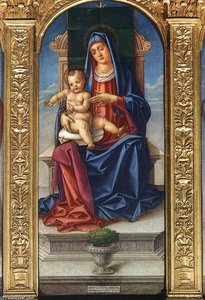
Madonna Enthroned
Reproduction Medium
Reproduction Size
-


Total Price
$ 300
Bartolomeo Vivarini’s Madonna Enthroned: A Venetian Echo of Early Renaissance Ideal
Fra Angelico, a Monk’s Vision of Paradise – The Dominican friar who bore this title was one of the most profoundly spiritual artists of the Italian Renaissance. Born around 1395 in the Mugello region of Tuscany, his life intertwined seamlessly with his art, creating a body of work that continues to resonate with its ethereal beauty and deeply felt piety. Unlike many of his contemporaries who sought patronage from wealthy merchant families or powerful courts, Angelico’s primary allegiance lay within the walls of San Domenico in Fiesole, where he served as a monk for nearly forty years. This unique context profoundly shaped his artistic vision, imbuing every brushstroke with a sense of devotion and a yearning for the divine. Angelico's early training remains somewhat shrouded in mystery, though it’s widely believed that he apprenticed under Lorenzo Monaco, a prominent Florentine pai Vivarini’s Madonna Enthroned (1482) stands as a testament to Venetian artistic sensibilities during the burgeoning Renaissance—a masterful blend of Byzantine tradition and emerging naturalism. The painting depicts Mary with Jesus seated upon her lap, framed within an opulent gold throne, against a dark background that amplifies the luminosity of the central figures. This composition immediately establishes itself as a Maestà, mirroring the stylistic conventions prevalent in Florence at the time, yet infused with Vivarini’s distinctive Venetian flair. The artwork's style leans heavily toward Early Renaissance ideals—characterized by smooth transitions between forms, idealized representations of human anatomy, and an unwavering focus on religious iconography. Unlike the rigid hierarchies of Byzantine art, Vivarini achieves a remarkable sense of depth and spatial illusion through subtle modeling and shading techniques. The artist skillfully employs atmospheric perspective, diminishing colors and details in the distant background to create a convincing illusion of recession—a technique pioneered by Giotto di Bondone and championed throughout Italy during this period. This deliberate departure from Byzantine conventions signaled a crucial step toward artistic innovation and represents Vivarini’s contribution to establishing the Renaissance aesthetic. The meticulous execution demonstrates Vivarini's mastery of oil painting, utilizing thin glazes layered upon each other to build up rich color palettes—primarily blues, reds, golds, and browns—that evoke a profound sense of reverence and majesty. The artist’s brushwork is remarkably delicate, capturing minute details in drapery folds and facial expressions with astonishing precision. Furthermore, the textured surface of the wood panel itself contributes to the artwork's visual impact, grounding the ethereal figures within a tangible reality. Symbolism permeates every aspect of Madonna Enthroned. Mary’s gesture—presenting Jesus—is a cornerstone of Christian iconography, representing divine grace and humility. The small plant pot nestled beneath Mary’s throne symbolizes fertility and paradise—a motif frequently employed in Renaissance art to convey themes of spiritual renewal and eternal life. These carefully chosen symbols underscore the painting's overarching message: an affirmation of faith and devotion amidst the grandeur of God’s majesty.- Artist: Bartolomeo Vivarini
- Year Created: 1482
- Medium: Oil on Wood Panel
- Style: Early Renaissance
- Location: Unknown
Questions & Answers
What is the emotional tone of "Madonna Enthroned" by Bartolomeo Vivarini?
"Madonna Enthroned" is associated with a spiritual feeling. The emotional tone describes the impression the work gives.
What saturation and intensity does "Madonna Enthroned" by Bartolomeo Vivarini show?
The color of "Madonna Enthroned" is balanced soft in saturation and balanced in intensity.
When and with what materials was "Madonna Enthroned" made?
"Madonna Enthroned" was created in 1482 using the acrylic on canvas technique. Material and date describe how and when the original was made.
What are the date and style of "Madonna Enthroned" by Bartolomeo Vivarini?
"Madonna Enthroned" was created in 1482 as a work of the Early Renaissance movement. Date and movement anchor the artwork in art history.
How old was Bartolomeo Vivarini when creating "Madonna Enthroned" in 1482?
Bartolomeo Vivarini made "Madonna Enthroned" at the age of 42. The artist was born in 1440 and the work is dated 1482.
What is the creation date of "Madonna Enthroned" by Bartolomeo Vivarini?
"Madonna Enthroned" by Bartolomeo Vivarini was created in 1482.
Who is the artist behind "Madonna Enthroned"?
The artist behind "Madonna Enthroned" is Bartolomeo Vivarini. The work is catalogued under Bartolomeo Vivarini's name.
Artist Biography
A Legacy of Venetian Light and Devotion
In the vibrant, shimmering atmosphere of the Quattrocento, Bartolomeo Vivarini emerged as a pivotal figure in the evolution of Venetian painting. Born in the storied glassmaking hub of Murano, Italy, he was part of an influential dynasty of artists that helped shape the visual identity of the Republic of Venice. As a member of the Vivarini family, his life and work were deeply intertwined with the artistic pulse of his homeland, bridging the transition from the ornate, gilded traditions of the late Gothic period to the burgeoning humanism of the early Renaissance.
The artistry of Vivarini is characterized by a profound sense of spiritual depth and technical precision. While he was a master of tempera, often utilizing gold leaf to imbue his compositions with a celestial luxury, he was also an innovator in the use of new mediums. It is noted that he learned the art of oil painting from Antonello da Messina, and he is credited with producing what is believed to be the first oil painting in Venice around 1473. This mastery allowed him to manipulate light and texture in ways that brought a new level of intimacy and serenity to his religious subjects.
Mastery of Form and Symbolism
Vivarini’s work often presents a striking balance between hard, defined outlines and a rich, emotive color palette. His figures frequently possess a dignified and devout expression, capturing the solemnity required for the altarpieces that adorned Venetian basilicas. This ability to convey human emotion through structured forms made him a sought-after painter for significant religious commissions. A notable example of his skill is found in his Madonna and Child, where he uses light entering through windows and deep red drapery to create a sense of sacred space.
Beyond the figures themselves, Vivarini’s paintings are often layered with symbolic meaning:
- The use of gold: His frequent application of gold leaf serves not only as decoration but as a medium to represent divine light.
- Natural motifs: In a charming nod to his name—as vivarino translates to goldfinch in Italian—he occasionally included the small bird as a subtle signature within his works.
- Architectural depth: His compositions, such as the Conversano Polyptych, demonstrate a sophisticated understanding of perspective and the integration of sacred figures into complex, multi-paneled structures.
Historical Significance and Artistic Influence
The historical importance of Bartolomeo Vivarini lies in his role as a bridge between eras. He stood at the crossroads of the Byzantine-influenced traditions of his predecessors and the revolutionary Renaissance styles brought by artists like Fra Angelico and Giovanni Bellini. By blending these diverse influences, he helped establish a unique Venetian visual language—one that prioritized luminous color and emotional resonance.
His influence extended through his family lineage, notably impacting the work of his nephew, Alvise Vivarini, who would become a leading artist in Venice before the rise of Bellini. Through his meticulous detail and his pioneering adoption of oil techniques, Bartolomeo Vivarini left an indelible mark on the history of Italian art, ensuring that the spiritual and aesthetic grandeur of Murano and Venice would be preserved for generations to come.

Bartolomeo Vivarini
1440 - 1499 , Italy
Quick Facts
- Artistic Movement Or Style: Venetian Renaissance
- Artists Or Movements Influenced By This Artist: ['Alvise Vivarini']
- Artists Who Influenced This Artist:
- Antonello da Messina
- Fra Angelico
- Full Name: Bartolomeo Vivarini
- Nationality: Italian
- Notable Artworks:
- Madonna and Child
- Conversano Polyptych
- Triptych (detail)
- Place Of Birth: Murano, Italy
- Date Of Birth: 1440
- Date Of Death: 1499
Related Articles

Uffizi's 25 Masterpieces: Renaissance Art & Timeless Decor Inspiration
Journey through the Uffizi Gallery's 25 most iconic Renaissance artworks! Explore Botticelli, Leonardo da Vinci & Michelangelo’s masterpieces. Find museum-quality art reproductions and curated decor ideas to bring timeless Italian beauty into your home. Discover all masterpieces on OriginalUniqueArt.com

Divine Grace: An Art Historian's Journey Through Iconic Masterpieces of the Virgin Mary
Explore the profound beauty of Marian iconography through an art historian's lens. Discover iconic masterpieces by Raphael and Renaissance masters, celebrating the divine grace and timeless elegance of the Virgin Mary in classical fine art.
Divine Grace: A Journey Through the Most Iconic Depictions of the Virgin Mary in Art History
Embark on a profound journey through art history with our exploration of the most iconic depictions of the Virgin Mary. Discover the divine grace, symbolism, and masterful techniques found in Renaissance masterpieces and sacred iconography.
Fra Angelico's Masterpieces: 25 Renaissance Paintings for Your Home | OriginalUniqueArt
Explore 25 breathtaking masterpieces by Fra Angelico, a Renaissance master. Discover the stories behind his iconic frescoes, Annunciations & religious art. Find museum-quality reproductions and elevate your home decor with OriginalUniqueArt.com.
Raphael's Masterpieces: 25 Iconic Paintings & Renaissance Art for Your Home
Explore 25 breathtaking Raphael paintings! Journey through the Italian Renaissance with masterpieces like 'School of Athens' & iconic Madonnas. Find museum-quality art reproductions and elevate your home decor on OriginalUniqueArt.com.